
[AI Capital Cycle Reflection] The Essential Differences Under Similar Frenzy! Three Core Differences Between AI and the …
 Complete. Here is the key summary
The article compares the AI boom with the dot-com bubble, pointing out the essential differences between the two in terms of capital expenditure entities, supply and demand structure, and monetization capabilities. The dot-com bubble was primarily driven by startups reliant on external financing, resulting in a fragile funding chain; whereas the current AI infrastructure is dominated by tech giants like Microsoft and Google, which have abundant cash flow and mature profit models, providing stronger operational resilience and risk resistance, making a complete collapse like that of the past difficult to replicate
Introduction
The previous article outlined the market phenomenon where the AI boom closely overlaps with the tech bubble, the model of capital expansion, and the risks in the industrial chain, leading to concerns that "AI is about to repeat the mistakes of the tech bubble." However, relying solely on historical market comparisons to judge the industrial cycle has obvious limitations. There are significant underlying differences between the two in terms of capital expenditure entities, supply and demand structures, and monetization capabilities, which are key supports for why this round of AI is unlikely to replicate the comprehensive collapse of the past. This article will compare the core differences between the two technological waves, objectively clarifying the current resilience and shortcomings of the AI industry.
Capital Expenditure Entities: Mature Giants' Self-Sustaining vs. Startups' Financing for Survival
The core capital expenditure entities of the 2000 tech bubble were a group of internet startups that were newly established, had no stable profits, and relied entirely on external financing for survival. At the peak of the bubble in 1999, there were 289 internet-related IPOs in the U.S. stock market, with an average listing period of only 30 months for these companies, most of which lacked complete operational and profit validation, relying purely on the heat of the capital market for their listings.
The expansion model of these companies was extremely fragile, relying on VC investments, IPOs, and secondary market refinancing for external funding, pouring all raised funds into server procurement, bandwidth leasing, and marketing expenses, with no self-generated operating cash flow to support them. In 2000, industry funding peaked, with U.S. venture capital, internet IPOs, and equity refinancing injecting approximately $170-180 billion into the sector, with the entire industry's expansion relying entirely on capital sentiment, detached from operational fundamentals. Once market liquidity tightened and financing windows closed, the companies' cash flow chains would break instantly, ultimately leading to large-scale bankruptcies. Additionally, during that time, U.S. telecom giants cumulatively invested over $300 billion in leveraged fiber infrastructure over five years, which was also an important component of bubble capital expenditure, with high-debt expansion ultimately causing severe overcapacity and debt crises.
Today's AI capital expenditure structure is based on an entirely different logic.
The current core leaders in AI computing infrastructure are cloud giants such as Microsoft, Google, Amazon, Meta, Alibaba (09988.HK), and Tencent (00700.HK), all of which possess ample operating cash flow, robust balance sheets, and mature profit-generating businesses.
These giants are all top players in their respective fields, possessing high moats, pricing power, diverse ecosystems, and commercial closed loops, with significantly higher profit margins. More importantly, they can continuously generate stable cash flow to support their capital expenditures.
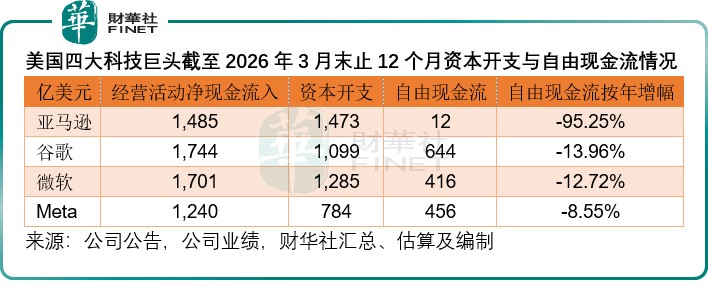
As shown in the table below, the combined capital expenditure of the four major U.S. cloud providers reached $46.4086 billion for the 12 months ending March 2026, while their net cash inflows from operating activities during this period exceeded $100 billion. After deducting capital expenditures, they were still able to generate free cash flow.
 Tencent is the same. As of the end of March 2026, the company's operating cash flow totaled RMB 327.5 billion for the 12 months, with capital expenditures of approximately RMB 83.7 billion, resulting in free cash flow of about RMB 192.2 billion, an increase of 27.71% compared to the same period last year, as shown in the table below.
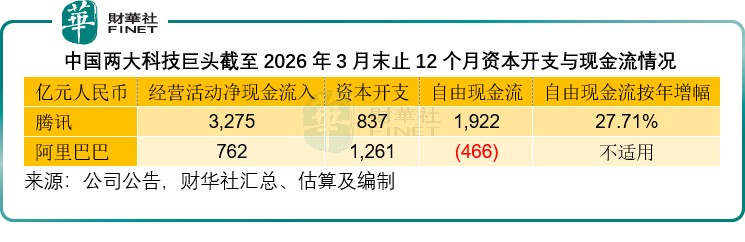
However, it is important to note that with the intensification of AI competition, major tech giants have increased their capital expenditures, and their core operating activities may not generate sufficient cash flow to support subsequent capital expenditures. As seen in the above chart, the free cash flow of the four major cloud giants in the United States is already contracting. Meanwhile, Alibaba has also rarely experienced a net outflow of free cash flow for the fiscal year ending March 2026, mainly due to a significant contraction in its net cash flow from operating activities in an environment of consumer contraction, while capital expenditures are increasing.
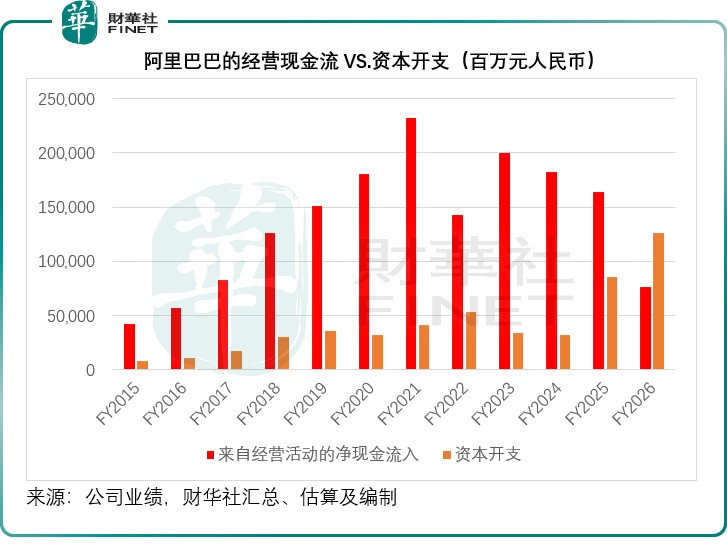
In any case, compared to the early players during the dot-com era, these tech giants entering AI have strong cash-generating capabilities. Even if short-term returns are not as expected, they have enough buffer space to adjust their pace and digest mistakes, unlike during the dot-com era—once external funding is cut off, the entire industry has nowhere to escape.
Supply and Demand Pattern: Long-term Shortage of Computing Power VS Widespread Idle Fiber Optics
The fatal flaw of the dot-com bubble was not the excessive scale of capital expenditures, but the severe overestimation of future demand by the market, ultimately leading to a serious surplus of ineffective capacity. In 1999, there were only 250 million global internet users, with dial-up internet still mainstream, limited internet speed, single online scenarios, and an undeveloped commercialization system. However, driven by the frenzy of the capital market, global telecom giants frantically invested in the construction of fiber optic backbone networks, achieving a significant leap in network capacity, completely detached from real user demand.
The extreme mismatch of supply and demand led to widespread asset idleness. During the bubble period, 360networks laid over 100,000 kilometers of fiber optic networks, with an overall utilization rate of less than 1% before bankruptcy; when Global Crossing went bankrupt in 2002, the actual traffic utilization rate was only 7%. Massive infrastructure investments became sunk costs that could not generate cash flow. The globally sensational WorldCom accounting fraud, which inflated profits by over $11 billion by misclassifying operating expenses as capital expenditures, essentially covered up the brutal reality of "idle capacity, lack of demand, and losses in core business" within the industry, and was the core reason for the inevitable collapse of the dot-com bubble This round of the AI cycle is different from previous years; everyone is scrambling to build computing power, while the core computing power utilization rate of leading data centers remains high. The iteration of generative AI and intelligent agents continues to bring about a hundredfold increase in computing power.
However, we must face a key issue: the explosive demand for computing power is clear, but the progress of commercialization is highly uncertain.
Although AI has covered scenarios such as office work, research and development, and industrial empowerment, with a vast number of users and pilot applications, large-scale enterprise payments, standardized profit models, and stable cash flow returns have not yet been fully realized. The current frenzy of capital expenditure on computing power by tech giants is based on a forward-looking bet on the future commercialization dividends of AI, rather than a certain investment supported by current profits. Whether computing power investment can match future revenue and profit growth remains highly uncertain.
Thus, both rounds of super technology expansion are essentially characterized by forward-looking capital expenditure where future stories precede commercial returns. The 2000 dot-com bubble was about using current infrastructure investment to bet on future universal internet traffic and commercialization; today’s AI computing power frenzy is about using massive capital expenditure to bet on the future realization of AGI, intelligent agents, and industrial intelligence—where the pace and scale of capital investment are outpacing real commercial validation.
The current hot demand for AI computing power is merely a "technical demand," not a stable, realizable commercial profit demand. If the future commercialization pace does not keep up with the speed of computing power production, the huge capital expenditure on computing power will not match revenue and profit returns, leading to depreciation pressure, idle capacity, and the risk of profit collapse.
The difference between the two is that the dot-com era was characterized by a complete false excess without a real foundation, with a collapse being a certain outcome; whereas this round of AI involves structural forward investment with technical demand but questionable commercial returns, presenting risks of bubbles and withdrawal pressure, depending on whether the speed of technological advancement can exceed the pace of capital investment.
Business Model: Synchronized Realization of Closed Loop vs. Pure Cash-Burning Traffic Story
Internet companies during the dot-com era generally lacked sustainable monetization paths, with leading companies suffering long-term large losses, and the capital market valuing them solely based on future traffic stories. Most companies, after exhausting their financing, could not achieve profitability, leading to a rapid clearing of the bubble. The current AI industry has established a basic commercialization system: OpenAI has formed a dual revenue pillar of subscriptions and enterprise APIs, while domestic companies like ZhiPu AI and MiniMax achieve scaled revenue through interface calls and C-end subscriptions; overseas cloud providers like Azure and AWS continue to see their AI value-added business revenue double, with computing power investments being recouped through enterprise payments.
The shortcomings are also clear: the industry as a whole exhibits the characteristic of "having revenue but no widespread profitability," with domestic and foreign AI companies experiencing rapid revenue growth while continuing to incur large losses, and the growth rate of computing power investment far exceeding that of revenue, leaving long-term investment returns to be validated over time.
In the 2000 dot-com era, internet companies generally told forward-looking stories, purely focusing on attracting users first and then discussing profitability, following an eyeball economy logic where companies burned cash to capture market share, with almost no reliable business models. In 1999, leading companies like Amazon, Priceline, and eToys all reported massive losses while holding market valuations in the hundreds of billions. The capital market crazily overvalued future profits, but ultimately the market discovered that the vast majority of startups, after exhausting their financing, could never establish a sustainable monetization path, leading to a complete cash flow break The bubble has collapsed in an instant.
This round of the AI cycle is different; the industry has significantly increased capital expenditure on computing power while also generating verifiable real revenue. For example, OpenAI is expected to achieve an annualized revenue of approximately $13 billion by 2025, with subscription revenue from ChatGPT and enterprise API call revenue forming a dual pillar. The number of paid users has surpassed 20 million, and the product exhibits pricing power characteristics with sustained demand growth after price increases, proving that AI services possess real commercial value and user willingness to pay. Domestic AI companies have also seen effective monetization: Zhipu (02513.HK) has experienced several-fold growth in business call volume despite an over 80% price increase in APIs, leading to rapid revenue growth; companies like MiniMax (00100.HK) have achieved scaled revenue through C-end subscriptions and advertising, with initial commercialization models starting to take shape.
The financial reports of global cloud giants further confirm the closed-loop capability. Microsoft's Azure, Google Cloud, and Amazon AWS have seen their AI value-added services and model call businesses continue to double in growth, with massive investments in computing infrastructure able to continuously return operational cash flow through enterprise cloud procurement and paid AI functionalities.
However, this difference must be viewed dialectically. The core issue of AI today is: there is real revenue, but no widespread profitability; there is monetization flow, but the return on investment has yet to be verified. Behind OpenAI's billions in revenue are losses in the hundreds of billions, with the growth rate of capital expenditure on computing power far exceeding the growth rate of revenue; domestic AI companies, while experiencing high growth, still generally incur losses, and the industry as a whole remains in the "burning money for scale" phase.
Conclusion:
A comprehensive comparison reveals that the AI boom and the tech bubble only share superficial characteristics of frenzy. The three fundamental differences—domination by mature giants, real demand for computing power, and initial commercialization monetization—provide the industry with foundational resilience. However, structural risks have not disappeared. Will the industry ultimately face a complete collapse or a structural adjustment? The next article will combine all previous clues to predict the final direction of this round of the AI cycle