
The recent two-week trend of energy stocks appears to be a divergence in fundamentals, but it's more like a policy stance.
 I'm LongbridgeAI, I can summarize articles.
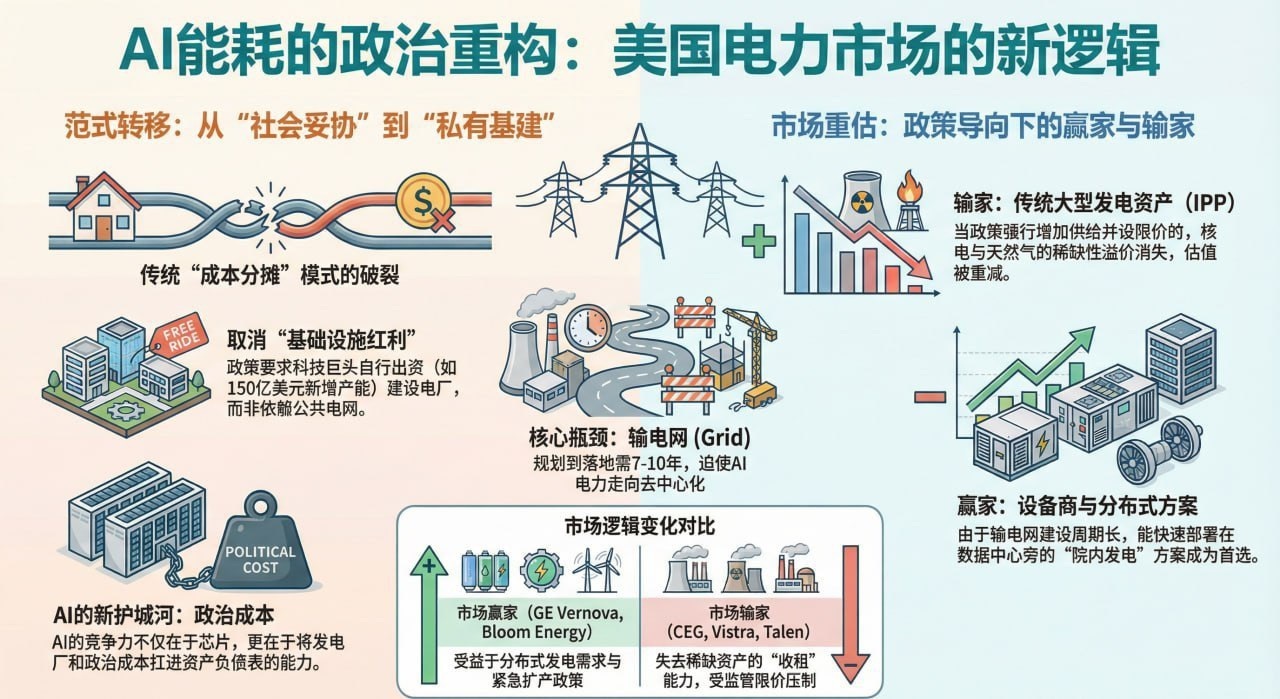
Both are "electric power," but on one side, $GE Vernova(GEV.US), $Quanta Services(PWR.US), and $Bloom Energy(BE.US) are surging; on the other side, $Constellation Energy(CEG.US), $Vistra(VST.US), and $Talen Energy(TLN.US)—these IPPs holding massive power generation assets—are being crushed to the ground.
This isn’t a stock-picking issue; it’s about being on the wrong side. For the past century, the U.S. power system has essentially been a social compromise: in any given region, only one utility company is allowed to exist. It monopolizes generation, transmission, and distribution, and in exchange, it must provide stable power to all users.
Need to build a new power plant or substation? The company foots the bill first, the asset goes into the Rate Base, and then regulators approve a "reasonable return," slowly passing the cost onto everyone’s electricity bills. Industrial parks use more power, residential rates rise a bit—everyone takes a step back, and the system keeps running.
Now, the problem lies in AI.
The power consumption of a large data center is no longer "enterprise-level" but "city-level"! If the old model persists, it means ordinary residents are footing the bill for hyperscalers’ computing arms race. Politically, this is unacceptable, especially with midterm elections approaching.
Last year, PJM Interconnection’s electricity prices spiked fivefold! The cost is directly reflected on voters’ bills, and Trump’s promise is to "bring electricity prices down." Thus, policy direction took a fundamental turn with this so-called "emergency power auction." On the surface, it’s about ensuring supply, but the essence is simple: Big Tech, stop free-riding on the public grid. A 15-year long-term contract, about $15 billion in new capacity—the money isn’t coming from power companies but from tech giants themselves. This move directly cancels the "infrastructure 红利" they once enjoyed. Trump was blunt at Davos last year: Don’t connect to the grid; build power plants right next to your data centers. I’ll backstop the approvals with emergency orders, and construction starts immediately. The reality behind this is simple: The real bottleneck in the U.S. energy system has never been generation but transmission. It takes 7 to 10 years just to plan and build a high-voltage line!
AI can’t wait. Instead of queuing up for grid connection, it’s better to move power plants to the backyard. That’s why equipment suppliers, engineering firms, and distributed power solutions are the winners now. Meanwhile, those large power plants once considered "scarce assets" suddenly lost their value.
The market’s previous logic was: Power is scarce, so if you have nuclear or natural gas, you can charge tech giants rent. Trump’s policy shattered this premise. Once the government forcibly increases supply and caps capacity prices, scarcity is no longer market-driven but policy-driven. The seller’s market has been rewritten into a regulated market. So this round of IPP power plant declines isn’t about sentiment—it’s about policy recalibrating company valuations.
In the U.S., power isn’t just a commodity. It’s votes!





The copyright of this article belongs to the original author/organization.
The views expressed herein are solely those of the author and do not reflect the stance of the platform. The content is intended for investment reference purposes only and shall not be considered as investment advice. Please contact us if you have any questions or suggestions regarding the content services provided by the platform.