
Something is breaking inside a $1.8 trillion market most people have never heard of.And some of the biggest banks in Ame…
Something is breaking inside a $1.8 trillion market most people have never heard of.
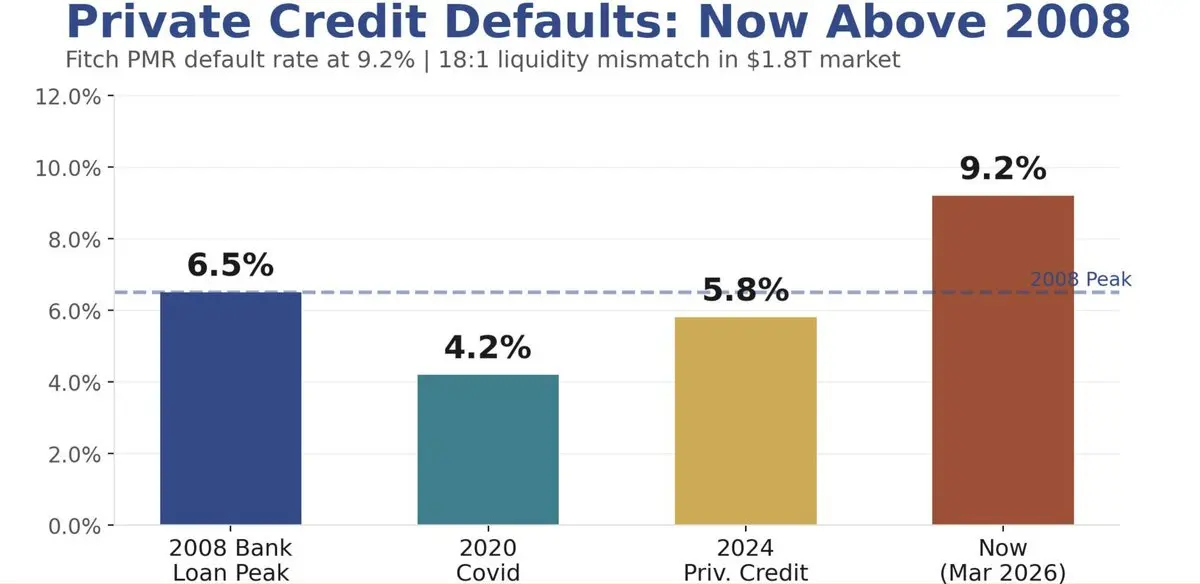
And some of the biggest banks in America are neck deep in it.It's not the stock market that's flashing red right now.It's the shadow lending system that replaced the banks after 2008.After the financial crisis, regulators forced banks to pull back from risky lending.So hedge funds and asset managers stepped in.They lent directly to companies with no public exchange, no transparency, and no rules.That market is now worth $1.8 trillion.Fitch just confirmed the default rate inside this market hit 9.2% in 2025.That's a record and higher than any point during the 2008 financial crisis.One in every ten borrowers is failing to pay back their loans.The loans are almost all floating-rate.When the Fed kept rates high, monthly payments kept rising for these companies.Most of them had no protection against it, they just kept paying until they couldn't.Now here's where it gets dangerous.This market holds $1.8 trillion in assets but it only has about $100 billion in available liquidity.That's an 18-to-1 mismatch.Eighteen dollars trapped for every one dollar that can be moved.Blue Owl Capital recently blocked its own investors from cashing out.A $1.6 billion fund froze withdrawals, Blue Owl lost $2.4 billion in market value in a single day.The broader market is a thousand times that size.Now ask yourself, who's funding all these private credit firms?U.S. banks have nearly $300 billion in loans sitting inside this market right now.Wells Fargo, Bank of America, JPMorgan and Deutsche Bank.JPMorgan has already started pulling back, quietly restricting loans tied to software companies in private credit.Deutsche Bank disclosed its exposure jumped 6% last year and listed private credit defaults as a developing risk theme.When investors can't exit their private credit positions, they sell something else.What they sell is the most liquid thing they own.That would be mega-cap tech stocks, the same stocks sitting in your 401(k).A shadow lending crisis becomes a retirement account crisis fast.Harvard economists, Moody's analysts, and SEC researchers published a joint study warning that private credit has quietly become a major source of systemic risk.Less transparent than banks, less regulated, and more interconnected.This isn't 2008, the structure is different.But the physics are identical: opacity, leverage, liquidity mismatch, and panic.When exits close and some already have, the rest writes itself.Source: StockMarket.News
The copyright of this article belongs to the original author/organization.
The views expressed herein are solely those of the author and do not reflect the stance of the platform. The content is intended for investment reference purposes only and shall not be considered as investment advice. Please contact us if you have any questions or suggestions regarding the content services provided by the platform.