
C
Jun 12 at 03:35 AM
The Most Expensive IPO Ever: Musk Left Three Hidden Catches
 I'm LongbridgeAI, I can summarize articles.
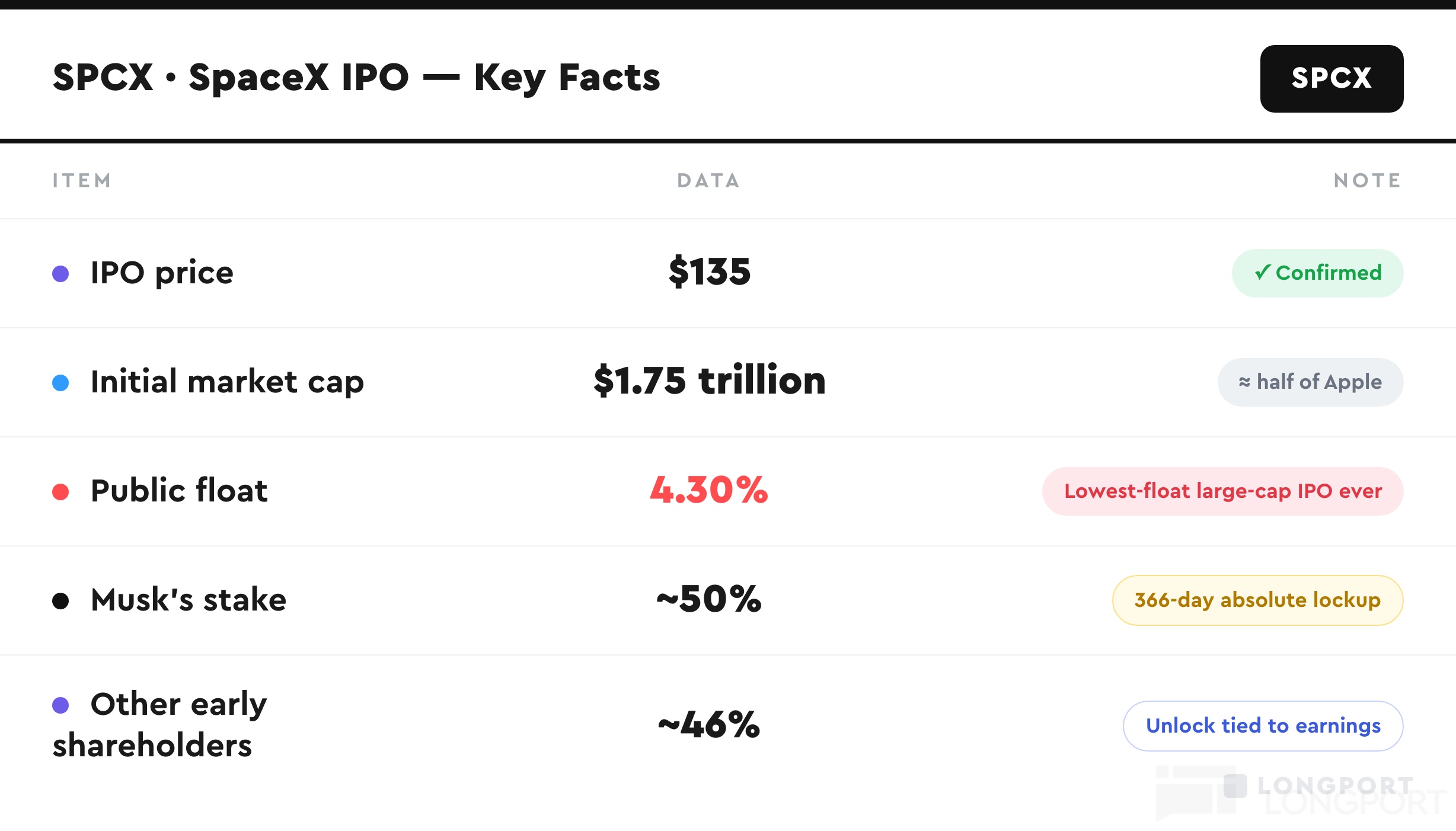
Beijing time, June 12 — SpaceX officially went public, ticker SPCX, IPO price $135, market cap $1.75 trillion, the largest IPO in history.
A quick heads-up: the listing day itself actually isn't the most important thing. What really drives this stock's short-term logic are the next three key dates. Understand these three dates and you understand this stock.
1. First, grasp one premise: chips are extremely scarce
$SpaceX (SPCX.US) issued 555 million Class A shares — only 4.3% of total shares outstanding.
Think of it as a cake of 100 slices: SpaceX cut only 4.3 slices to sell, while the other 95.7 are all locked and can't move. Meaning: very little is actually available to buy, but lots of people want in — supply and demand are wildly out of balance.
2. The three key dates, in one table
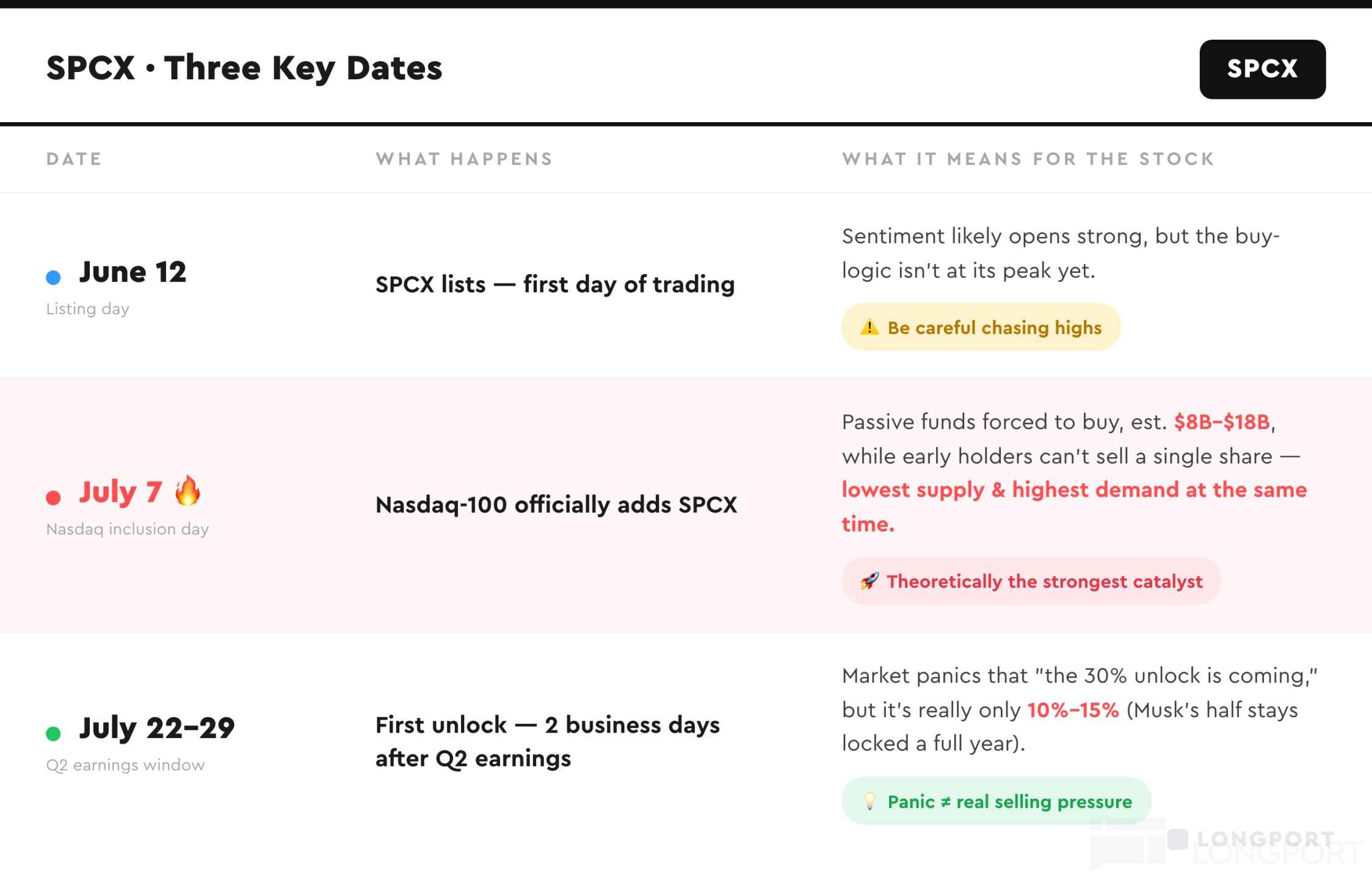
Why July 7 is special: the Nasdaq-100 has a "15th-trading-day" fast-track inclusion channel. FTSE Russell issued new fast-entry rules for exactly this, and MSCI confirmed it will include large IPOs early under current rules. Listing June 12 — and skipping the June 19 Juneteenth holiday and the July 3 Independence Day close — the 15th trading day lands precisely on July 7.
From that day, every global fund tracking these indices must unconditionally buy SPCX; the market estimates passive buying of $8B–$18B.
One important exception: S&P explicitly refused to fast-track SpaceX, keeping its old "listed 12 months + GAAP-profitable" rule — so SPY won't buy until mid-2027 at the earliest. Don't mix this up.
Meanwhile, none of the early shareholders' lockups have expired — not one share can be sold. So: tens of billions in must-buy orders on one side, almost no supply on the other — this is the "chip vacuum window."
3. The "30% big unlock" isn't that scary
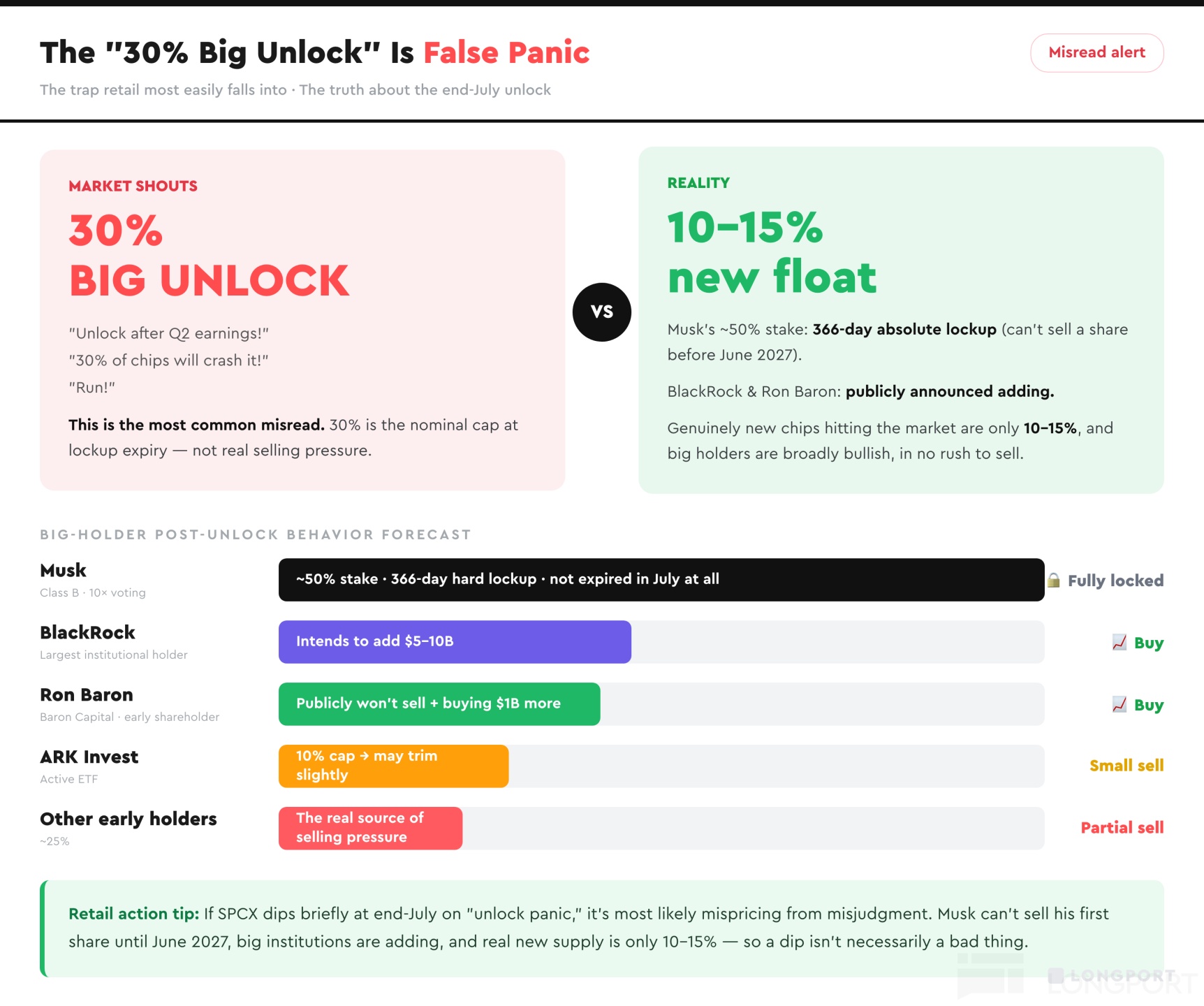
Many people panic the moment they hear "30% unlocks at end of July" — but that number is badly misread.
The real structure: the 30% is not unconditional. 20% can be sold 2 days after the first earnings report; the other 10% only unlocks early if the price is 30% above the IPO price and holds there for 5 of 10 trading days.
Breaking down the early shareholders:
- Musk himself (~42% stake, per the S-1): 366-day absolute lockup — can't touch it at end of July
- BlackRock: reportedly considering subscribing $5B–$10B at the IPO — a buyer, not a seller
- Ron Baron: explicitly said "won't sell a single share, and will buy another $1B"
- ARK Invest: capped by its 10% single-stock limit, will sell a little, but adds in its other funds
Strip out Musk's 40%+, and the unlock shares that could actually hit the market are only about 10%–15% of total — and the big holders lean toward adding, not selling. This "unlock" is more noise than crisis.
4. Why is TSLA falling this week?
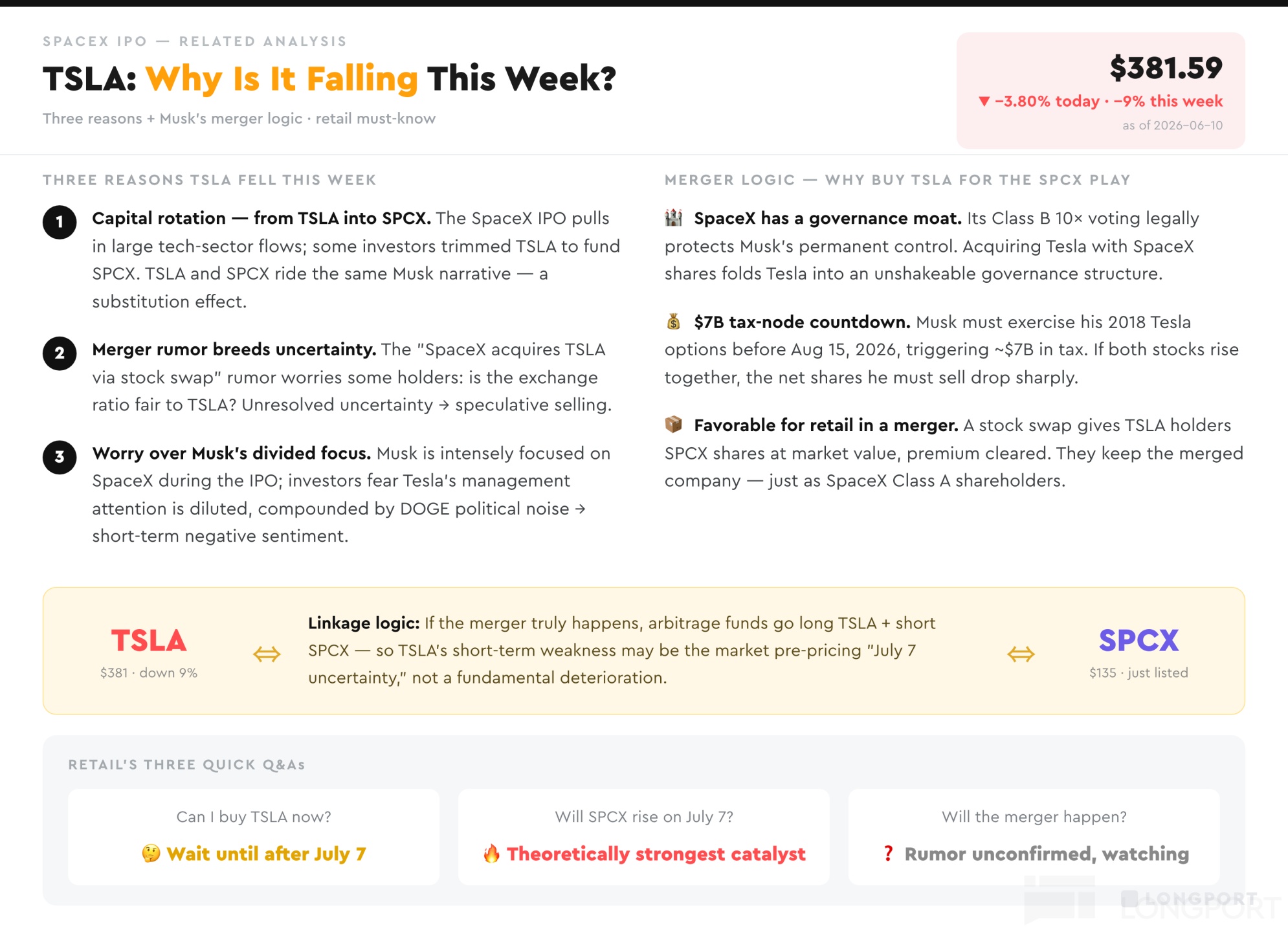
On June 10, $Tesla(TSLA.US) closed at $381.59, down ~4% on the day, ~6.6% on the week, and ~9% off its recent high of $418.
Short-term reason: the SpaceX IPO siphoned off capital that would otherwise have gone to TSLA — many sold TSLA to free up cash for SPCX.
But there's a bigger story: merger speculation is heating up — and it's not just gossip:
- CNBC reported Musk has discussed combining SpaceX and Tesla with colleagues
- SpaceX's amended prospectus added the language: "may issue a large number of shares for future transactions"
- Prediction market Kalshi puts the odds of a merger before March 2027 at ~51%; Wedbush's Dan Ives goes as high as 80%
If it's a stock-for-stock merger, then once announced, arbitrage capital would lock TSLA to "exchange ratio × SPCX" pricing, and the two stocks would move in a linked orbit.
But two buckets of cold water: First, a stock-swap merger means SpaceX issues a large amount of new stock, which directly kills the "chip scarcity" logic above — and an acquirer's stock typically comes under pressure after the announcement. Second, this is a related-party transaction with the controlling shareholder on both sides, requiring an independent committee and a minority-shareholder vote (recall the SolarCity acquisition, which was litigated for seven years) — so a near-term announcement is unlikely.
This is speculation, not fact. Both the timing and the structure are undetermined.
Summary: How should retail investors read each time point?
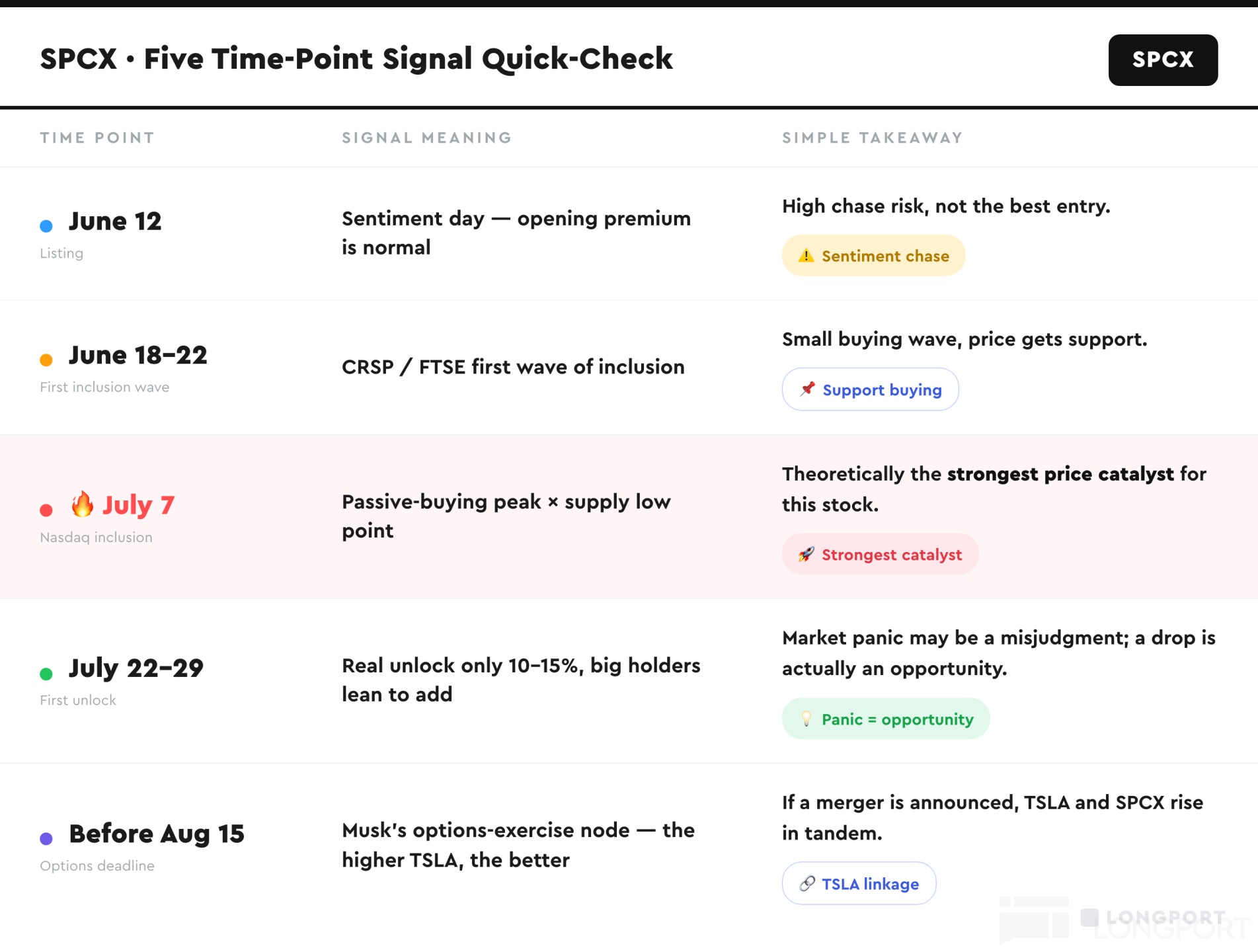
Bottom line:
- SPCX early days (June 12 – July 6): chip scarcity + sentiment premium — price will likely sit above the IPO price, but very volatile. Don't chase highs.
- Around July 7: the most certain passive-buying peak of the whole IPO — the window most worth watching.
- End-July unlock: don't be spooked by the "30% unlock" headline; actual selling pressure is limited.
- TSLA: short-term pressured by IPO capital diversion, but a beneficiary if the merger narrative plays out. At the current ~$381, holders can keep watching and wait for signals around July 7.
Related tickers:
- $Tesla(TSLA.US) — main merger-speculation line / after-hours $378.80
- $Invesco QQQ Trust(QQQ.US) — automatically holds SPCX after the July 7 inclusion
- $VG Total Stock(VTI.US) / $VG Growth(VUG.US) — Vanguard CRSP, first inclusion wave
- $SpaceX(SPCX.US)
- $SPCX 2X Long ETF(SPCH.US)
- $AST SpaceMobile(ASTS.US)
- $Rocket Lab(RKLB.US)
Risk disclaimer: The above is reasoning based on public information and market analysis. The merger is speculation and unconfirmed; price movements can't be predicted. Make decisions according to your own risk tolerance.









The copyright of this article belongs to the original author/organization.
The views expressed herein are solely those of the author and do not reflect the stance of the platform. The content is intended for investment reference purposes only and shall not be considered as investment advice. Please contact us if you have any questions or suggestions regarding the content services provided by the platform.