

📉 23October: Why Wall Street and commodities corrected
 I'm LongbridgeAI, I can summarize articles.
.
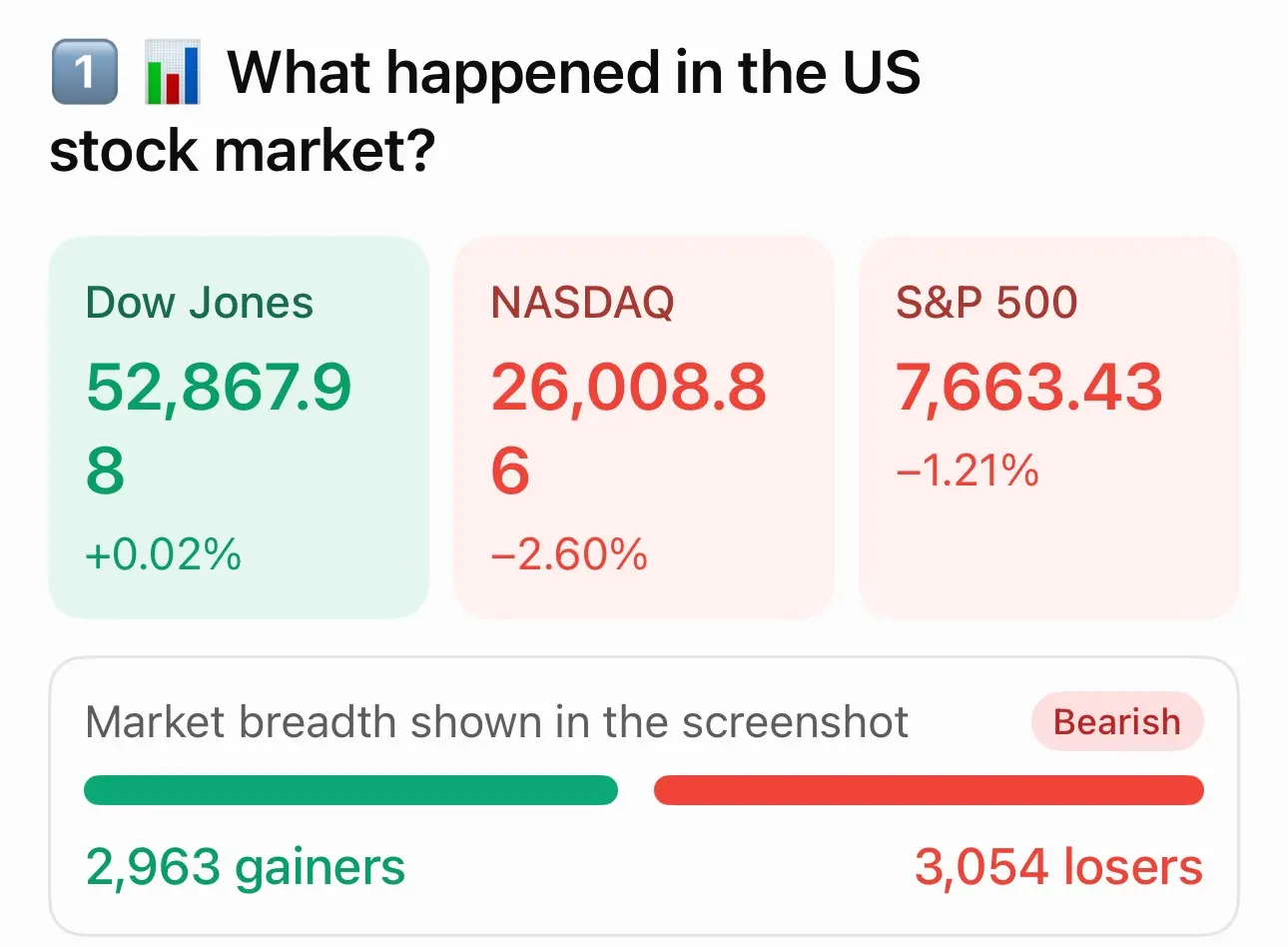
My biggest observation is that this was not a uniform decline across the US market. The Dow Jones was almost flat, while the NASDAQ fell 2.60% and the S&P 500 dropped 1.21%.
That difference matters. When technology shares fall substantially more than the broader market, it can indicate that investors are reducing exposure to growth stocks, reassessing valuations or taking profits from positions that have performed well.
The NASDAQ is particularly sensitive to changes in interest-rate expectations because many technology companies derive a significant portion of their perceived value from profits expected years into the future. When investors demand a higher return to own those future earnings, the prices they are willing to pay today can fall.
The market-breadth figures tell a similar story. There were 3,054 losers compared with 2,963 gainers. That is a modest negative balance, not a market-wide collapse by itself. The more striking signal is the sharp divergence between the NASDAQ and Dow.
My interpretation is that investors may be becoming more selective. Rather than abandoning every asset, they could be reducing higher-volatility exposures while retaining some positions in companies or sectors they consider relatively resilient.
But one trading session cannot establish a lasting trend. I would want to see whether technology shares continue to underperform, whether Treasury yields remain elevated and whether selling spreads into financials, industrials and other sectors.

2️⃣ 🤖 Why did technology stocks suffer the most?
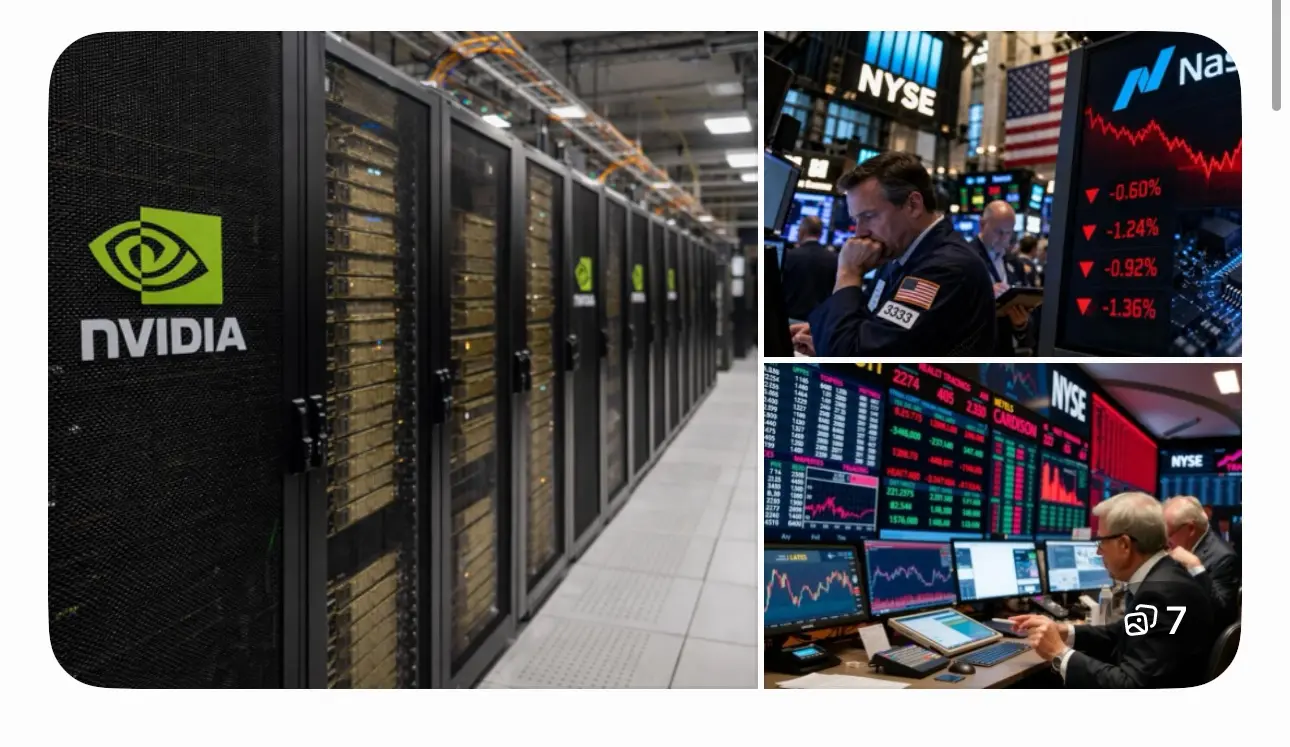
The biggest story from Thursday, 22 October, was renewed concern about the cost and profitability of the artificial intelligence boom.
Investors have spent considerable money buying companies expected to benefit from AI infrastructure, advanced chips, cloud computing, networking equipment and data centres. However, even when the long-term opportunity remains attractive, stock prices can fall if investors begin questioning whether the profits will justify the enormous spending required.
Recent earnings-related concerns involving Meta and Tesla added pressure to the market. Meta fell sharply amid worries about cash flow and higher capital expenditure, while semiconductor and AI infrastructure shares also suffered heavy losses. Nvidia was among the technology stocks that declined.
There are three important issues here.
First, AI investment does not automatically translate into immediate profits. Companies may need to spend billions of dollars on chips, servers, electricity, networking and data centres before receiving a corresponding financial return. If investors believe spending is growing faster than revenue, they may reduce their valuations.
Second, high interest rates make expensive growth stocks less attractive. A company expected to generate substantial profits in five or ten years is more sensitive to changes in discount rates than a business generating strong cash flows today. Even if its long-term earnings outlook remains unchanged, a higher discount rate can reduce the present value of those future earnings.
Third, crowded trades can unwind quickly. When a large number of investors own similar AI-related stocks, a disappointing earnings report or a change in market expectations can trigger simultaneous selling. Investors who bought on margin, use short-term trading strategies or need to reduce portfolio risk may all try to exit at the same time.
This can create a feedback loop: prices fall, volatility rises, risk limits are reached and more investors sell.
However, I would not conclude that the AI investment story is over. I would distinguish between a long-term business opportunity and the price I am willing to pay for it.
A great company can still be an expensive stock. Likewise, a sharp price decline does not automatically mean a stock has become cheap.
For me, the next questions are whether AI spending is generating measurable revenue, whether margins remain healthy, and whether management teams can demonstrate that their capital expenditure will eventually produce attractive returns.
3️⃣ 🥇 Why did gold retreat?
Why
Gold also suffered a substantial decline on 22 October. According to the reported settlement figures, October-delivery COMEX gold fell 2.12% to US$4,042.80 per troy ounce. The decline reflected concerns about energy-driven inflation, the US dollar and uncertainty over the Federal Reserve’s policy outlook.
My interpretation is that gold was caught between two competing forces: its role as a defensive asset and the pressure created by interest-rate expectations.
Gold does not pay interest. Investors holding gold receive no coupon or dividend. When yields on cash instruments and government securities become more attractive, some investors may prefer to hold those assets instead.
Consider a simplified example. If an investor can earn an attractive yield on short-term US Treasury bills, holding gold means giving up that interest income. If the dollar also strengthens, gold priced in US dollars can become more expensive for buyers using other currencies, potentially reducing demand.
That creates an opportunity cost for owning gold.
Why inflation can be negative for gold in the short term
Many investors buy gold as protection against inflation. Yet the relationship is not always straightforward.
If oil prices rise, businesses may face higher transport, manufacturing and energy costs. If those higher costs keep inflation elevated, the Federal Reserve may have less room to lower interest rates and could maintain a restrictive policy for longer.
That possibility can put pressure on gold, even though inflation itself is often viewed as a reason to own precious metals.
There is an important distinction between inflation rising and real interest rates falling. Gold can benefit when investors fear currency debasement or when real yields decline. But if inflation concerns lead to expectations of tighter monetary policy and higher real returns on bonds, gold can struggle.
I would therefore avoid saying that gold fell simply because interest rates rose that day. The market reports are not entirely consistent about the direction of Treasury yields during the session: one account describes a sharp fall in yields as investors sought safety, while another attributes gold’s decline partly to rising-yield pressure.
The more defensible explanation is that gold was reacting to a combination of rate expectations, currency movements, inflation concerns and position adjustments.
What would I watch next?
I would watch three things:
- US real yields: Rising real yields can increase the opportunity cost of holding gold.
- The US dollar: A stronger dollar can weigh on dollar-denominated gold.
- Geopolitical risk: Renewed uncertainty can support demand for safe-haven assets, although that support is not guaranteed to outweigh interest-rate pressures.
For someone trading gold through an ETF such as IAU, I would not automatically buy every dip. I would examine price support, trading volume, volatility and whether the market is stabilising.
Gold can recover quickly after a sharp sell-off, but it can also continue lower if the assumptions supporting the trade have changed.
4️⃣ 💵 Is money rotating into short-term bonds?

My view is that investors may be allocating some money away from expensive equities and into short-term bonds or cash-like instruments while waiting for better opportunities.
This is a sensible possibility, but we should distinguish between a market hypothesis and confirmed fund flows. A falling stock market alone cannot tell us exactly where every dollar has gone.
The attraction of short-term US Treasury bills is relatively straightforward. Investors can earn interest while keeping their money available for future purchases. Short maturities also generally expose investors to less interest-rate risk than long-duration bonds.
For example, imagine I have US$10,000 available for investment. I could put all of it into technology shares, leave it in cash or allocate part to short-term Treasury bills while waiting for a better entry price.
If the stock market falls another 10%, having some money outside equities gives me flexibility. I can use that capital to purchase shares at lower prices without necessarily having to sell my existing long-term holdings.
That is the value of maintaining liquidity: I do not need to predict the exact market bottom to prepare for opportunities.
There is also evidence that short-duration bonds have attracted investor interest in the broader 2026 market. BlackRock’s investment research unit recently shifted towards an overweight position in US Treasuries, favouring short-term government debt.
However, short-term bonds are not risk-free in every respect. Their market prices can still fluctuate, Treasury bills carry reinvestment risk when they mature, and investors outside the United States face currency risk if they hold unhedged US-dollar assets.
I would also distinguish short-term bonds from long-term bonds. Long-duration bonds can be more sensitive to changes in interest rates. If yields rise, their prices can fall more substantially. Short-term instruments generally have lower duration risk, although their yields may fall when the instruments mature and need to be reinvested.
For my own market analysis, I would watch Treasury yields, money-market returns and actual fund-flow data before declaring that a large rotation has taken place.
5️⃣ 🛡️ My theory: Are hedge funds buying more puts near market highs?
This is one of the more interesting possibilities to consider.
In my opinion, when markets are trading near elevated levels, some institutional investors may purchase put options to protect their portfolios against a sudden correction. Hedge funds may also use puts to express bearish views or implement relative-value strategies.
But there is a distinction between buying protection and deliberately pushing the market lower.
A put option gives its buyer the right to sell an underlying asset at a specified strike price, subject to the contract terms. Investors can use puts to limit potential losses on existing holdings without immediately selling those holdings.
For example, a fund holding a large position in the S&P 500 may buy index puts before an important earnings announcement. If the market drops, the puts may gain value and help offset losses in the portfolio.
How put buying can influence stock prices
The mechanism becomes more complicated when market makers sell those puts to investors.
Depending on their existing positions and the option’s sensitivity to changes in the underlying price, market makers may hedge their exposure by trading futures, ETFs or the underlying shares.
In some circumstances, those hedges can involve selling as the market falls. That selling may add pressure to an already declining market.
How the feedback loop could work
Investors buy protective puts
Demand for downside protection increases
Dealers adjust their hedges
Some positions may require selling futures or shares
Selling pressure may intensify
If hedging is procyclical, falling prices can trigger additional selling
This is a plausible market mechanism, not proof that it caused Thursday’s decline.
The effect depends on dealer positioning, the strikes and expirations involved, existing hedges and the market’s overall options exposure. Buying puts does not always force dealers to sell shares, and the net effect can be different when dealers are positioned on the other side of the trade.
We also need to consider the fundamentals. Thursday’s technology sell-off coincided with renewed concerns about AI expenditure and earnings, so it would be premature to attribute the decline primarily to options hedging.
My approach would be to look for supporting evidence: changes in put-call activity, implied volatility, dealer gamma estimates and trading volume around important index levels.
If these indicators show significant downside hedging and market makers are positioned in a way that encourages selling into weakness, the hedging theory becomes more credible.
Until then, I would treat it as one possible contributor rather than the main explanation.
6️⃣ 🐶 Options Puppy: What is my plan from here?
I do not want to react emotionally to one red trading session. I want to understand what changed, how much risk I am carrying and where the next opportunity might appear.
For my options strategy, I would focus on three areas.
First, preserve cash. If volatility rises, option premiums may become more attractive. However, higher premiums usually reflect higher perceived risk. Selling a put is not free money: I may be required to buy 100 shares per contract at the strike price if assigned, and losses can be substantial if the stock falls much further.
Second, avoid chasing falling technology stocks. I would look at valuation, earnings guidance and support levels before deciding whether to buy shares or sell cash-secured puts. A stock falling 5% is not necessarily a bargain if its earnings outlook is deteriorating.
Third, maintain a defensive allocation. Keeping some capital in suitable short-term instruments can reduce the pressure to sell investments at unfavourable prices. It also gives me the flexibility to act if valuations improve.
My two key questions remain:
- 1️⃣ Why am I making this trade now? Because the market is reassessing technology valuations, interest-rate expectations and the risk of crowded positions. I want to identify opportunities without assuming every decline will reverse.
- 2️⃣ What’s my plan from here? Monitor Treasury yields, gold, market breadth and AI earnings. Add risk only when the potential reward justifies it, and retain enough liquidity to manage assignments and unexpected market moves.
7️⃣ 🌏 My final takeaway
Thursday’s market action showed that the technology sector can experience a sharp correction even when the broader market is not collapsing. Gold also retreated as investors reassessed the relationship between inflation, the dollar and interest-rate expectations.
My working hypothesis is that some investors are becoming more defensive, potentially directing part of their capital towards short-term bonds and cash-like assets while using options to hedge equity exposure.
But I would not confuse that interpretation with proof of a single coordinated move by hedge funds. Earnings concerns, valuations, macroeconomic uncertainty and derivatives hedging can all influence prices simultaneously.
For me, the objective is not to guess every market move correctly. It is to keep sufficient liquidity, understand the risks behind each trade and be prepared to buy when the potential reward becomes more attractive.
Options Puppy reminder: Protect the capital first. Opportunities will come again, but a poorly managed position can leave me without the cash to take advantage of them.
follow my YouTube
https://x.com/chan_aldwi62444/status/2113441983016677710?s=46
do follow my X
$Global X Nasdaq 100 Covered Call ETF(QYLD.US)


The copyright of this article belongs to the original author/organization.
The views expressed herein are solely those of the author and do not reflect the stance of the platform. The content is intended for investment reference purposes only and shall not be considered as investment advice. Please contact us if you have any questions or suggestions regarding the content services provided by the platform.