

[Mou Weekly] Lightning Strikes During Storms: What to Do After a Plunge (Week 45, 2026 | Issue #295)
 I'm LongbridgeAI, I can summarize articles.
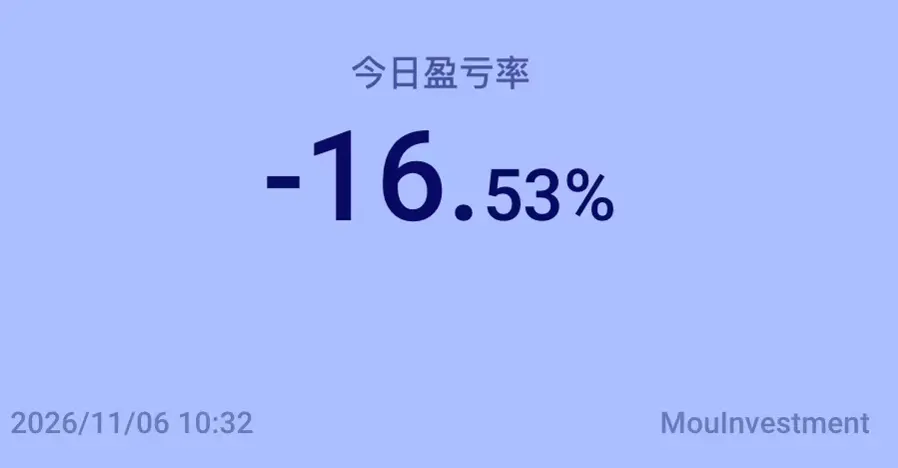
Last Thursday, the S&P 500 fell 4.35%, marking its worst day since the tariff war began in April 2025; the Philadelphia Semiconductor Index dropped 12%, its poorest performance since March 2020; and the Nasdaq entered a correction phase. Friday saw a one-day rebound, but for the full week, the S&P 500 fell 2.7%, the Nasdaq 100 fell 4.9%, and the SOX fell 13%. My own account took a 16.53% hit on Thursday, the largest single-day drawdown since the pandemic. So, what do you do after a crash? First, let's discuss why you shouldn't make decisions on the night of a crash, and then, if you must act, which leg to move first.
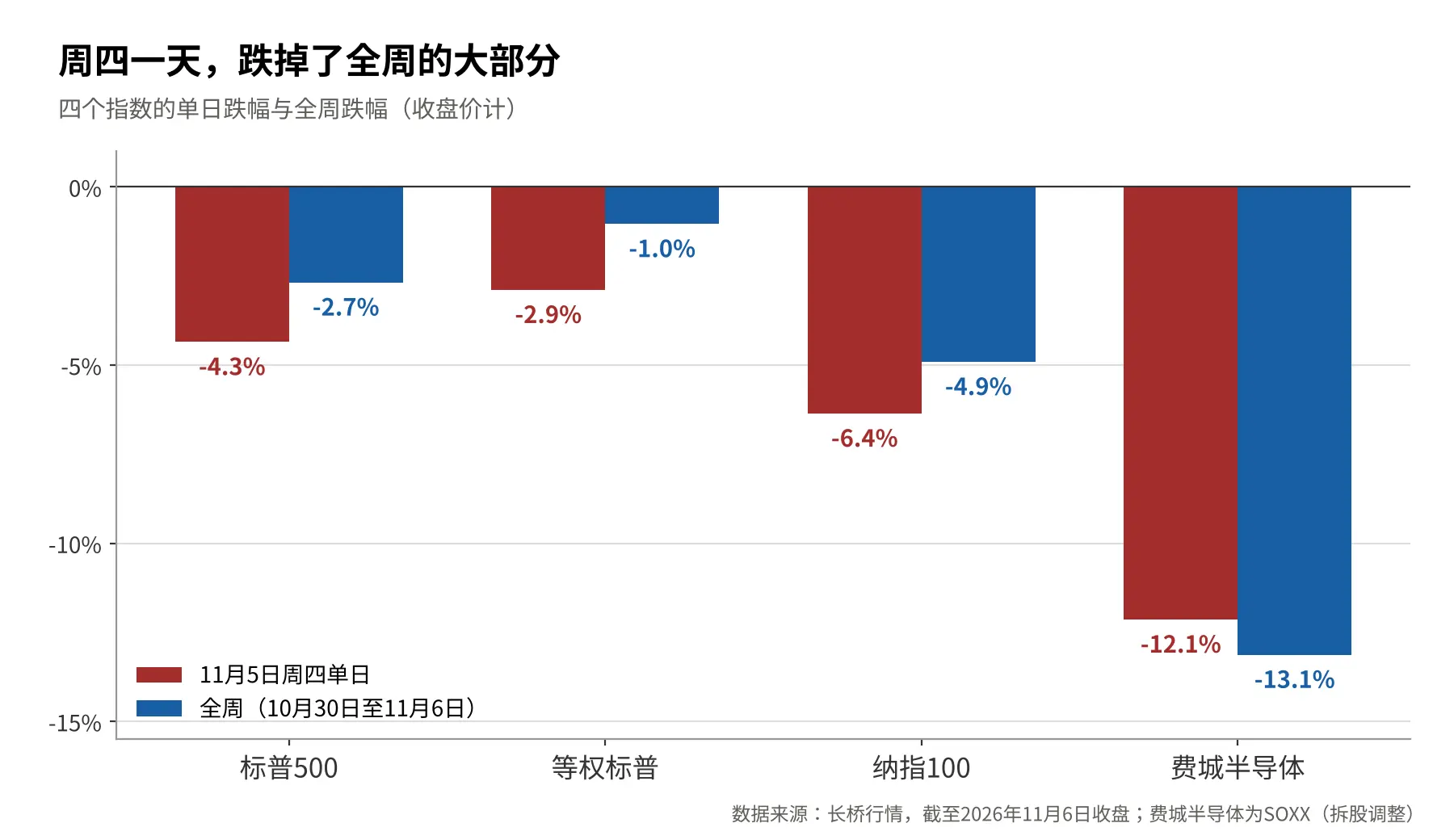
Let's reconcile last week's numbers first.
I wrote down five signals for admitting mistakes last week; two appeared, so the 'buy the dip' call was wrong. A week later, the first signal manifested halfway: the S&P 500 closed the week at 7,377, breaking below 7,500; however, the equal-weight S&P only fell 1% for the week, staying near highs on Wednesday without breaking structure. VIX peaked at 28.4, failing to breach 30; high-yield bonds remained static; the 10-year yield retreated from 4.93% to 4.86%, with capital still flowing into Treasuries rather than a simultaneous stock-bond selloff. There is no public data to verify if trend-following funds have flipped short.
By my own rules, the thesis still holds. But holding doesn't mean comfort: a week ago, when I wrote those five signals, I didn't expect to verify them against an account that had just lost 16.53%.
Two voices, one decision
On Thursday night, there were likely two voices in my head. One said: 'I can't take it anymore, sell everything, one more day like this and I'll break.' The other said: 'Don't sell, wait for it to bounce back; or add a bit to average down, or leverage up to make it back quickly.'
Having these voices doesn't make you a retail sucker; it's a normal human reaction. But looking at them together reveals they are doing the same thing: trying to stop the pain. Stopping the pain is not the same as making money back. Liquidating to avoid discomfort and adding to positions to gamble on a rebound are the same decision, just repackaged.
The most painful market conditions are precisely the worst time to make major decisions. When you feel you 'must make a big decision now,' that decision is often the least appropriate to make at that moment. Floating losses are real, but you still hold the right to 'do nothing.'
Standing next to the worst ten days are the best ten days
Charles Ellis's analogy in *Winning the Loser's Game* should be familiar to long-time readers of this account: investment returns are like lightning; you must be present when it strikes. Over the past twenty years, holding the S&P 500 continuously turns $10,000 into $70,000; missing just the best 10 days reduces it to $32,600, wiping out more than half the wealth.
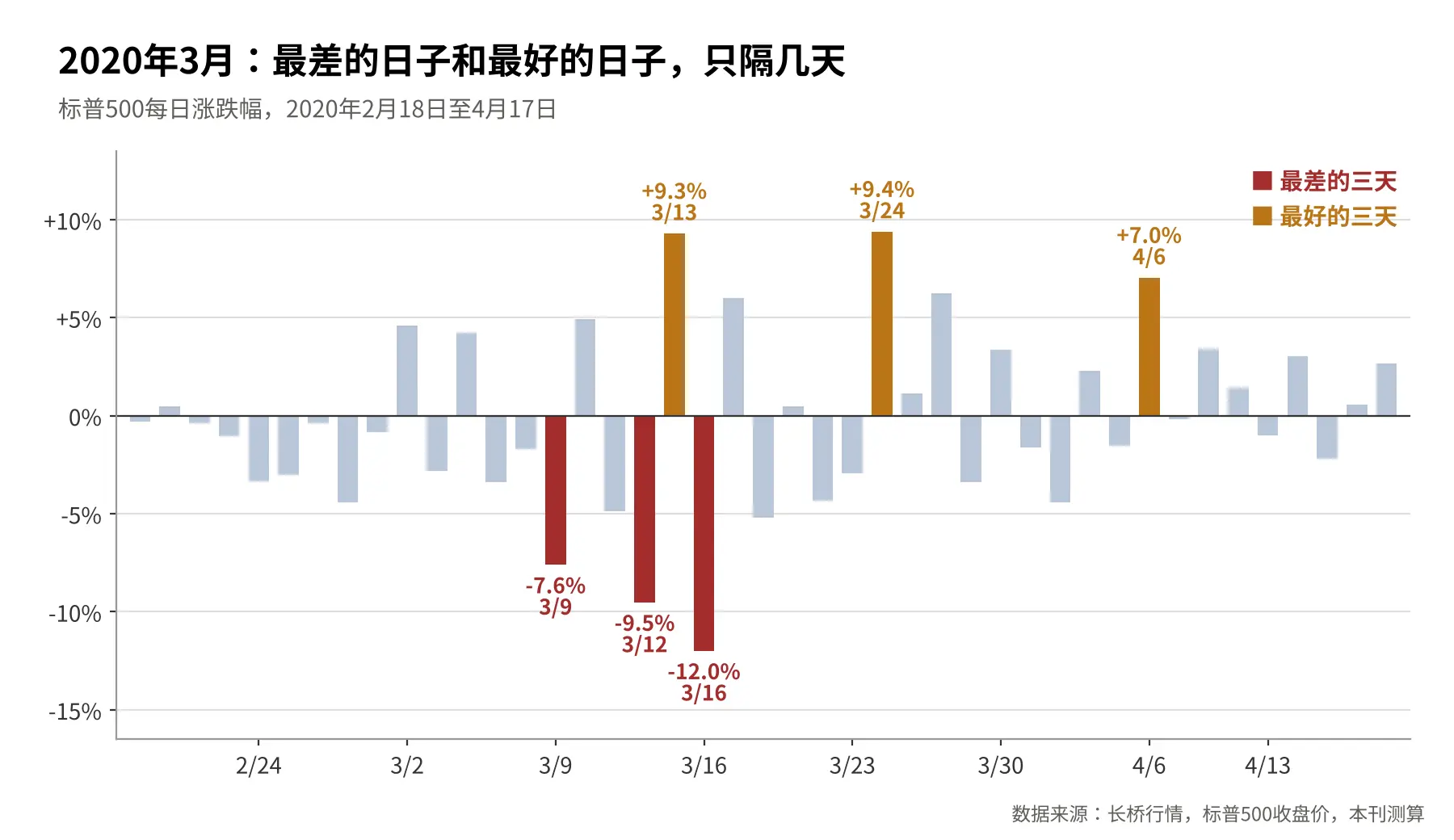
The key isn't that there aren't enough lightning strikes, but where they fall. JPMorgan's statistics show: in the best 10 trading days, 7 occur within two weeks of the worst 10 days. March 2020 is the textbook case: March 12 saw a 9.5% drop, followed by a 9.3% rally the next day; March 16 saw a 12% drop, with a 9.4% gain six trading days later. Those who liquidated after closing on March 12 or 16 captured all the downside but missed all the upside.
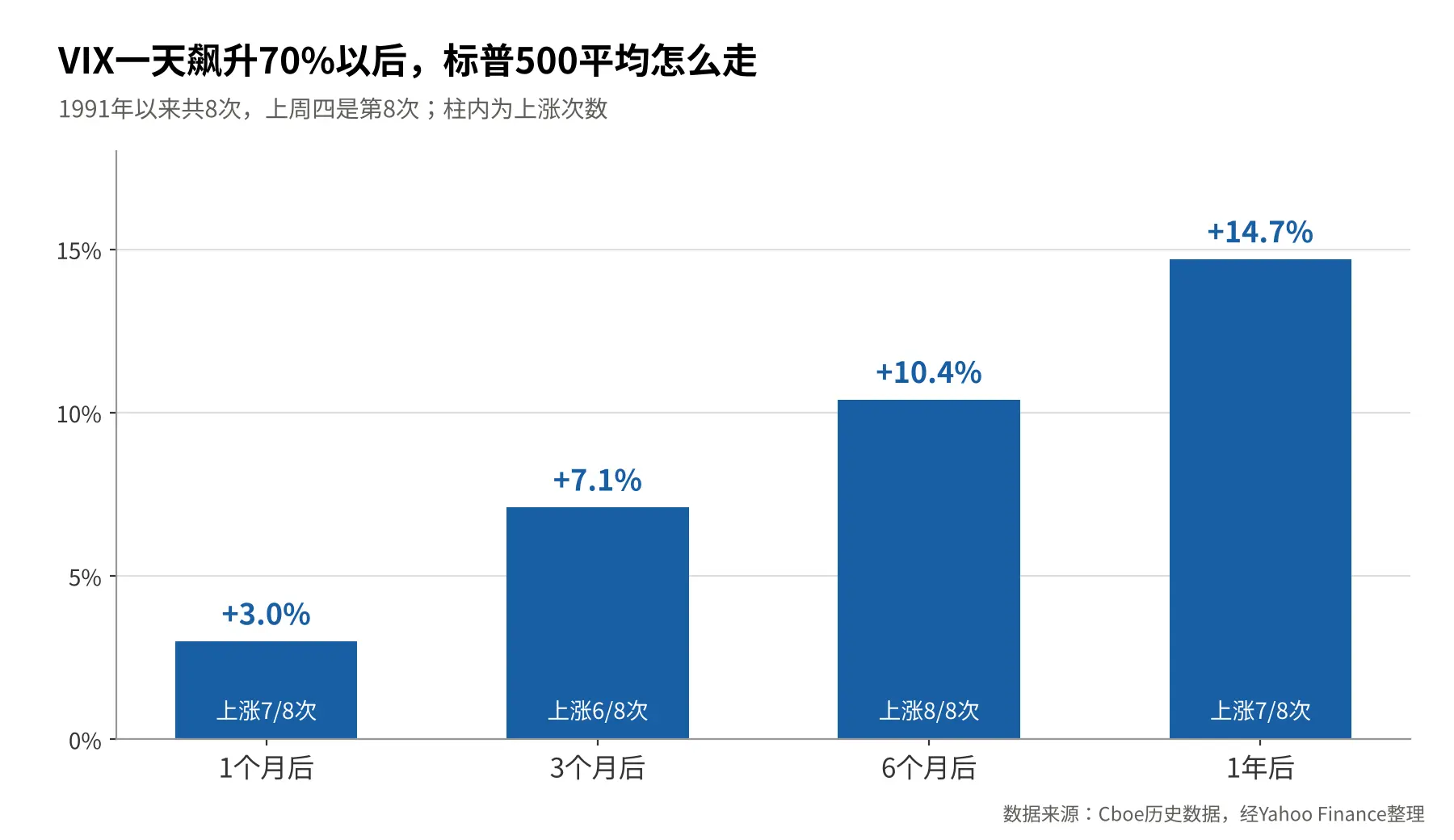
Thursday's 12% drop in the SOX was a 'worst 10 days' level event. VIX spiked 70% in one day, a occurrence seen only 8 times since 1991; over the following 6 months, the S&P 500 averaged a 10.4% gain, with all 8 instances being positive. This doesn't guarantee a rise next week, but illustrates that lightning doesn't fall evenly across 252 trading days; it targets the days with the heaviest storms.
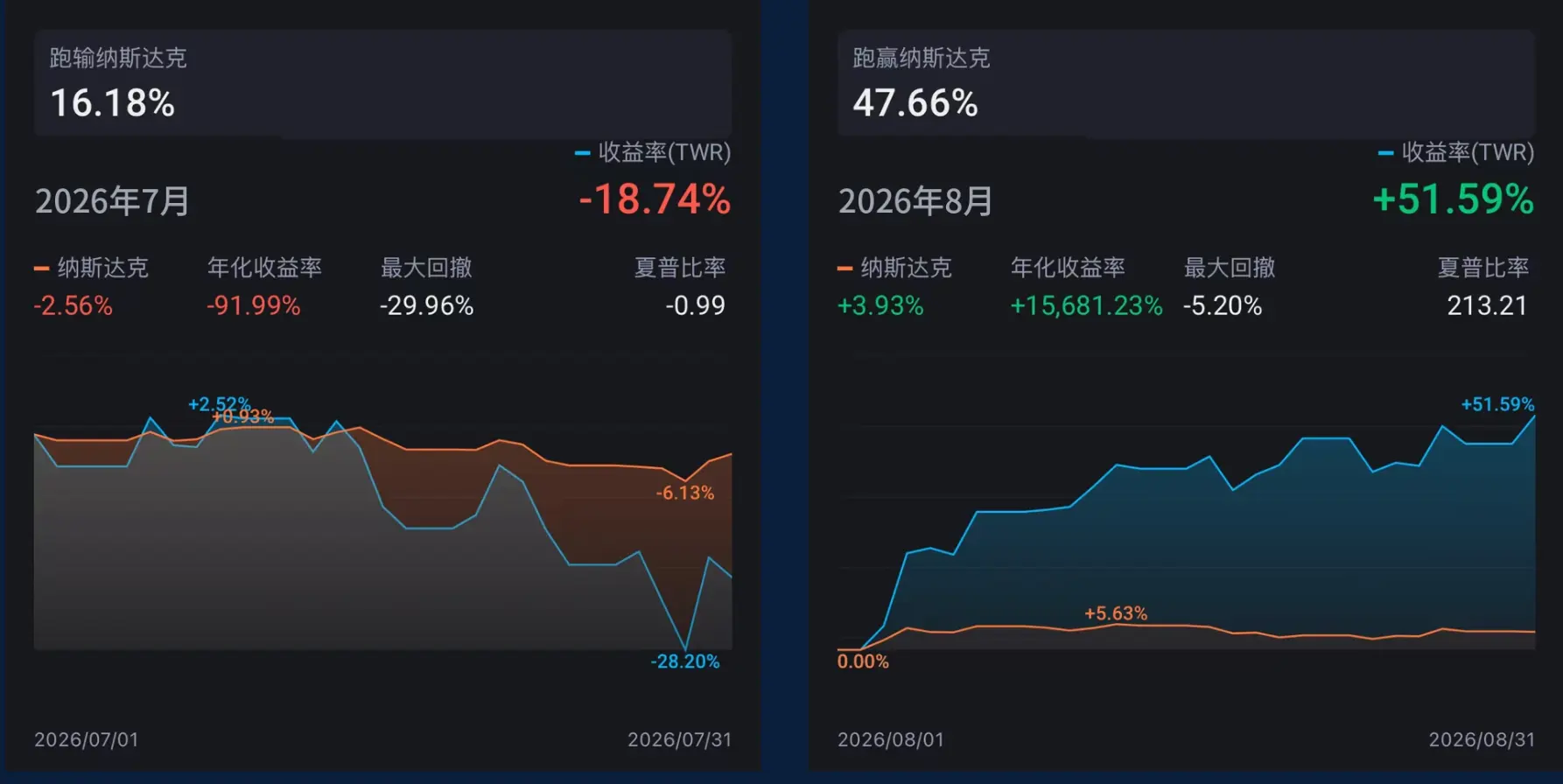
The line on my own account is more direct than any book quote: In July, I dropped 18.74%, while the Nasdaq fell 2.56% in the same period, with an intramonth max drawdown nearing 30%; in August, I gained 51.59%. Linking the two months yields a 23% gain. Those who liquidated in late July thinking 'I can't take it anymore' didn't get to ride that August line.
No one forces you to sell
Who was selling on Thursday? McElligott from Nomura noted that hedge funds were locking in annual profits, 'sacrificing the general first,' not due to fundamental issues; Vanda reported that retail investors net sold $338 million that day, the largest single-day exit since 2020, signaling 'total surrender.' Yet, on the same day, VOO tracking the S&P saw a net inflow of $9.15 billion. In panic, some are leaving, while others are entering.
Institutions face three tight constraints: drawdown discipline, requiring sales upon hitting risk limits; external pressure, such as client redemptions, monthly reporting, and peer rankings, necessitating explanations after a 10% drop; and rule-driven positioning, where volatility targets and risk parity models force passive de-risking as VIX spikes. These disciplines are virtues normally, but fatal flaws on crash days: they force institutions to sell on the worst days, then watch the lightning strike from the sidelines.
April last year serves as a ready example. On April 2, reciprocal tariffs caused a 12% drop over four days; on April 3, retail investors net bought $4.7 billion in a single day, setting a decade record; on April 9, tariffs were paused, and the S&P surged 9.5% in one day; by early May, all losses were recovered. The Bank for International Settlements later reviewed: it was retail, not institutions, that bought the rebound.
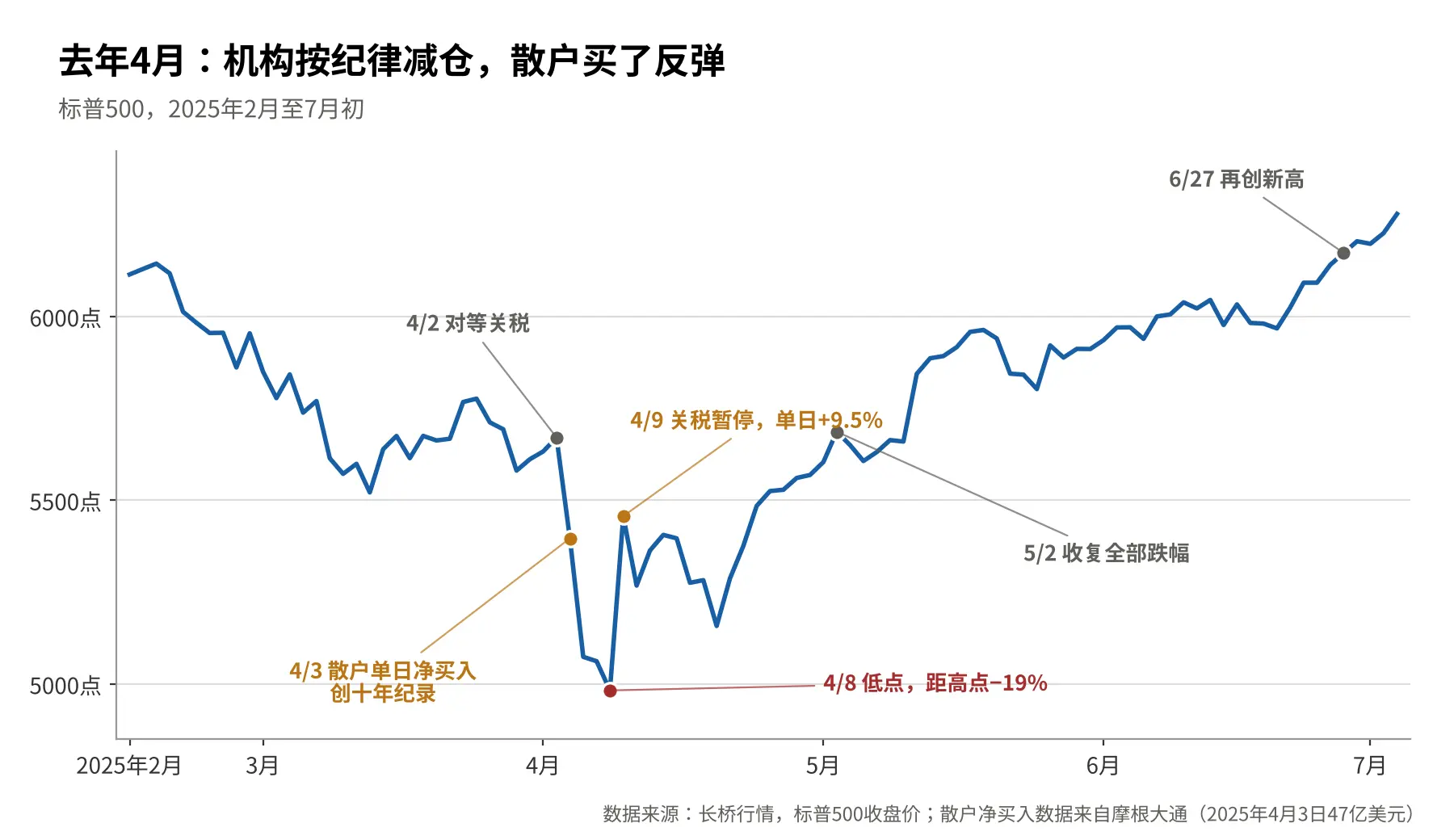
Retail's only true and permanent advantage over institutions: no one forces you to sell on the worst days. There is only one prerequisite: don't become someone forced to sell. Leverage, margin calls, or money needed in the short term will turn you back into an institution.
If you must reduce positions after a crash: which leg to move first
You typically hold three things: stocks, bought Calls, and sold Puts. Order them by 'who is most likely to be forced out.'
Step one isn't checking which stock fell the most, but opening your broker app's risk control page to find two numbers: risk status and remaining liquidity. Remaining liquidity is the 'how much more you can lose before a margin call' calculated by your broker; dividing this by your position market value gives the drawdown you can withstand. If it's less than 10%, you're standing on a cliff edge; any margin-funded positions should be handled first. Forced selling is the worst kind of selling.
Second are bought Calls, which evaporate fastest as time value and IV collapse. Those near expiry and deep out-of-the-money are already sunk costs; accept them. Those far from expiry with unchanged logic can be kept, but do not add. Third are cash-secured sold Puts; not urgent, but requires answering one question: would you want to acquire the stock at this price? If yes, wait for assignment; if no, roll out to further months and lower strikes while IV is high, rather than hard closing at a loss.
Stocks go last. Stocks are logical positions, not emotional ones. If the logic hasn't changed, leave them alone tonight; if it has, wait for emotions to subside before reducing orderly.
If you must add after a crash: small steps
Before adding, pass three questions: Has the logic changed, is the company releasing new info or is it just price action? Is the position oversized, would a further 10% drop force a sale? Can you sleep tomorrow? The part that keeps you awake is what should be reduced. Only if all three pass does adding come into play.
The rule for adding is small steps. Divide the money intended for adding into four or five parts, adding a portion for each drop segment; each tranche should be small enough that 'a further 10% drop wouldn't cause regret'; the tranches you regret are always the too-large ones. Use cash for adding, not margin. My trades from Thursday to Friday were all small lots: dozens of shares, a few to over a dozen option contracts, executed over two days. Don't aim to buy the absolute bottom; only hindsight knows the true bottom. Buying near the bottom and staying in the game is sufficient.

[Next Week Outlook]
This week's theme is reconciliation: reconciling with the worst-case scenario, December rates, and Nvidia's earnings.
Thursday's drop was driven by one-third Texas, one-third hedge funds, and one-third Qualcomm. Texas Governor-elect Hinojosa's interview on Thursday drew boundaries: all approved data centers can be completed, covering projects through 2027; new approvals require taxes, no residential electricity rate hikes, and union labor. Goldman Sachs calculated that states where newly elected governors promised to halt or pause construction account for 45% of planned US data center capacity. Drawing boundaries around the worst-case scenario doesn't mean the alarm is off.
This week's calendar: Tuesday's October CPI, Friday's PPI. Last Friday's October NFP came in at 165k vs. expectations under 70k, unemployment returned to 4.1%, pushing the probability of a December rate hike to 78%. Further out, Nvidia's earnings on November 18 will be the final verdict on this correction.
Semiconductors are falling on valuation; NFP supports rates; one calculates next year's earnings, the other calculates December's meeting.
Watch two things for buying opportunities: equal-weight S&P holding support, VIX staying below 30. Both are currently intact. The pace for adding is the small steps mentioned above, not all-in.
Markets can crash, but positions must remain orderly.
(The above represents personal views and does not constitute investment advice.)
The copyright of this article belongs to the original author/organization.
The views expressed herein are solely those of the author and do not reflect the stance of the platform. The content is intended for investment reference purposes only and shall not be considered as investment advice. Please contact us if you have any questions or suggestions regarding the content services provided by the platform.