

SHEIN was named, behind 'The fashion capital says no to fast fashion'

Recently, two short news items have been drowned out by the vast sea of trending topics and hot discussions. Yet their significance of the times still unsettles the few who attempt to discern the direction of the tide:
According to Germany's WirtschaftsWoche, France plans to legislate strict regulations on "fast fashion," imposing a 5-euro environmental tax per garment. Among them, fast fashion giant SHEIN was specifically named.
Separately, The Wall Street Journal reported that SHEIN plans to open its supply chain infrastructure and technology to global brands and designers.
From the perspective of the general public, the "5-euro environmental tax" event may seem uneventful. But for millions of industry professionals, its underlying implications resemble a hidden undercurrent.
In short, the "Thirty Years' War" between the textile belts at 40°N and 25°N latitudes is quietly beginning.
01 40°N vs. 25°N
In the 1970s, under Hiroshi Yamauchi's leadership, Nintendo learned from Atari's failures and transformed the Famicom into an electronics product driven by content quality. To achieve this, Yamauchi developed what was then considered a highly unconventional revenue model: the licensing fee system.
This standard not only ensured content quality but also lowered the production barriers for third-party developers, allowing Japanese games to dominate the European and American markets.
However, American creators gradually grew dissatisfied with this model, believing that licensing fees stripped them of their "free market" rights: Why should Easterners selling consoles dictate terms to North American content creators?
Thus began a 30-year rivalry between the American and Japanese gaming industries.
If Yamauchi had been asked in the 1990s to summarize Nintendo's decline in the console market, he might have attributed it to the licensing fee system encroaching on the American content creators' market share, leading to their resistance.
But two decades later, he might have reconsidered: After all, Apple adopted a similar model with the App Store, propelling it to become the world's most valuable company.
The issue lies not in the rules themselves but in whose interests the rule-makers represent and who holds greater power to sustain those interests. In other words, beneath the conflicts of business models or cultural differences lies a struggle for influence.
A deeper examination of the current "Fashion Capital Says No to Fast Fashion" event reveals at least two key layers worth scrutinizing:
Surface-Level Cause: Targeting 'Fast,' i.e., Control Over the Apparel Supply Chain
The global evolution of the textile industry has revolved around the principle of labor cost efficiency in light industries: Since the invention of the steam engine, production has shifted from Europe and the U.S. to Japan, Hong Kong and Taiwan, South Korea, mainland China, and now Southeast Asia.
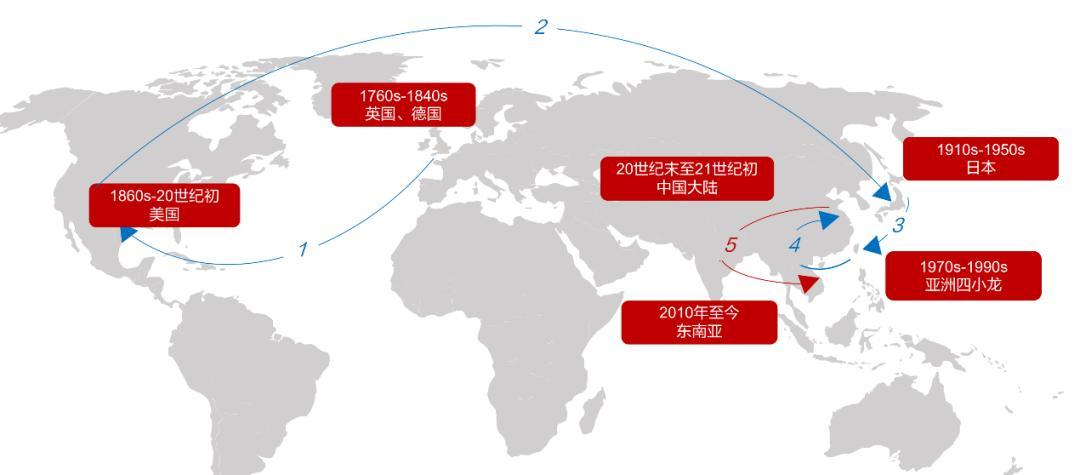
Figure: Evolution of the Apparel Supply Chain (Source: Internet)
But over the past decade, the most notable change has been China's light textile industry. Centered around clusters in Shantou and Qingyuan, Guangdong, the industry has expanded to Dongguan, Kaiping, Zhongshan, Puning, Foshan, and coastal Fujian, defying cost-driven migration trends to reclaim its position as a top exporter. Fujian and Guangzhou now form the 25°N industrial belt.
The reason becomes clear when examining the "smile curve" of the textile industry's value chain (see below). Most supply chain migrations have been OEM-driven, with the high-value ends—branding, marketing, services, and R&D—remaining firmly in Western hands.
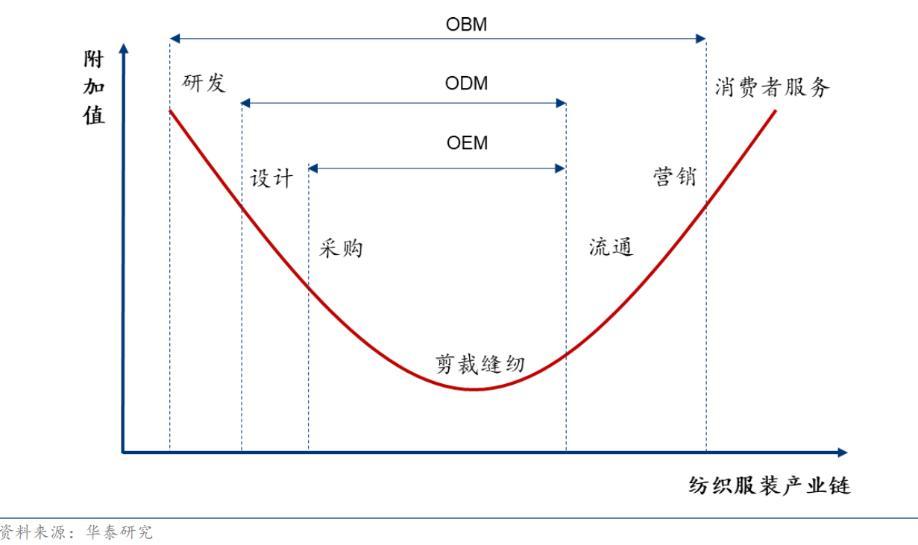
Figure: Textile Industry Value Curve (Source: Huatai Research)
However, the rise of cross-border e-commerce platforms like SHEIN, leveraging the 25°N belt's robust logistics and internet-driven models, has disrupted the right side of the curve—distribution, marketing, and consumer services—laying the groundwork for industrial repatriation.
This has inevitably clashed with Western clusters that traditionally dominated these high-value segments.
Yet, if this were the only factor, it wouldn’t justify another industrial belt's decision to wage war. The deeper catalyst lies in the 25°N belt's encroachment on the left side of the curve.
Underlying Cause: Targeting 'Fashion,' i.e., Control Over Aesthetic Authority
The left side of the curve—R&D and design—has long been Western industry's pride, a self-proclaimed stronghold. This was undeniably true for much of history.
Take Japan: Fashion pioneers like Kensuke Ishizu and Yohji Yamamoto built their legacies catering to Western tastes. Ishizu's Ivy Look was inspired by Western sports trends, while Yamamoto's creative awakening came in France.
In China, early OEM manufacturers rebranding as labels often adopted Western names and partnered with obscure European designers, staging shows in Paris to legitimize themselves as local fashion vanguards.
Thus, Western fashion has long levied an invisible "aesthetic tax": luxury brands justify exorbitant markups with aristocratic heritage, while promoting Western aesthetics to lock in design dominance.
But Chinese cross-border e-commerce clusters are disrupting this hierarchy with data-driven rigidity: Using AI, big data, and user feedback, they amalgamate popular design elements, rapidly iterate, and return aesthetic authority to the masses—upending the top-down Western design dogma and devaluing its premium.
From LVMH to ZARA, the 40°N industrial belt has, over 40 years, ceded low-value OEM segments and even labor-intensive distribution—but aesthetic sovereignty is its red line. It’s akin to traditional automakers facing electrification: an existential threat.
Thus, the "fast fashion tax" is fundamentally a collision between the traditional 40°N belt and the tech-empowered 25°N belt.
We must recognize that this may only be the beginning. As tensions escalate, the entire 40°N belt could be drawn into the fray.
02 The Foundation of Fashion Dominance
Contrary to modern assumptions, the East historically led cultural exports in materials, design, and aesthetics.
Marco Polo's 13th-century travels introduced Chinoiserie, influencing Western aristocracy for 300 years—from Italian painters incorporating Chinese motifs to European nobles replacing silverware with porcelain.
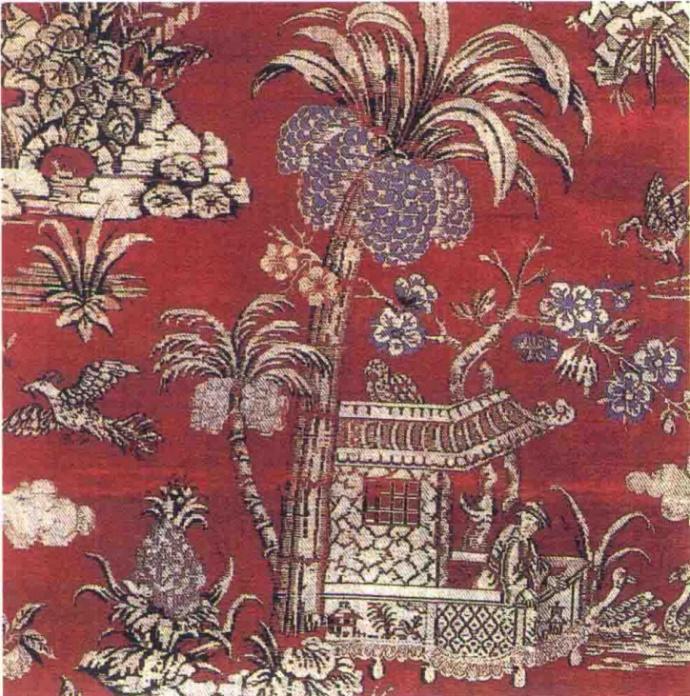
Figure: French Lyon-produced "Brocade of the East" pattern (Source: Wu Bin's "The Power of Civilization")
Three globally coveted commodities emerged: silk, porcelain, and tea.
Silk, integral to textiles, traces back to Xu Fu's voyages to Japan. By the Han dynasty, it reached Constantinople via the Silk Road, becoming a European status symbol. Tang-era maritime trade peaks shifted silk from diplomatic gifts to commercial exports, fueling Italy's Lucca silk industry by the 13th century.
The 18th-century Industrial Revolution replaced silk with cheap cotton, and Qing China's decline sealed its fate.
Porcelain exports began in the 9th century (Tang), surged during Song maritime trade, and Ming blue-and-white became European banquetware, influencing Korean and Japanese ceramics.
Tea culture reached Korea and Japan in the Tang era, Europe by the 16th–17th centuries, but colonial plantations later supplanted Eastern trade.
Historically, aesthetic dominance aligns with power: Tang China's golden age—economic might, cultural zenith, and global stature—made its exports aspirational.
Records like "The Great Tang Records on the Western Regions" and "The Classic of Tea" (the world's first tea encyclopedia) attest to Western emulation. Even in the 18th century, Jesuit d'Entrecolles' "Letters on Chinese Porcelain" remained Europe's ceramic bible.
For centuries, the East symbolized advanced craftsmanship.
The 18th-century reversal reflects industrial capitalism's rise. German sociologist Werner Sombart declared, "Fashion is capitalism's darling." Mechanized textiles undercut handmade goods, eroding Eastern prestige.
Eileen Chang noted, "Under 300 years of Qing rule, women wore the same clothes without boredom"—highlighting diverging aesthetic trajectories.
Industrial and military superiority cemented Western aesthetic hegemony—until now.
03 An Ending and a Beginning
Aesthetic authority is high-value trade authority. For 30 years, the East has sought parity, with mixed results.
A landmark success: Cao Dewang's 2002 U.S. anti-dumping case. Facing PPG's allegations, Fuyao Glass spent a year's profits fighting—and won, paving its path to global dominance.
The West respects strength. Japanese semiconductors' 1980s compromise (ceding market share via the U.S.-Japan Semiconductor Agreement) led to Korea's rise and Japan's decline from 80% to 15% market share.
Today, SHEIN's supply chain concessions during its IPO may seem pragmatic but reflect a recurring dilemma.
Yet Western pushback validates SHEIN's success: Its agile model represents superior productivity. China's fourth-wave globalization—backed by economic scale, supply chains, and logistics—positions it for cultural and commercial export.
Current setbacks are micro but affirm macro advantages. Future entrepreneurs will build on this foundation.
Twenty years ago, German cars crossed oceans to China; today, Chinese EVs reverse the route. Thirty years after Yamauchi, Nintendo's Iwata and Miyamoto conquered gaming through content, not hardware. After 150 years of Western aesthetic dominance, the East responds—not with compromise, but resolve.
The autumn wind still blows, but this is no longer an era of concessions.
The copyright of this article belongs to the original author/organization.
The views expressed herein are solely those of the author and do not reflect the stance of the platform. The content is intended for investment reference purposes only and shall not be considered as investment advice. Please contact us if you have any questions or suggestions regarding the content services provided by the platform.
