

Why do consumer companies choose it for listing? Australian-style IPO vs Hong Kong-style IPO

RBF has recently become a hot topic in the investment circle, with domestic representative MicroConnect experiencing rapid expansion in recent years, once getting caught in a whirlpool of public opinion. Has anyone had experience with Australian-style IPOs? Let's discuss!
The Hong Kong stock market has always been one of the choices for domestic companies to go public. In Q1 2024, the number of companies listed and the amount of funds raised in the Hong Kong IPO market both declined compared to last year. In the relatively "bleak" environment of Hong Kong-style IPOs, domestic companies, especially those in the consumer sector, are targeting Australian-style IPOs! What are the differences between Australian-style IPOs and Hong Kong-style IPOs? Why are institutions shifting their focus recently?
What is an Australian-style IPO?
Before understanding Australian-style IPOs, imagine this scenario: If a company is relatively small, lacks collateral, banks ignore it, wants to go public through margin financing but doesn’t want to dilute equity—do we have a solution?
The answer is yes! This margin financing method is called Revenue-Based Financing (RBF).
RBF is a revenue-based financing method that sits between debt financing and equity financing. Simply put, it doesn’t take equity but instead generates investment returns through revenue sharing. It may seem trivial or unoriginal, but it has become a trend, changing the rules of the game in venture capital and providing better financing options for millions of entrepreneurs.
Compared to traditional financing methods, it focuses more on revenue certainty rather than pure growth. Entrepreneurs can repay investors’ principal and returns step by step based on a portion of their projected revenue. This approach not only provides financial support but also helps establish a clear profit model early on, making revenue more predictable.
Additionally, RBF financing has the advantage of reducing investment risk. Traditional investment methods require investors to bear greater risks, but RBF financing disperses risk across the entire revenue stream. Moreover, it improves capital efficiency.
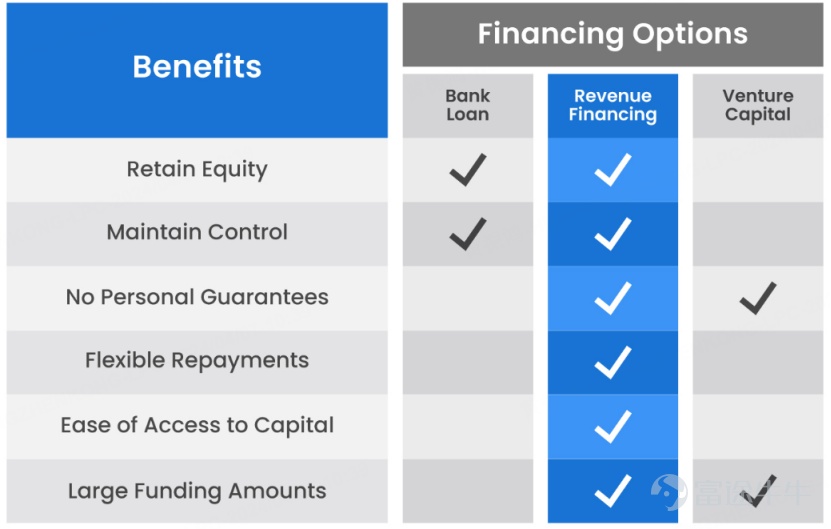
Australian-style IPO (International Professional Offering) refers to a business unit or store, regardless of size, that meets two conditions—transparent revenue information and controllable cash flow—and can list on the MicroConnect Macao Exchange (MCEX) using revenue-sharing contracts, raising funds from international professional investors.
MicroConnect is a financial technology-driven exchange group connecting global capital with Chinese micro and small enterprises. Stores in industries like catering, retail, services, and culture/sports can list and raise long-term funds on MCEX, the world’s first revenue-sharing product exchange. According to MicroConnect’s official data, since March, the pace of new listings on MCEX has accelerated significantly, raising over 100 million yuan for 31 brands.
How exactly does it differ from Hong Kong-style IPOs?
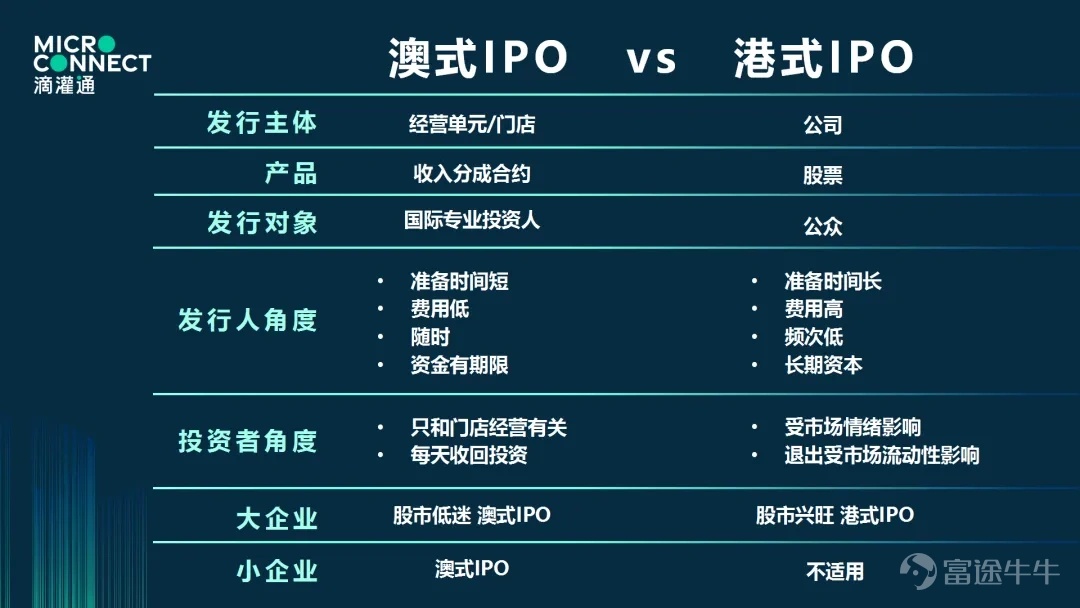
First, the issuing entities and products are vastly different. Hong Kong-style IPOs are issued by companies, with stocks as the product; Australian-style IPOs can be issued by single stores or business units, with revenue-sharing contracts as the product. Additionally, Hong Kong-style IPOs target the general public, while Australian-style IPOs focus on international professional investors—ordinary people can’t invest.
The factors affecting returns also differ. Australian-style IPO investors’ returns depend more on the actual performance of the store, while Hong Kong-style IPO investors’ returns are more influenced by market sentiment. For large companies, Hong Kong-style IPOs are ideal for raising substantial long-term capital during bull markets; during downturns, Australian-style IPOs allow individual stores to raise funds in batches as needed.
Behind its rapid expansion in recent years, MicroConnect has been embroiled in controversy over product attributes, return rates, risk control, and regulatory gaps. DRO (Daily Revenue Obligation), this revenue-based asset portfolio, differs significantly from traditional equity and corporate debt assets. The market and investors see parallels with some asset-backed securities (ABS), sparking heated discussions.
However, a turning point came quickly. On January 16, 2023, the release of the MicroConnect Macao Exchange General Standards (MAP) disclosed details of every underlying asset listed on MCEX, marking the exchange’s entry into "Phase Two." The release of these standards also signaled MCEX’s commitment to opening up and involving a wide range of market participants—intermediaries, brands, investors—to leverage their strengths and empower micro-economies.
Anyone familiar with or currently exploring Australian-style IPOs, let’s chat!

$内地消费(000942.SH) $Yinhua CSI HK Equities Consumption Theme ETF(159735.SZ) $SSE Cons Staples(000036.SH)
The copyright of this article belongs to the original author/organization.
The views expressed herein are solely those of the author and do not reflect the stance of the platform. The content is intended for investment reference purposes only and shall not be considered as investment advice. Please contact us if you have any questions or suggestions regarding the content services provided by the platform.
