
 Buffett Apprentice
Is Vanke facing a critical moment with both stocks and bonds plummeting?

Although only a little over four months have passed in 2024, for Vanke, these may be the toughest four months in the company's nearly thirty-year history.
First, the company's bonds faced a crisis, with market rumors swirling about potential defaults. However, Vanke managed to avert disaster by successfully repaying its debts time and again. Then came the annual report, which showed a significant drop in performance, leading the company to cancel its 2024 dividend—a rare move in recent years.
As April began, amid ongoing scrutiny, news broke on the morning of April 10 that the general manager of Vanke's Jinan branch was cooperating with an investigation by relevant authorities.
While this wasn't the final straw for Vanke, it sent shockwaves through the market, resulting in a simultaneous plunge in its stocks and bonds.
In fact, we had been monitoring Vanke's situation nearly nine months earlier. At that time, the company's 15 billion yuan private placement plan had not yet been canceled.
With a price-to-earnings ratio of less than 0.7, Vanke still had significant room for growth.
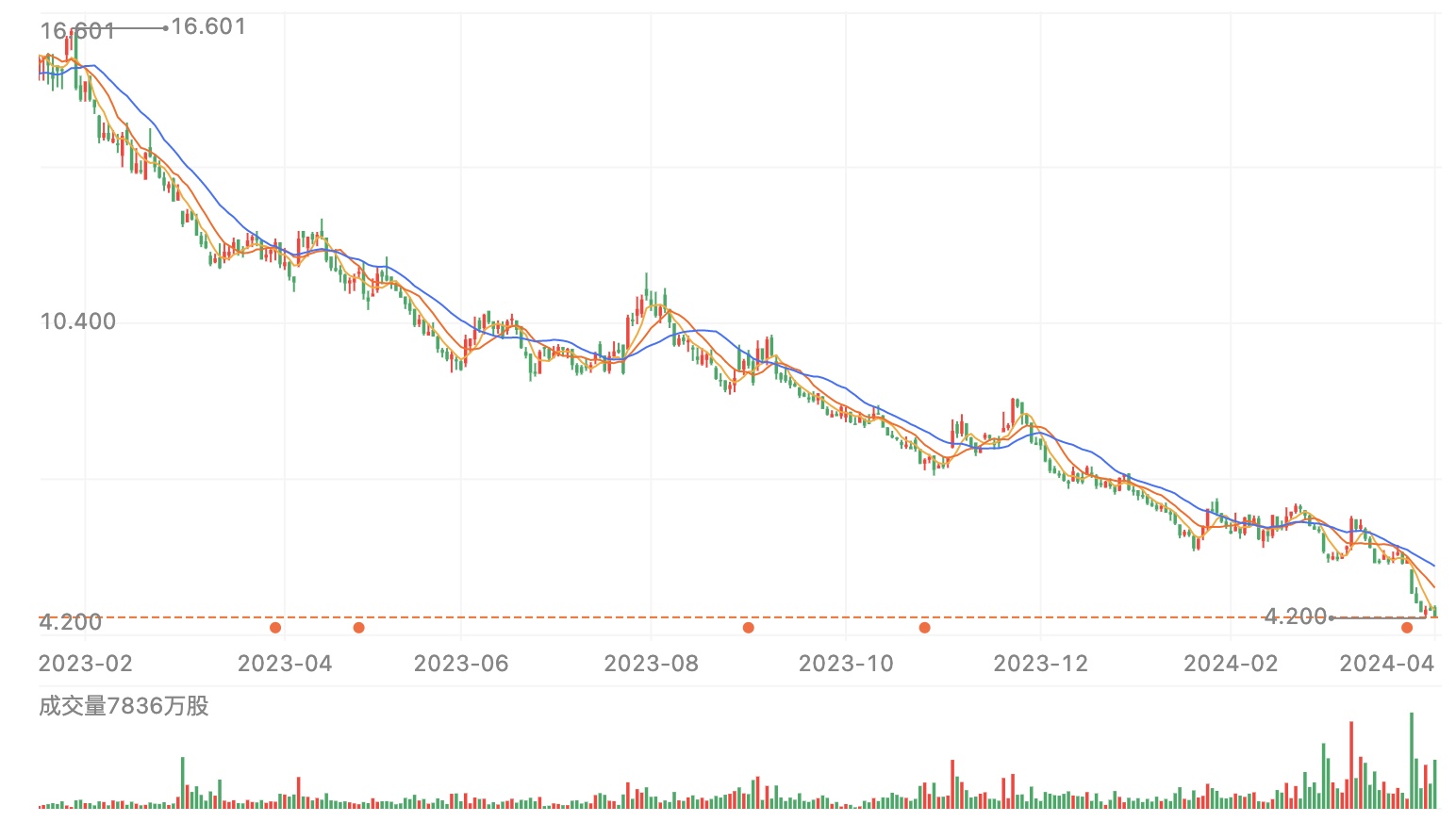
In reality, Vanke's bomb may have been set in motion when the private placement was canceled, or even as early as July of last year, when signs began to emerge.
As one of China's top real estate companies, Vanke, though controlled by Shenzhen's state-owned assets, often operates outside the state-owned system.
The biggest difference between Vanke and state-owned enterprises like COFCO, Poly, and OCT lies in the fact that Vanke's state-owned background is more of a symbolic status—it can add icing on the cake but is unlikely to provide help in times of need.
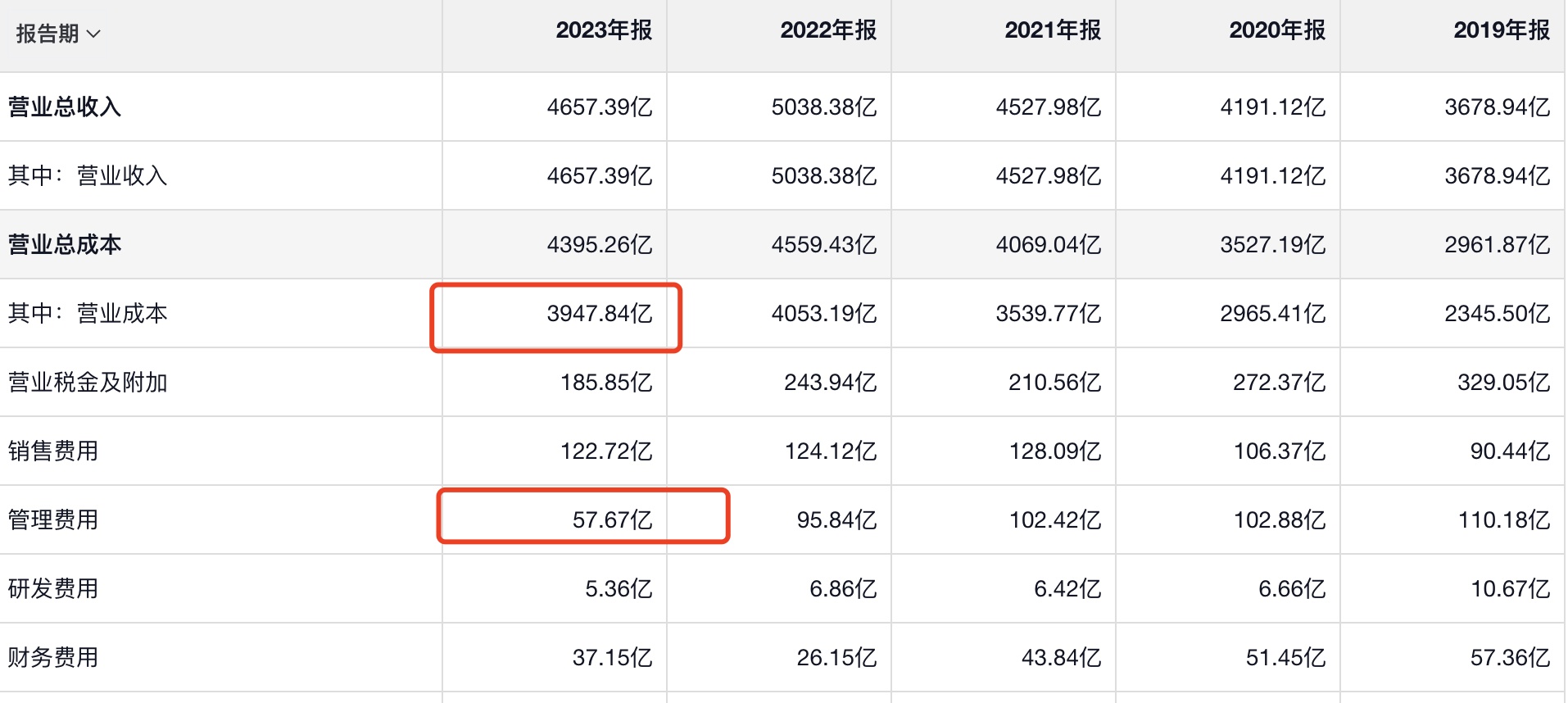
The company's 2023 annual report was indeed dismal. Despite Vanke's best efforts to cut costs and increase revenue, its operating expenses continued to rise.
In 2023, the company's operating costs for 460 billion yuan in revenue were 390 billion yuan, compared to 350 billion yuan for 450 billion yuan in revenue in 2021. This suggests that Vanke has been pushing hard to sell properties to improve cash flow or make its financial statements look better.
At this point, survival is Vanke's most pressing challenge.
The company's administrative expenses have nearly halved, dropping from around 10 billion yuan to less than 6 billion yuan.
However, its net profit attributable to shareholders after deducting non-recurring gains and losses has been shrinking year after year.
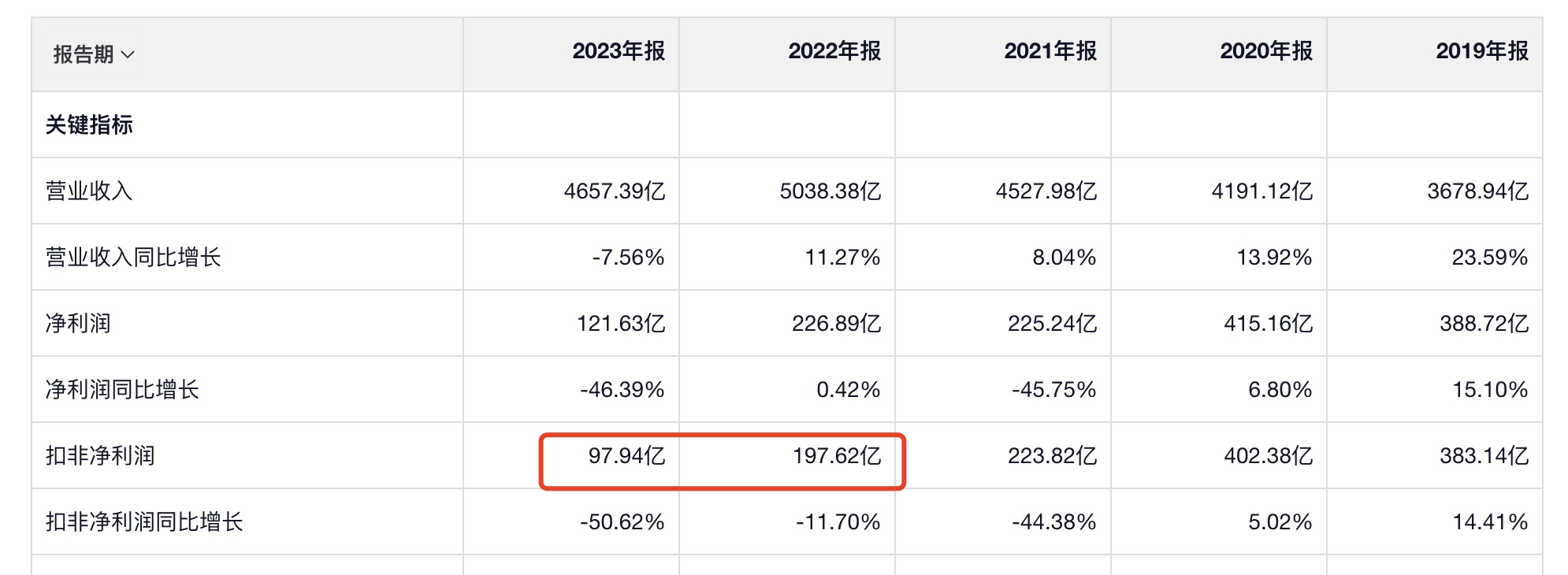
This trend has been evident since 2021. In 2020, Vanke's net profit attributable to shareholders after deducting non-recurring gains and losses exceeded 40 billion yuan, but by 2021, it had plummeted to 22 billion yuan.
During this period, Vanke's revenue still grew by over 30 billion yuan.
This indicates that Vanke has gradually shifted from economies of scale to diseconomies of scale. As the external environment changed, the company had to ramp up efforts, offering discounts and promotions to meet its cash flow needs.
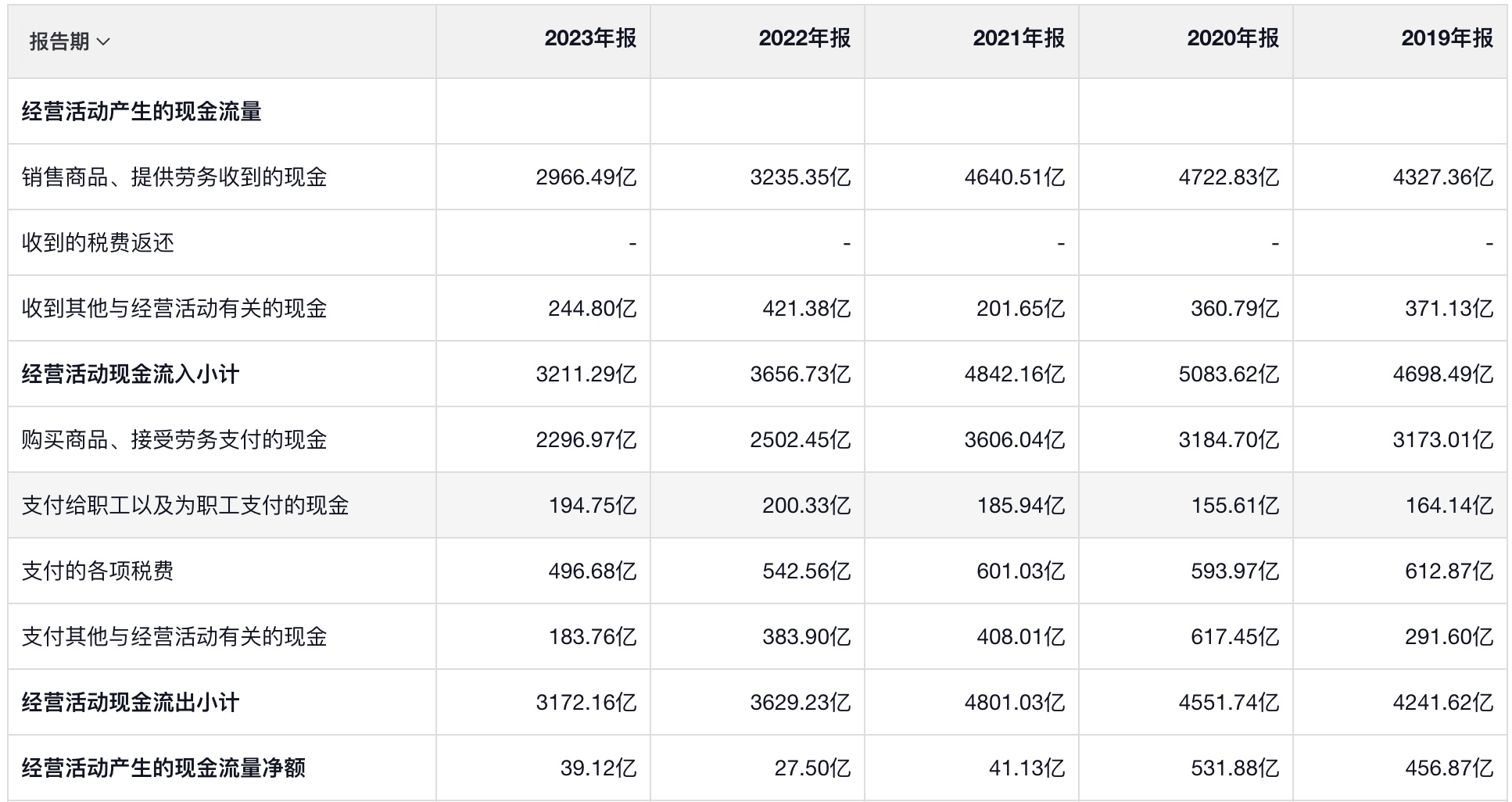
Even so, in 2021, the company's operating cash flow was still stretched thin.
Starting in 2021, Vanke's net operating cash flow plummeted from 53 billion yuan in 2020 to just 4.1 billion yuan—less than 10% of the previous year's figure. The following two years saw further declines.
Such cash flow levels may only suffice for day-to-day operations.
By the end of 2023, Vanke's accounts payable exceeded 200 billion yuan, with an additional 300 billion yuan in contract liabilities.
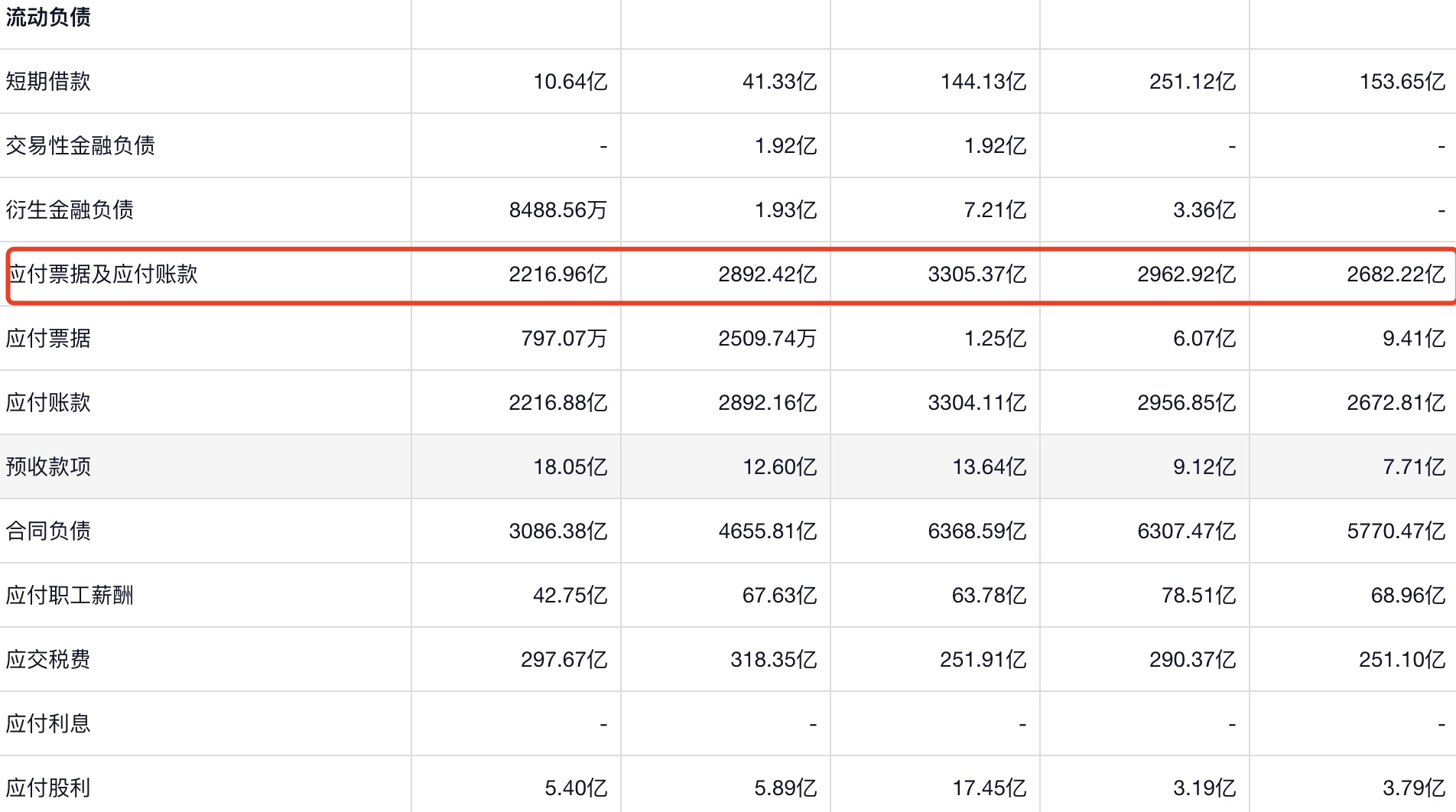
Of course, this is the result of Vanke's efforts to reduce inventory.
Real estate is a highly leveraged industry. Companies must maintain high turnover and quick returns to maximize the leverage effect.
However, after the "three red lines" policy, the era of reckless expansion came to an end.
China has no companies or industries that are "too big to fail." The country once facilitated reemployment for hundreds of millions and has now accepted the collapse of Evergrande.
But Vanke is different.
Vanke A's stock code is 000002, while 000001, formerly Shenzhen Development Bank, is now Ping An Bank.
As a benchmark in China's real estate industry, Vanke has long been seen as a model company. About a decade ago, Vanke ceased to be an aggressive real estate developer. It has also weathered multiple high-profile ownership battles, with the most recent "Baoneng-Vanke feud" becoming a classic case study in corporate takeovers.
Now, this very company faces a dual crisis in its stocks and bonds, along with a credit crunch.
Vanke's troubles could drag down the entire real estate sector. On April 10, 2024, Poly Real Estate's market cap fell below 100 billion yuan.
The real estate bomb will explode, but how the risks unfold and how to mitigate the impact on the closely linked financial sector requires careful consideration.
Recently, State Council leaders held discussions with economists. The official readout suggests that China's current economic situation is "sunny with clouds." But on whose head will those clouds rain?
No one can predict which cloud will bring the storm.
In recent days, several Hong Kong-listed companies have experienced flash crashes, indicating poor market liquidity and institutional sell-offs amid major shareholder pledges.
On the evening of April 10, the U.S. released its March CPI data, which exceeded market expectations across the board. The U.S. CPI rose 0.4% month-on-month (forecast: 0.3%, previous: 0.4%) and 3.5% year-on-year (forecast: 3.4%, previous: 3.2%).
The U.S. core CPI rose 3.8% year-on-year (forecast: 3.7%, previous: 3.8%) and 0.4% month-on-month (forecast: 0.3%, previous: 0.4%).
This data, combined with U.S. employment figures, suggests the Fed is unlikely to cut rates soon, meaning tighter monetary conditions ahead. For Chinese companies, this could add insult to injury.
For Vanke, it has finally entered its own long, harsh season.$CHINA VANKE(02202.HK)
The copyright of this article belongs to the original author/organization.
The views expressed herein are solely those of the author and do not reflect the stance of the platform. The content is intended for investment reference purposes only and shall not be considered as investment advice. Please contact us if you have any questions or suggestions regarding the content services provided by the platform.
