



Riding the wind and waves, TSMC's AI 'chip' opportunity

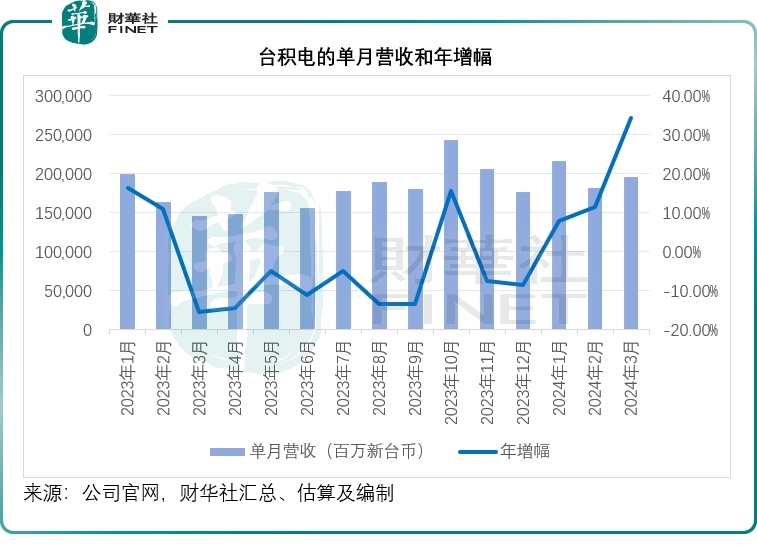
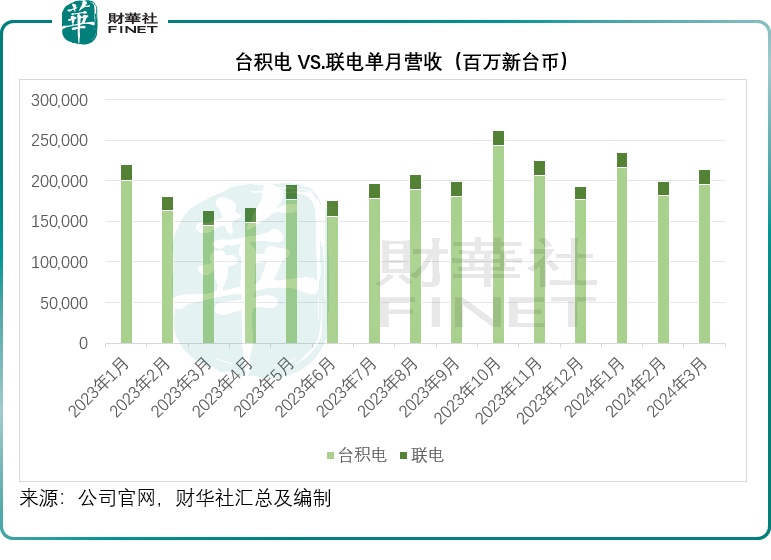
The world's largest wafer foundry $Taiwan Semiconductor(TSM.US) has just announced its March 2024 revenue data, with monthly revenue reaching NT$195.211 billion, approximately $6.055 billion USD, a year-on-year increase of 34.25%, soaring far above historical levels. See the chart below. In comparison, its much smaller local competitor UMC (UMC.US) reported monthly revenue of NT$18.167 billion, with only a 2.70% year-on-year growth.
Based on TSMC's disclosed monthly data, Caijing calculated that Q1 2024 revenue may reach NT$592.644 billion, approximately $18.383 billion USD, a year-on-year increase of 16.52%. In contrast, UMC's quarterly revenue was only NT$54.632 billion, with a 0.78% year-on-year growth.
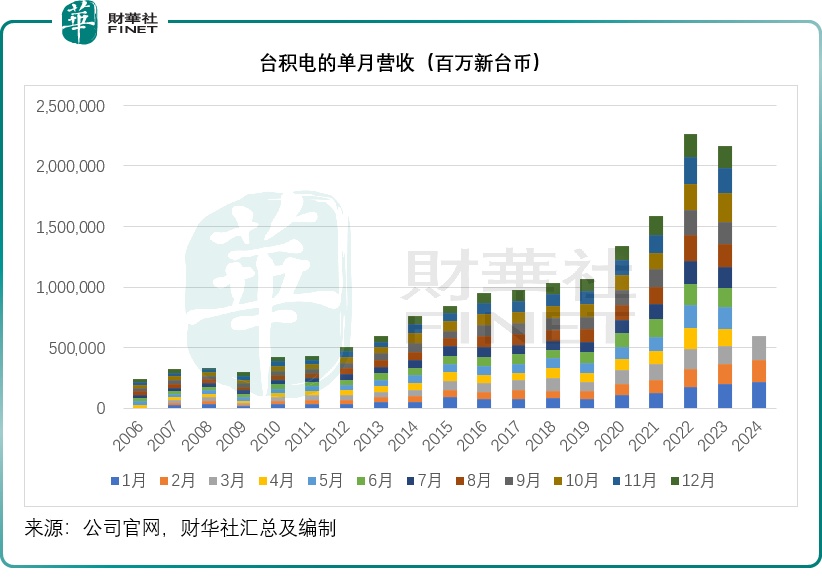
Generative AI experienced rapid development in 2023, sparking a global investment boom. As global tech giants rush to order NVIDIA's (NVDA.US) H100 AI chips, TSMC is quietly laughing all the way to the bank, as it is the primary foundry for NVIDIA's AI chips.
The H100 relies on TSMC's 5nm capacity, while NVIDIA's upgraded AI chips, the H200/B100, utilize TSMC's 4nm and 3nm processes, causing TSMC's capacity to be fully booked overnight. See the chart below—TSMC's revenue has surged significantly over the past two years.
The strong revenue growth is primarily driven by TSMC's advanced process capacity. As shown below, 5nm process revenue began to surge in 2022, and with the delivery of 3nm products starting in 2023, the contribution of 3nm processes has also climbed, accounting for 6% of total wafer revenue in 2023.
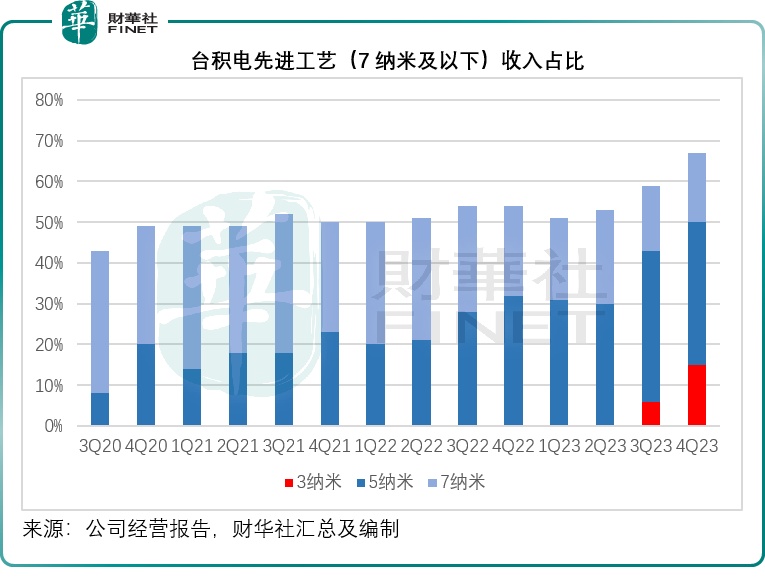
TSMC's management projected during the Q4 2023 earnings call that 3nm technology revenue would more than triple in 2024, accounting for approximately 15% of total wafer revenue.
Additionally, TSMC's 2nm process has garnered significant attention. Management revealed that the 2nm process will adopt a nanosheet transistor structure and is expected to become the industry's most advanced semiconductor technology in terms of density and energy efficiency upon its launch in 2025. According to the plan, 2nm products will enter mass production in 2025, with backside power rail versions launching in the second half of 2025 and entering production in 2026 to solidify its technological leadership.
Although Intel's (INTC.US) newly returned CEO, Pat Gelsinger, ambitiously aims to catch up with five nodes in four years and surpass TSMC, TSMC still holds an overwhelming advantage in terms of current technology and capacity. Intel recently launched its AI chip, Gaudi 3, to challenge NVIDIA's monopoly, using 5nm technology. For 5nm capacity, Intel may still need to rely on TSMC's foundry services.
Clearly, in the short term, TSMC remains irreplaceable in AI chip manufacturing.
TSMC's Capacity Expansion
Recently, TSMC signed a non-binding preliminary memorandum with the U.S. Department of Commerce, under which its Arizona subsidiary will receive up to $6.6 billion in direct subsidies.
Currently, TSMC's first Arizona fab is nearing completion and is expected to begin producing 4nm process technology in the first half of 2025. A second fab is under construction and slated to start production in 2028, focusing on 2nm process technology. TSMC also plans to build a third fab, bringing its total capital expenditure in Phoenix, Arizona, to over $65 billion. The third fab is expected to commence production by 2030, using 2nm or more advanced process technologies.
Additionally, TSMC is constructing a specialty fab in Japan, which will employ 12nm, 16nm, 22nm, and 28nm process technologies and is expected to begin mass production in Q4 2024. A specialty fab in Dresden, Germany, will start construction in Q4 2024, focusing on automotive and industrial applications. TSMC is also expanding its 3nm capacity in the Tainan Science Park and preparing for 2nm mass production in 2025, with plans to build multiple 2nm fabs in the Hsinchu and Kaohsiung Science Parks. Approval procedures for capacity expansion in the Taichung Science Park are also underway.
Clearly, to seize the opportunities presented by the booming generative AI sector, TSMC is going all out to expand its most advanced process capacity, striving to maintain its industry-leading position in the AI wave. However, this comes at a cost.
Q1 2024 Gross Margin May Contract
The primary cost for wafer foundries is depreciation, due to the massive upfront capital investments required for capacity construction and expansion, as well as product R&D. When the latest technology node capacity goes into production and generates revenue, these capitalized investments begin to appear in financial statements as depreciation and amortization, impacting profitability.
Despite the boost from mass-produced 3nm products, TSMC's 2023 gross margin fell by 5.2 percentage points year-on-year to 54.36%, while its operating margin dropped by 6.9 percentage points to 42.63%. See the chart below.
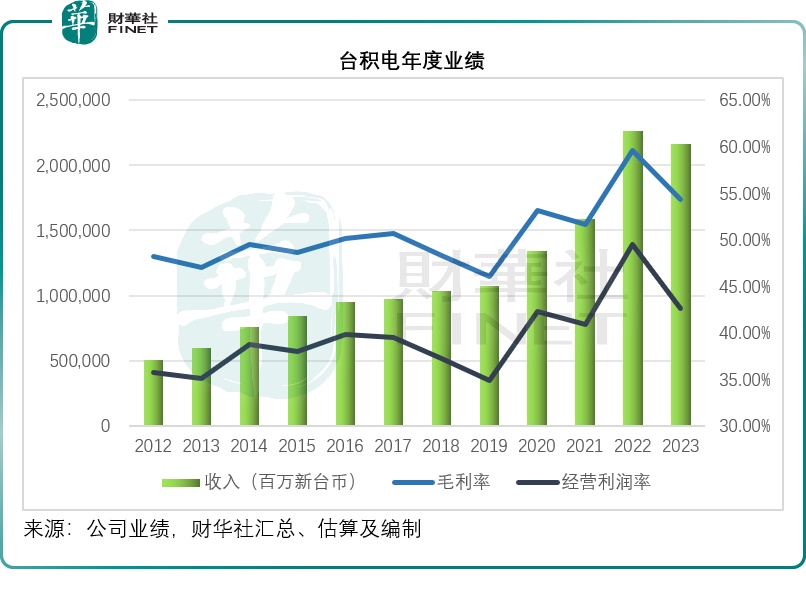
The reason is that the massive upfront R&D and capacity-building capital expenditures, as 3nm products began delivery in the second half of 2023, are being amortized over time. Depreciation and amortization are relatively fixed expenses, but in the early stages of production, new product output ramps up gradually, with initial deliveries relatively low. Lower revenue combined with higher depreciation and amortization expenses dragged down the gross margin of 3nm products initially. As 3nm products account for a larger share of total revenue, they also impact overall gross margin performance.
As a result, TSMC expects its Q1 2024 gross margin to range between 52% and 54%, significantly lower than the 56.3% in Q1 2023. The operating margin is projected to be between 40% and 42%, also below the previous year's 45.5%.
TSMC will announce its Q1 2024 earnings on Thursday, April 18, 2024. Caijing will closely track its latest performance trends—stay tuned.
Author: Mao Ting
The copyright of this article belongs to the original author/organization.
The views expressed herein are solely those of the author and do not reflect the stance of the platform. The content is intended for investment reference purposes only and shall not be considered as investment advice. Please contact us if you have any questions or suggestions regarding the content services provided by the platform.
