


【True Burning Finance】April 12 Market Morning Report: U.S. PPI weaker than expected; European Central Bank holds steady but sends strongest signal for June rate cut


"The U.S. Producer Price Index (PPI) in March recorded the largest year-on-year increase in 11 months, rising 2.1% compared to the same period last year, with a month-on-month increase of 0.2%. However, some categories within the inflation indicators favored by the Federal Reserve showed limited price increases."
Overnight Highlights
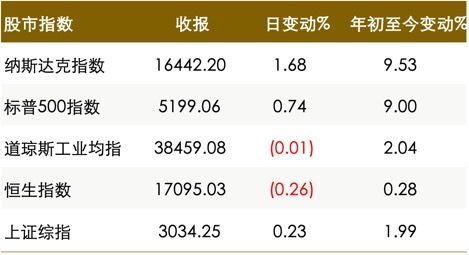
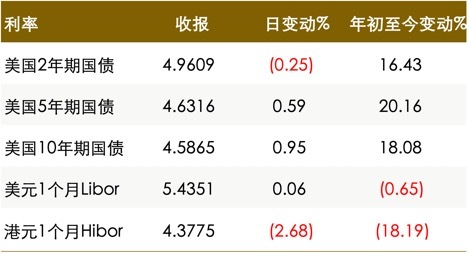
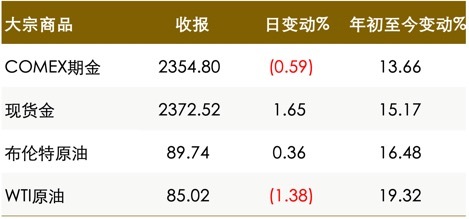
• U.S. PPI came in below expectations, suggesting that the core PCE increase might be more moderate. The S&P 500 index approached 5,200 points, driven by a rebound in large-cap tech stocks. Treasury bonds were generally calm, with short-term bonds outperforming. The 2-year Treasury yield retreated from briefly touching 5% during the session. The U.S. dollar index held steady. After the European Central Bank (ECB) sent strong signals about rate cuts, the euro underperformed other G-10 currencies. Gold prices hit another all-time high. An increase in U.S. crude oil inventories overshadowed concerns about potential attacks on Israel by Iran or its proxies. $Hang Seng Index(00HSI.HK)
International News
• The U.S. Producer Price Index (PPI) in March recorded the largest year-on-year increase in 11 months, rising 2.1% compared to the same period last year, with a month-on-month increase of 0.2%. However, some categories within the inflation indicators favored by the Federal Reserve showed limited price increases.
• The Federal Reserve's preferred inflation gauge is expected to be more moderate than the Consumer Price Index (CPI), which shook financial markets this week. Several analysts noted after the U.S. Labor Department released the PPI on Thursday that the core Personal Consumption Expenditures (PCE) price index, excluding food and energy, likely rose by 0.2% or 0.3% in March.
• New York Fed President John Williams stated that the central bank has made "tremendous progress" in achieving a better balance between inflation and employment goals but is in no rush to cut rates "in the very near term." He emphasized that current monetary policy is in a good place, and the labor market remains strong.
• International Monetary Fund (IMF) Managing Director Kristalina Georgieva said that inflation is easing faster than expected but has not yet been fully defeated. She urged central bank policymakers to carefully calibrate their rate-cut decisions based on the latest data. She noted that higher U.S. interest rates are not good news for the rest of the world and could become a concern if they persist for an extended period.
• Bank of America Global Research and Deutsche Bank expect the Federal Reserve to begin cutting rates in December, with only one rate cut this year. HSBC Holdings, however, still anticipates the Fed will start cutting rates in June, with a total reduction of 75 basis points this year.
• The European Central Bank (ECB) kept its deposit rate at a record high of 4%, in line with expectations. However, the Governing Committee, for the first time in its statement, hinted at the possibility of rate cuts, provided its economic forecasts show consumer price growth safely moving toward 2%. ECB President Christine Lagarde also reiterated signals about potential action in two months.
• Allianz Chief Economist Ludovic Subran warned that if the ECB's rate policy diverges too far from the U.S., it could face strong backlash from investors. ECB officials face a dilemma: they need to ease the restrictive monetary policy on the economy while avoiding being caught in the "U.S. financial vortex."
• Bloomberg: Apple, which is striving to boost computer sales, is preparing a comprehensive overhaul of its entire Mac product line. The next-generation products will be equipped with Apple's in-house chips designed to enhance AI capabilities. Apple released its first Mac with the M3 chip five months ago, and according to insiders, it is now close to mass-producing the next-generation M4 processor. $Apple(AAPL.US)
Greater China News
• Morgan Stanley raised its forecast for China's 2024 real GDP growth from 4.2% to 4.8%, citing stronger-than-expected export volumes and manufacturing capital expenditures.
• Bloomberg: After interbank 30-year government bonds posted their best quarterly performance in four years in Q1, rural credit cooperatives in at least four Chinese provinces reportedly warned local rural financial institutions about the risks of ultra-long-term interest rate bonds. Some even advised rural commercial banks to reduce their exposure to long-term interest rate bonds.
• According to a government statement, China's Minister of Industry and Information Technology, Jin Zhuanglong, emphasized the need to deepen the integration of AI and manufacturing, promote intelligent transformation across the entire manufacturing process, and accelerate smart upgrades in key industries.
• Fu Jinling, Director of the Economic Construction Department at China's Ministry of Finance, stated at a policy briefing that the government will guide financial institutions to increase loans for equipment upgrades and technological transformations in key sectors. This aims to stimulate endogenous momentum for industrial upgrades and drive economic transformation.
• Memory chip manufacturer Micron Technology stated that the earthquake in Taiwan on April 3 would impact its Taiwan-based DRAM supply by up to 5% in one calendar quarter. The company has four production bases in Taiwan. $Micron Tech(MU.US)
Commodities & Forex Markets
• The Organization of the Petroleum Exporting Countries (OPEC) stated in its monthly report that the oil market will need close monitoring in the coming months to ensure "a robust and sustainable market balance" as demand is expected to surge. OPEC maintained its optimistic outlook for global oil demand growth this year, projecting a year-on-year increase of up to 2.7 million barrels per day in Q3. Recent key data suggests oil consumption is hotter than expected, prompting market participants to warn that oil prices could hit $100 per barrel this summer.
• Japan's Vice Finance Minister for International Affairs, Masato Kanda, warned that authorities are considering all options for the forex market and are always prepared for any scenario. The yen initially fell after his remarks. Japan's Finance Minister Shunichi Suzuki later stated that officials are closely monitoring the forex market with a high sense of urgency, emphasizing the importance of stable movements aligned with fundamentals. Strategists at institutions like Bank of America increasingly view 155 yen per U.S. dollar as a new potential intervention line for Japanese policymakers.
Earnings & Economic Data Focus
• China March Trade Balance (USD) (Expected: 69.1B)
• UK February Three-Month GDP MoM (Expected: 0.10%, Previous: -0.10%)
• U.S. April One-Year Inflation Expectations (Expected: 2.90%, Previous: 2.90%)
• U.S. April UoM Consumer Sentiment Prelim (Expected: 79, Previous: 79.4)
Source: Goldhorse Capital Extramile
Author: Terry Chow
The copyright of this article belongs to the original author/organization.
The views expressed herein are solely those of the author and do not reflect the stance of the platform. The content is intended for investment reference purposes only and shall not be considered as investment advice. Please contact us if you have any questions or suggestions regarding the content services provided by the platform.
