


 Likes Received
 Posts
PostsZhou Hongyi's most profitable 'business' exposed!

The end of the internet is not just advertising, but also online lending.
As the "golden goose" of the internet industry, almost every major internet company has ventured into the online lending business. As the most profitable venture in the internet sector, it's an unspoken rule that companies don't openly promote it, often keeping the business under the radar.
Some even go as far as distancing themselves from their original brands.
This time, we use 360 (QIHU) to uncover this open secret behind internet companies.
In 2022, 360 reported a massive loss in its financial statements, marking its "first loss" since its backdoor listing on the A-share market. In 2023, 360's performance still didn't recover, despite embracing the concept of large-scale AI models and making it a primary focus.

The "desensitization" of the stock price stems from scrutiny over its performance.
A review of the financial reports shows that since 2019, 360's performance has been in a continuous decline. In the capital markets, the endless drop in stock price is the best reflection of this.
After embracing large-scale AI models, 360's stock price surged threefold in the short term. Shortly after, Zhou Hongyi (founder of 360) divorced his wife Hu Huan, sparking widespread discussion and even coining a new term—"technical divorce."
For a long time, although Zhou Hongyi has championed internet security, 360's core revenue has always come from internet advertising. Beyond advertising, its other lucrative business is online lending, despite efforts to "hide" this lending company and even rename it twice.
As the most profitable venture, Zhou Hongyi can't put it on the "table," but his public image must be saturated with AI.
Facing market changes and the declining share of PC-based ads in the internet advertising market, 360's core business hasn't "rushed" to transform. However, in terms of PR, Zhou Hongyi has pivoted to large-scale AI models.
On March 20, 360 released the 360 Security Large Model 3.0. Pan Jianfeng, Chief Scientist of 360 Group and CTO of 360 Digital Security Group, claimed that this product outperforms GPT-4 in multiple specialized tasks.
Surpassing GPT-4 has become an obsession for many companies. However, in terms of execution, Wang Xiaochuan, founder of Sogou, once said, "We are at least two years behind GPT."
Currently, many companies' large models aren't profitable or won't become a primary revenue driver. In fact, 360's financial reports show that its core profits have never come from its advertised security or AI models.
In our view, Zhou Hongyi has two disguises: security and AI. But his most profitable businesses remain internet advertising and online lending.
The Most "Profitable" Business
Despite the continuous decline in internet ad revenue, Zhou Hongyi's money-making machine hasn't stopped.
Financial reports show that as of the end of 2022, 49.47% of 360's revenue still came from internet advertising and services. However, due to the decline in ad revenue, the company's overall income has been on a downward trend since peaking in 2018.
As one of the earliest players in the internet space, Zhou Hongyi understood the limitations of internet ads. Before the backdoor listing, he had already planned his next move. Online lending became the company's "cash cow," and he played the Qifu Technology (QFIN) card early on.
Public records show that Qifu Tech was formerly known as 360 Finance. After two name changes, it gradually shed its "finance" and "360" branding.
Zhou Hongyi holds a 12.23% stake in Qifu Tech. Compared to his other ventures, Qifu Tech (online lending) is an incredibly strong profit generator.
In mid-March 2024, Qifu Tech released its full-year 2023 results. The report showed that Qifu Tech generated revenue of 16.29 billion yuan, down 1.59% year-on-year, but net profit rose 6.96% to 4.285 billion yuan, with a net profit margin of 26.2%, up 2 percentage points from 2022.

In terms of revenue scale, Qifu Tech has far surpassed 360. In terms of profitability, it has taken over as Zhou Hongyi's most lucrative tool.
The report also revealed that in 2023, Qifu Tech partnered with 157 financial institutions, facilitating loans for 30.4 million borrowers. Its total loan facilitation volume reached 475.8 billion yuan, up 15.37% year-on-year, with outstanding loans at 186.5 billion yuan, up 14.07%. The repeat borrowing rate exceeded 90%, hitting 91.6%. Notably, Qifu Tech's user base grew significantly—by the end of December 2023, potential borrowers reached 235 million, up 12.8% year-on-year.
Behind Zhou Hongyi's wealth machine lies a vast network of financial institutions and borrowers.
It's worth noting that online lending isn't just about scale—it also comes with exorbitant interest rates. So how high are Qifu Tech's rates? Data shows its maximum annual interest rate can reach 23.735%. From October to December 2023, the average IRR for loans facilitated by Qifu Tech was 21.3%.
It should be noted that "pushing the legal limit" isn't unique to Qifu Tech. According to incomplete statistics, platforms like JD Finance, Du Xiaoman, and Ctrip Finance also offer rates as high as 23% APR. Compared to traditional bank loans at around 4%, these online lending rates, though under 24%, are still shockingly high.
Statistics show that over the past three years, Qifu Tech has earned Zhou Hongyi and his partners 14 billion yuan.
Behind the "Tech" Facade
On April 8, Zhou Hongyi hosted his second free livestream lecture, titled "How Businesses Can Embrace AI." His previous lecture was "Predicting AGI."
In effect, these weren't just free lectures but AI evangelism. Through AI, Zhou Hongyi has successfully tied himself, 360, and AI together.
As the founder of 360, from security to AI, every time he steps into the spotlight, it's for the trendiest concept—even if these concepts haven't fundamentally transformed 360.
Rewind to 360's backdoor listing.
When asked why he returned to the A-share market, Zhou Hongyi once said, "For national cybersecurity needs and to resolve 360's identity crisis."
Months after the listing, 360 formed strategic partnerships with EosLaoMao, OracleChain, digital wallet Dbank, and Binance, covering crypto exchanges, nodes, and wallet services.
Blockchain became 360's first post-listing battleground.
Later, these platforms faced severe crackdowns by regulators, and 360 quietly distanced itself from blockchain.
In 2019, 360 split from Qi An Xin, marking one of its toughest periods. To find a new narrative, "enterprise security" became a buzzword in Zhou Hongyi's speeches.
The plunging stock price shattered all narratives, and market valuations left Zhou Hongyi restless. In 2021, as the EV boom swept the globe, 360 announced a 2.9 billion yuan investment in Neta Auto, becoming its second-largest shareholder with a 16.594% stake.
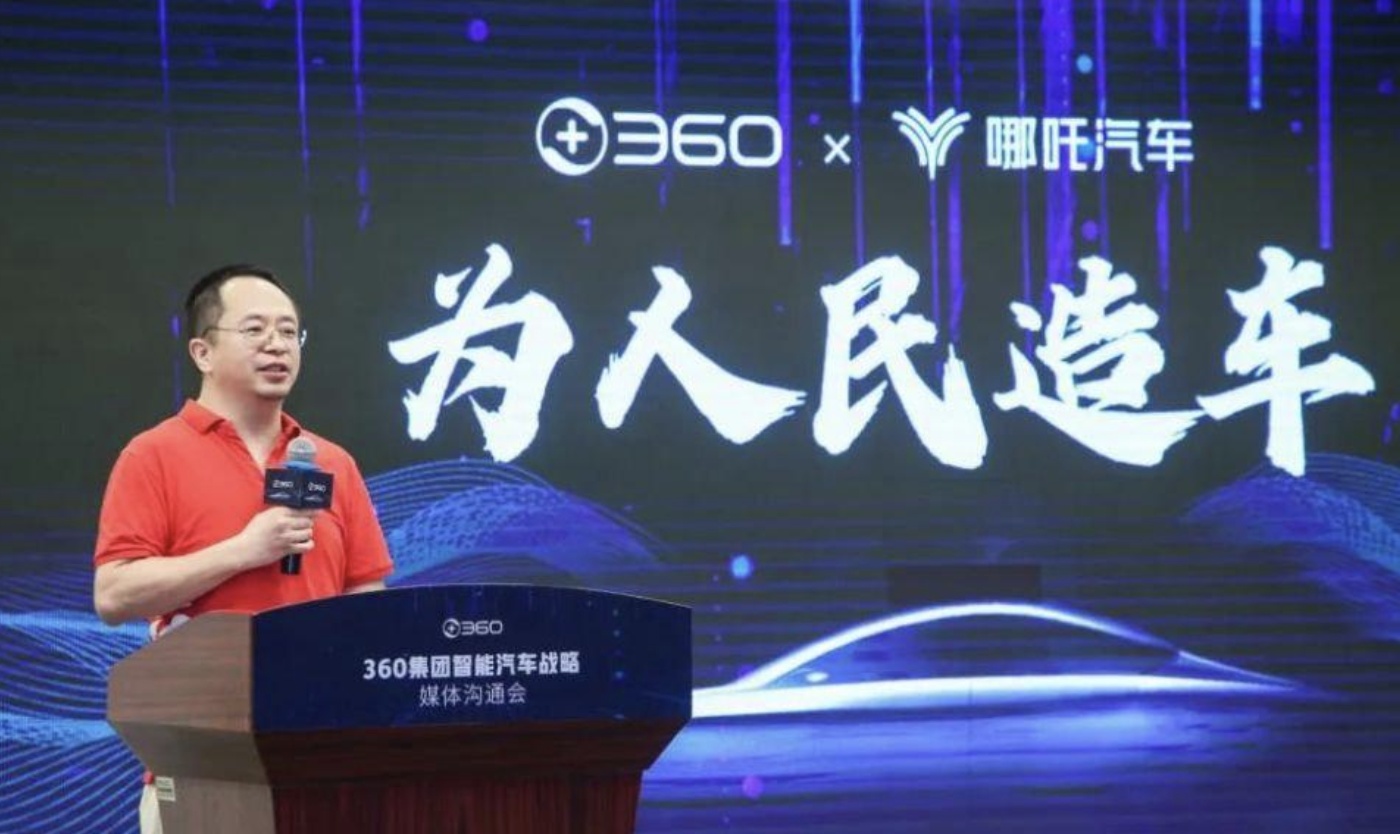
Entering the EV space was supposed to boost the stock, but the market wasn't convinced.
Facing skepticism, Zhou Hongyi once quipped, "A security guy making money from ads seems unprofessional, so I joke that my earnings are 'vulgar,' but how I use them isn't. Over 10 billion yuan in annual revenue mostly goes back into security."
On January 26, 2022, Zhou Hongyi sent a company-wide letter announcing 360's full transition into a digital security firm.
But none of this became its core business—it was more like a "camouflage."
In 2023, as GPT took off, most internet companies pivoted to large models, and Zhou Hongyi was no exception. Through speeches and lectures, he positioned himself as an AI evangelist.
Riding the AI wave, 360's stock finally staged a comeback, soaring from 6 yuan to over 20 yuan. Then Zhou dropped a bombshell—announcing his divorce, which sparked intense market debate.
Now, as the AI hype fades, 360's stock has retreated. But as its "camouflage," AI remains Zhou Hongyi's go-to PR tool.
Tech trends change every year, and 360's self-branded concepts shift with them. But beneath Zhou Hongyi and his empire, his most profitable businesses remain unchanged: internet advertising and online lending.
The copyright of this article belongs to the original author/organization.
The views expressed herein are solely those of the author and do not reflect the stance of the platform. The content is intended for investment reference purposes only and shall not be considered as investment advice. Please contact us if you have any questions or suggestions regarding the content services provided by the platform.
