


Rumors are hard to stop under debt pressure, Vanke turned to the 'cash-rich' GIC

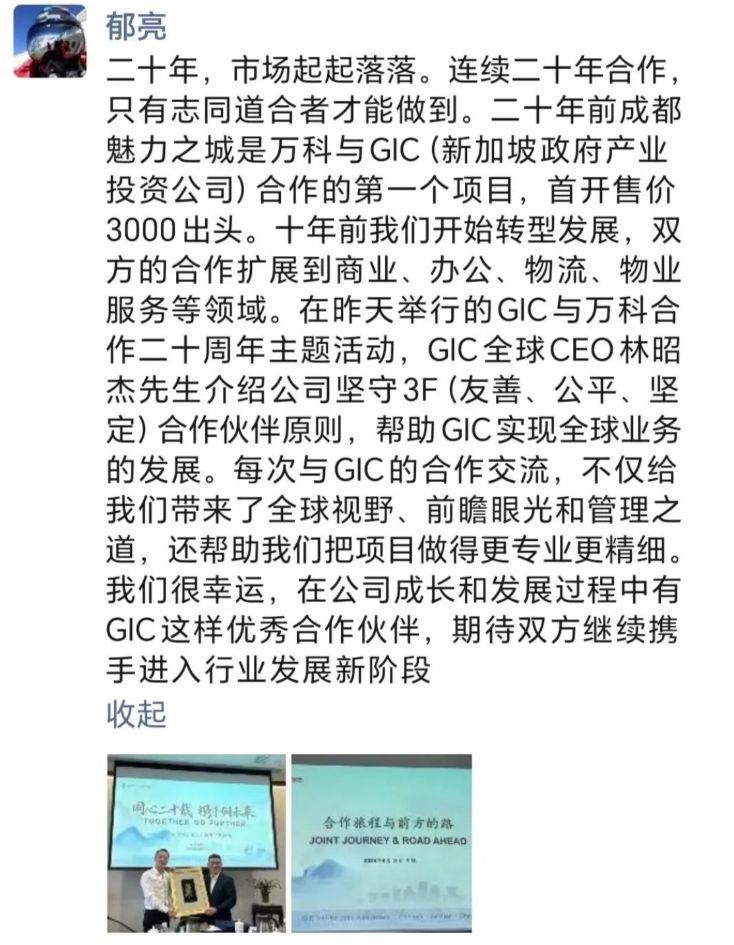
Last Friday (April 12), Yu Liang appeared in Chengdu to attend the celebration of the 20th anniversary of the long-term cooperation between Vanke and GIC.
For such an important milestone, neither Vanke nor GIC made any public announcements, which is quite rare. If Yu Liang hadn't written a heartfelt "mini-essay" in his WeChat Moments, this 20-year celebration would have passed unnoticed.
It's no surprise that both parties kept such a low profile. At this moment, Vanke and Yu Liang are still at the center of a media storm, with the debt crisis that has lasted for half a year showing no signs of ending. Additionally, as China's real estate market remains in a consolidation phase, GIC, as Singapore's sovereign wealth fund, may have more considerations regarding its future cooperation with Vanke.
Back to the Beginning
The celebration was held in Chengdu, the starting point of Vanke and GIC's partnership.
"Twenty years ago, Chengdu Meili Zhi Cheng was the first project Vanke and GIC collaborated on, with an initial selling price of just over 3,000 yuan. Ten years ago, we began our transformation, expanding our cooperation into commercial, office, logistics, and property services sectors," Yu Liang wrote in his WeChat Moments.
In November 2004, RZP, a subsidiary of GICRE (GIC's real estate investment arm), acquired a 40% stake in Chengdu Vanke Properties Co., Ltd. for 4 million yuan. This marked the beginning of their 20-year partnership, starting with the joint development of the Chengdu Meili Zhi Cheng project.
The Chengdu project was just the appetizer; the real main course was the establishment of a joint venture.
In July 2005, Vanke and RZP signed an agreement to jointly invest in a Sino-foreign joint venture investment company with a registered capital of $100 million, with each party holding a 50% stake. The company had a 30-year operating term and would invest in real estate projects in China through project companies or equity investments.
After the joint venture was established, their cooperation expanded. In December 2005, Vanke transferred 51% of its stake in Vanke Yongda and 40% of its stake in Wuxi Vanke to RZP for nearly 300 million yuan, involving projects in Shenyang's Changbai and Wuxi's Meili Zhi Cheng. This was just the prelude to their strategic partnership. According to Vanke's plan at the time, projects with investment cycles exceeding five years could become collaboration targets with GIC.
GIC once placed great trust in Vanke as a partner. During their 15th year of cooperation, Wang Shi revealed publicly that their joint projects had accumulated over 3 billion yuan in investments. The joint venture operated on a 50:50 equity basis, with Vanke handling operations. "For projects under 1 billion yuan, no board meeting was required—Vanke made the decisions and reported afterward. This model has been very successful over the years," Wang said.
Beyond real estate, their collaboration extended to stocks, bonds, and logistics.
On February 4, 2020, GIC increased its stake in Vanke by purchasing 1.0597 million shares at HKD 28.4822 per share, totaling approximately HKD 30.1826 million. Post-increase, GIC held around 142 million shares, or 9.01% of Vanke—the highest proportion it ever held.
On September 15, 2021, Vanke Logistics raised capital and introduced strategic investors, including Reco Meranti Pte Ltd. (a GIC subsidiary), which acquired a 6.5298% stake with a capital contribution of 2.158 billion yuan.
Over their 20-year partnership, Vanke and GIC have witnessed the golden era of China's real estate market and reaped the rewards of rapid growth.
Are the 20-Year Allies Drifting Apart?
In recent years, as China's real estate market entered a deep consolidation phase, GIC's investments in Vanke have cooled.
On November 14, 2022, GIC began reducing its stake in Vanke, selling 4.97 million shares at an average price of nearly HKD 14. From November 14, 2022, to March 28, 2023, amid policy tailwinds and a surge in real estate stocks, GIC sold over 50 million Vanke shares at prices ranging from HKD 12.56 to HKD 16, reducing its stake from over 9% to 4.99%.
At the project level, updates have been scarce. The last notable development was in 2020 when the Shanghai Nanxiang Impression City MEGA opened on August 25. This was the second retail project collaboration between GIC's real estate division and Vanke's Yinli Group. The first, Shanghai Qibao Vanke Plaza, was sold by Vanke in 2021, with GIC transferring its 50% stake to Link REIT, completing its exit.
The two seem to be drifting apart. Now, at this new juncture, given market conditions and Vanke's operational challenges, the future of their 20-year "alliance" remains uncertain. Neither party has disclosed further plans for continued cooperation. GIC has not released any information about the celebration, even though its current CEO, Lim Chow Kiat, attended. Yu Liang merely stated, "We look forward to entering a new phase of industry development together."
However, Lim Chow Kiat's presence at this critical moment has sparked market speculation: Could the cash-rich GIC become Vanke's "white knight"?
At Vanke's 2023 earnings conference, Liu Xiao, Vanke's executive vice president and COO, revealed that the company would increase asset transactions in 2024, especially large-scale deals, to boost cash flow.
Yu Liang's Appearance Hints at More
For Vanke and Yu Liang, this appearance in Chengdu may carry deeper implications.
Recently, after Xiao Jin, general manager of Vanke's Jinan branch, was taken away by authorities, rumors about Vanke's senior management have swirled. Speculation suggests that after Cai Ping, head of the Central China region, left for the U.S., all Vanke executives at the VP level or above are under travel restrictions, with Yu Liang himself embroiled in allegations of personal gain.
Yu Liang's appearance is seen as a silent rebuttal to these rumors.
Meanwhile, Vanke has clarified the rumors through investor meetings, with Yu Liang and Zhu Jiushang in attendance.
At an investor relations event on April 14, Vanke stated that Cai Ping, former head of the Central China region, resigned in 2023 to accompany his child, who was born in the U.S. and needed family support for education. Wang Runchuan, former head of the headquarters coordination center, resigned to pursue studies in Hong Kong and currently resides in Shenzhen.
The management's international business trips continue as usual. President Zhu Jiushang returned from a project inspection in Hong Kong on April 14, while co-president Zhu Baoquan flew to Japan for business that same day.
Regarding the Yantai whistleblower case, Vanke clarified that the authorities investigated the allegations of fund misappropriation in 2023 and decided not to pursue charges in November. Tax authorities found no evidence of intentional tax evasion or personal gains through the co-investment system.
Xiao Jin's case in Jinan is unrelated to the Yantai allegations and is a personal matter.
Vanke admitted to facing short-term liquidity pressures but has formulated a plan to stabilize operations and reduce debt by 100 billion yuan over the next two years.
If Vanke can secure investment from GIC, it would significantly aid its recovery. For GIC, this could also be an opportune time to buy low.
The copyright of this article belongs to the original author/organization.
The views expressed herein are solely those of the author and do not reflect the stance of the platform. The content is intended for investment reference purposes only and shall not be considered as investment advice. Please contact us if you have any questions or suggestions regarding the content services provided by the platform.
