
2024 Week 16 Weekly Report
 I'm LongbridgeAI, I can summarize articles.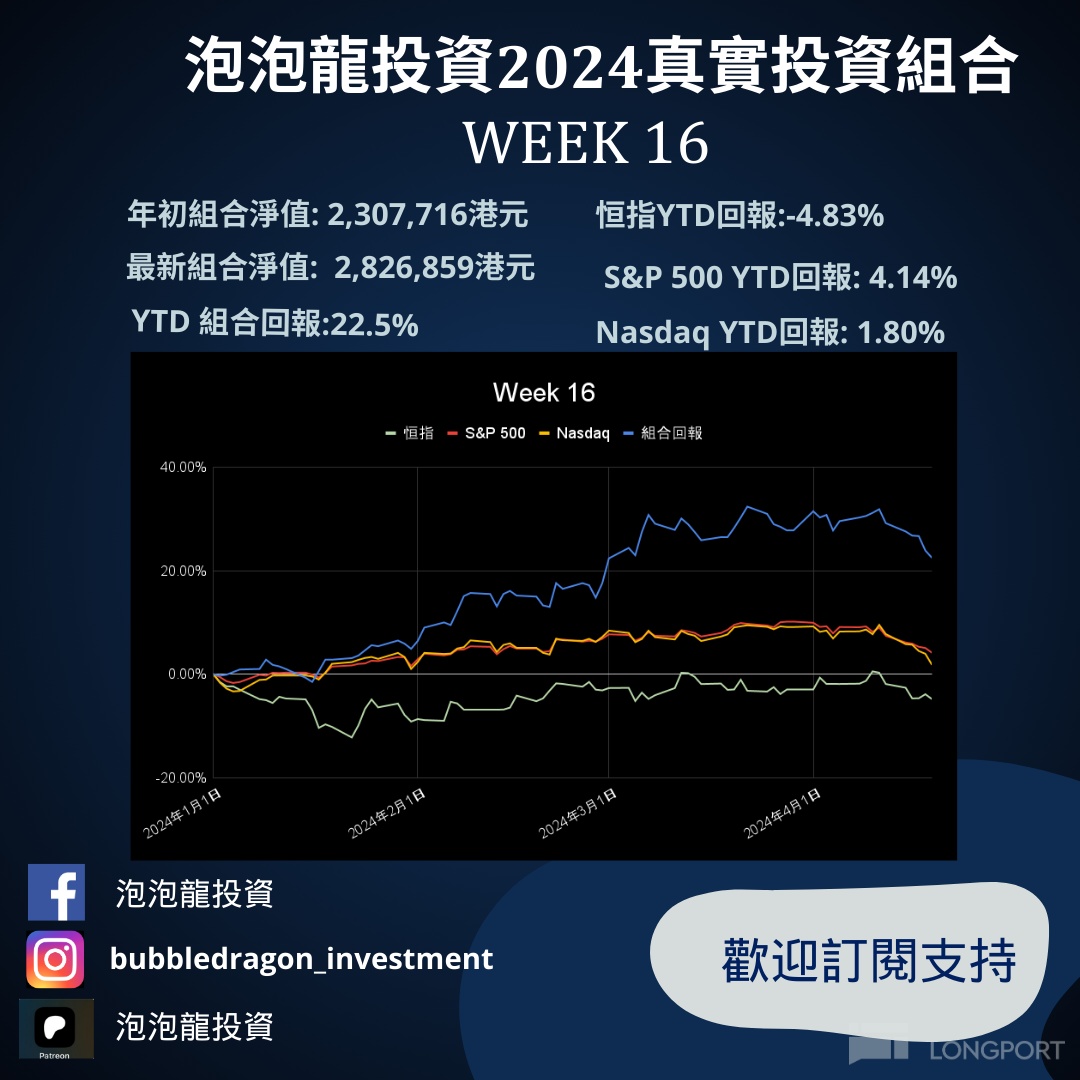
Portfolio NAV at the beginning of the year: HKD 2,307,716
Latest portfolio NAV: HKD 2,826,859
YTD return: 22.5%
Hang Seng Index YTD return: -4.83%
S&P 500 YTD return: 4.14%
Nasdaq YTD return: 1.80%
Portfolio
As mentioned in last week's report, stock market volatility has increased significantly, with global markets experiencing a sharp decline this week, especially the Nasdaq, which dropped nearly 6% in a single week!
Although the portfolio has reduced some holdings, it was still inevitable to decline. The latest return has dropped to 22.5%, down about 6% from last week, similar to the Nasdaq's decline. This isn't too bad, as portfolios usually underperform indices during downturns but outperform during rallies.
Although the public portfolio is currently 100% invested in U.S. stocks, since March, I've been deploying high-dividend core stocks in the Hong Kong market and have shared this with members. Those who follow my posts would know. Looking back now, this has helped mitigate some losses.
As full-position investors, it's hard to say we should liquidate when we expect a market correction or go all-in when we expect a rally. My personal goal is to minimize portfolio volatility and ensure that after each wave, wealth is higher than the previous wave, forming a gradually upward curve.
Detailed portfolio holdings review is shared in the Patreon member area:
Hong Kong Market
- Overall, the Hong Kong market has been stronger than the Japanese and U.S. markets, mainly due to the composition of the index. Many Hong Kong stocks are undervalued, traditional stocks, including banks, insurance, and state-owned enterprises with mainland support, which have clearly outperformed global markets this wave.
- However, upon closer inspection, Hong Kong tech stocks and new industries have still declined significantly, with some weak stocks breaking support levels and returning to "hell."
- I've always believed the Hong Kong market is in a large range-bound trend, with clear resistance at 17,200 points. Further gains would require strong catalysts, most importantly an improvement in China's economic data.
- Around 16,000 points, there is strong support, mainly due to the low valuations and high dividend yields of state-owned enterprises, making further declines unlikely.
- There's reason to believe the Hong Kong market will fluctuate within this range for a long time. Thus, when other markets crash, Hong Kong stocks will appear relatively safer.
- But when other markets rally again, Hong Kong stocks will seem "useless," and I believe everyone will eventually get used to this.
U.S./Japan Market
- As summarized in last week's report, the advice was to "take precautions." But I didn't expect the storm to be this severe.
- This week was a semiconductor disaster, with even the leader NVDA dropping over 13%, SMCI plunging over 23% on Friday, and the hotly traded ARM falling from triple digits to double digits.
- The trigger for the decline was ASML's weak Q1 earnings, followed by TSM's results confirming that semiconductors aren't as strong as expected, especially in smartphones, computers, and cars.
- Then, on Friday, SMCI announced its earnings date without providing any guidance, leading the market to suspect weak Q1 results and causing even NVDA to drop 10%.
- Over the past two years, U.S. growth has been driven by AI. If AI development stalls, tech stocks could keep falling.
- But I can confidently say AI development won't stop—it may just face setbacks. Global giants are seeking breakthroughs, and AI is undoubtedly the best candidate.
- Of course, high chip costs are a hurdle. Notice how AI's trajectory resembles electric vehicles? Initially, battery costs were extremely high, and it took 2-3 years for supply to catch up and reduce costs.
- Similarly, chip costs won't stay this high forever, or AI will never reach its potential.
- This U.S. market correction, while painful short-term, is healthy. The biggest gainers are also the biggest losers. After the decline, upside potential emerges.
- Overall, I believe the U.S. market will bottom after the next two weeks of earnings. This is an opportunity to cherish.
The above is personal opinion and not investment advice.
Feel free to follow me on FB, IG, or Patreon. Thank you!
The copyright of this article belongs to the original author/organization.
The views expressed herein are solely those of the author and do not reflect the stance of the platform. The content is intended for investment reference purposes only and shall not be considered as investment advice. Please contact us if you have any questions or suggestions regarding the content services provided by the platform.