



Semiconductor demand decline drags down performance, what are the characteristics of ASML's 'transition year' results?

On April 17, global lithography giant ASML (ASML.O) released its financial report for the first quarter of 2024. The data showed that ASML's revenue for the quarter was 5.3 billion euros, a year-on-year decrease of 21.6%; net profit was 1.22 billion euros, a year-on-year decline of 37.8%.
ASML's first-quarter performance significantly underperformed market expectations, with new order value dropping 60% compared to the fourth quarter of 2024. As a result, ASML's stock price fell 7% on the 17th. What caused ASML's sharp decline in performance? How has U.S. pressure impacted ASML's sales in China? What is the current demand in the semiconductor industry? Below is a brief analysis of ASML's first-quarter financial report.
01
Revenue and Net Profit Growth Both Decline, ASML Faces a "Transition Year"
ASML is the global leader in lithography equipment, with its products primarily used in the lithography stage of chip production. It holds the majority of the global lithography market share and is the only company capable of mass-producing EUV lithography machines. Therefore, the pace of its technological advancements directly impacts the progress of global chip manufacturing, and its performance reflects the demand in the semiconductor industry to some extent.
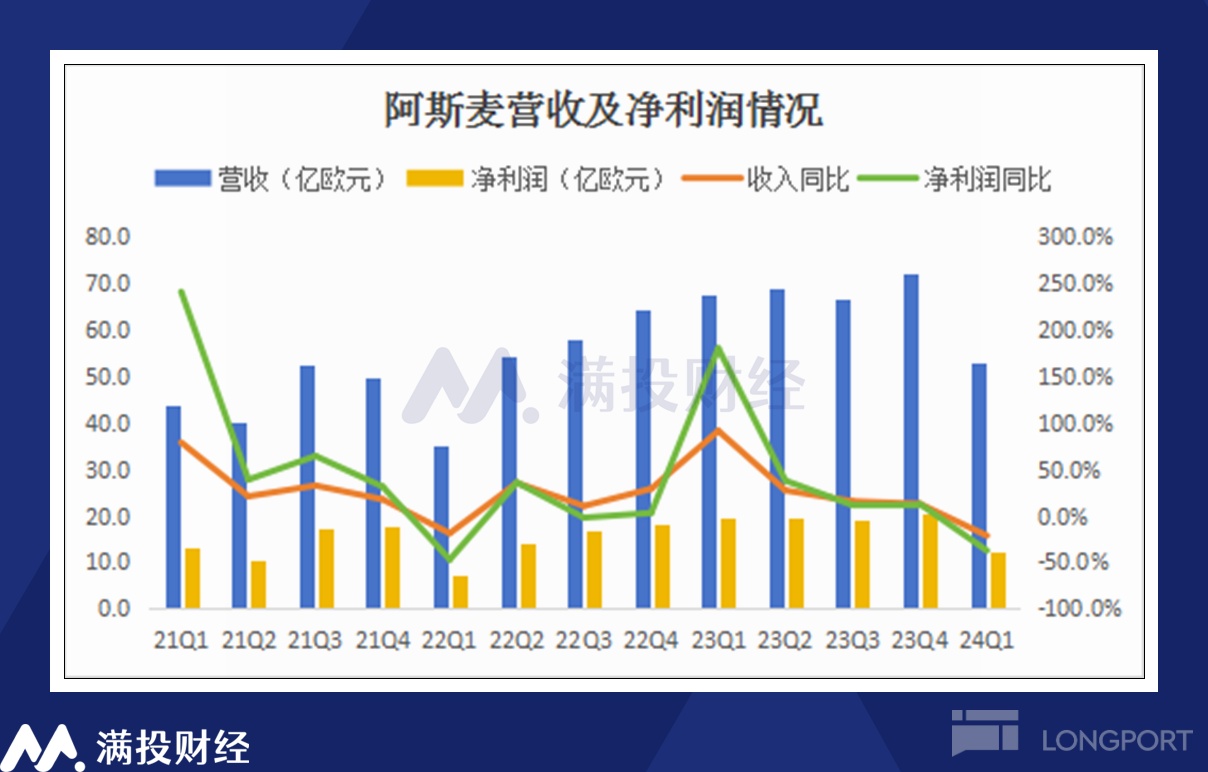
The financial report shows that ASML's first-quarter revenue was 5.3 billion euros, down 21.6% year-on-year and 26.9% quarter-on-quarter, marking the worst quarterly performance since Q1 2022. ASML's poor performance is largely due to the semiconductor industry's ongoing downturn, with demand still in recovery.
ASML stated that while inventory levels in end markets have improved significantly and this trend is expected to continue, they have not yet returned to normal levels. As a result, the company has labeled 2024 as a "transition year," providing a relatively weak Q1 guidance of 5 billion to 5.5 billion euros. ASML's first-quarter revenue fell at the midpoint of this guidance.
(Source: Wind)
The decline in revenue directly impacted net profit, with ASML reporting a net profit of 1.22 billion euros in Q1, down 37.8% year-on-year. Gross margin remained stable at 51.0%, compared to 50.6% in the same period last year.
In terms of expenses, R&D was ASML's largest cost item, totaling 1.032 billion euros in Q1 2024, up 8.9% year-on-year, with an R&D expense ratio of 19.6%. Due to the revenue decline, the R&D expense ratio increased significantly from 14.0% in the same period last year, further affecting net profit.
02
Decline in EUV Shipments, Rising Importance of the Chinese Market
ASML's lithography machines are categorized by application into EUV (extreme ultraviolet) and DUV (deep ultraviolet). EUV is the world's most advanced lithography machine, capable of supporting up to 3nm process nodes, and only ASML can produce it. DUV is further divided into ArFi, ArFdry, KrF, and I-Line models, supporting different chip manufacturing processes. The 28nm node marks the boundary between advanced and mature processes, with ASML's EUV and DUV ArFi machines enabling sub-7nm processes, which are also ASML's primary revenue sources.
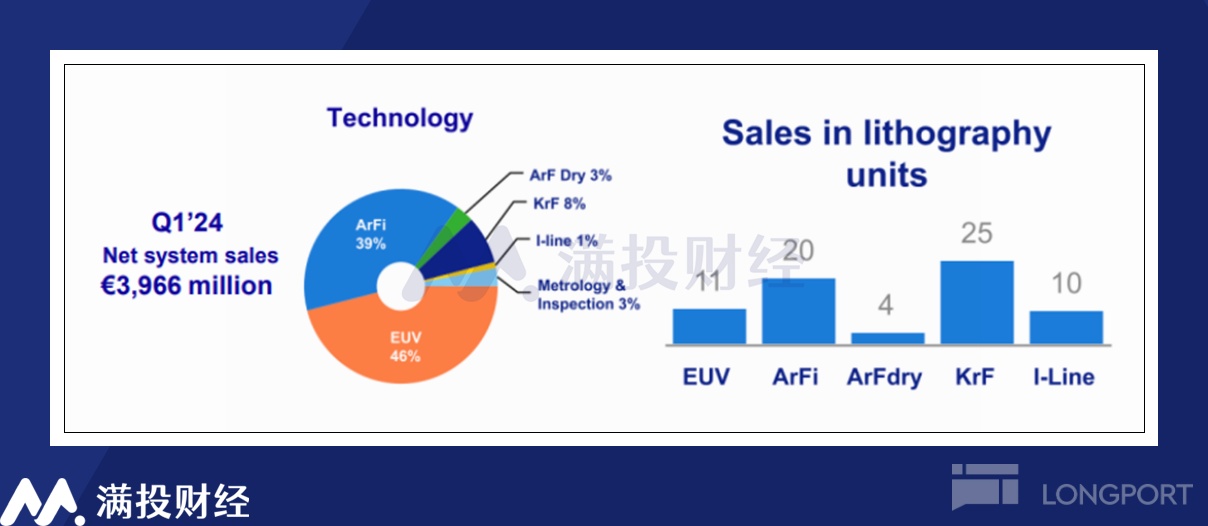
According to the report, EUV and ArFi accounted for 46% and 39% of ASML's Q1 revenue, respectively. In terms of shipments, EUV, ArFi, ArFdry, KrF, and I-Line units shipped were 11, 20, 4, 25, and 10, respectively. Compared to Q1 2023, EUV shipments decreased by 6 units, contributing to the revenue decline.
(Source: Company Report)
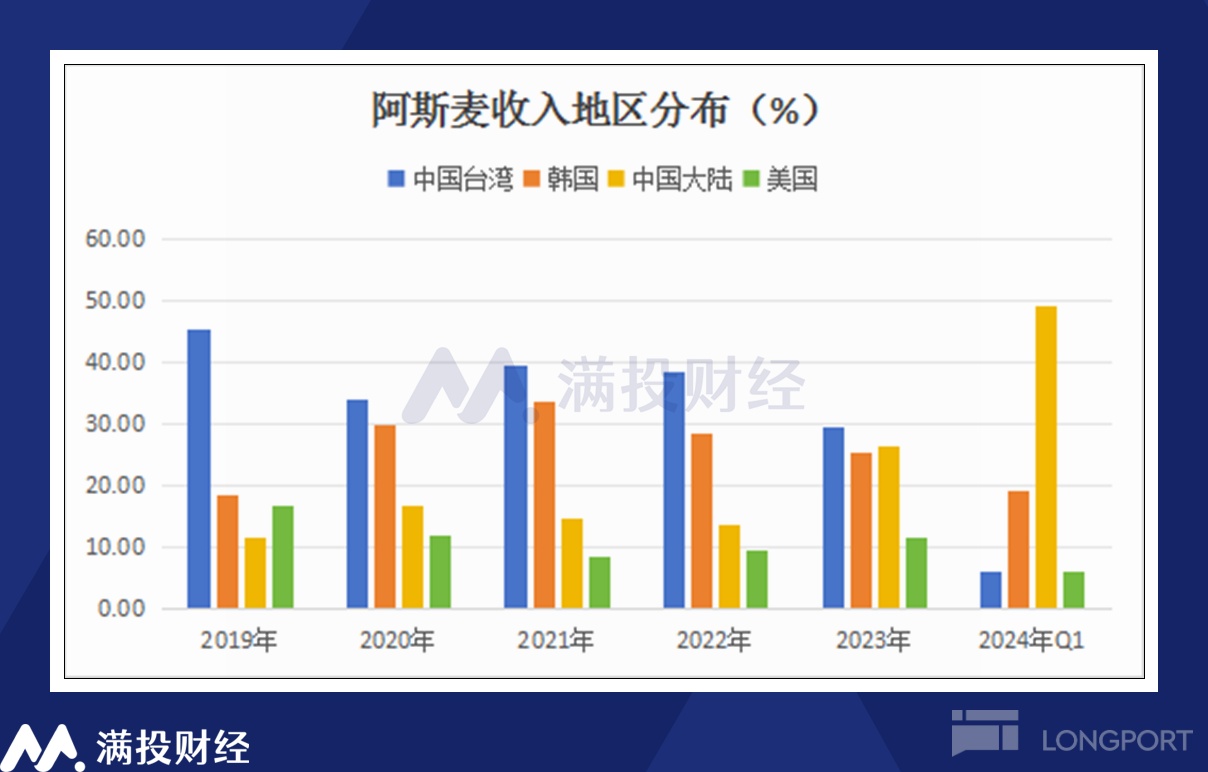
Geographically, due to demand from chip manufacturing giants like TSMC, Samsung, and Intel, Taiwan (China), South Korea, the U.S., and mainland China are key markets for ASML. However, ASML's regional revenue structure has shifted significantly in recent quarters.
Before 2024, Taiwan (China) was ASML's largest market, accounting for as much as 45% of revenue in 2019, but this share has declined sharply, dropping to just 6% in Q1 2024. South Korea, historically the second-largest market, also saw its share shrink to 19% in Q1 2024. In contrast, mainland China's share has surged in recent years, reaching 49% in Q1 2024 and becoming ASML's largest market for three consecutive quarters.
Due to U.S. export controls on China's semiconductor industry, ASML cannot sell EUV machines to China, meaning most shipments to China are for mature processes with lower added value. The growing share of China's sales has somewhat impacted ASML's overall revenue.
Regarding the rapid growth in China, ASML previously noted that due to high demand in recent years, the fulfillment rate for Chinese orders was below 50%. However, as demand from customers in Taiwan (China), South Korea, and the U.S. declined, ASML was able to allocate more capacity to Chinese orders, driving the surge in mainland China sales.
(Source: Wind)
03
2025 Expected to Be a Year of Strong Growth
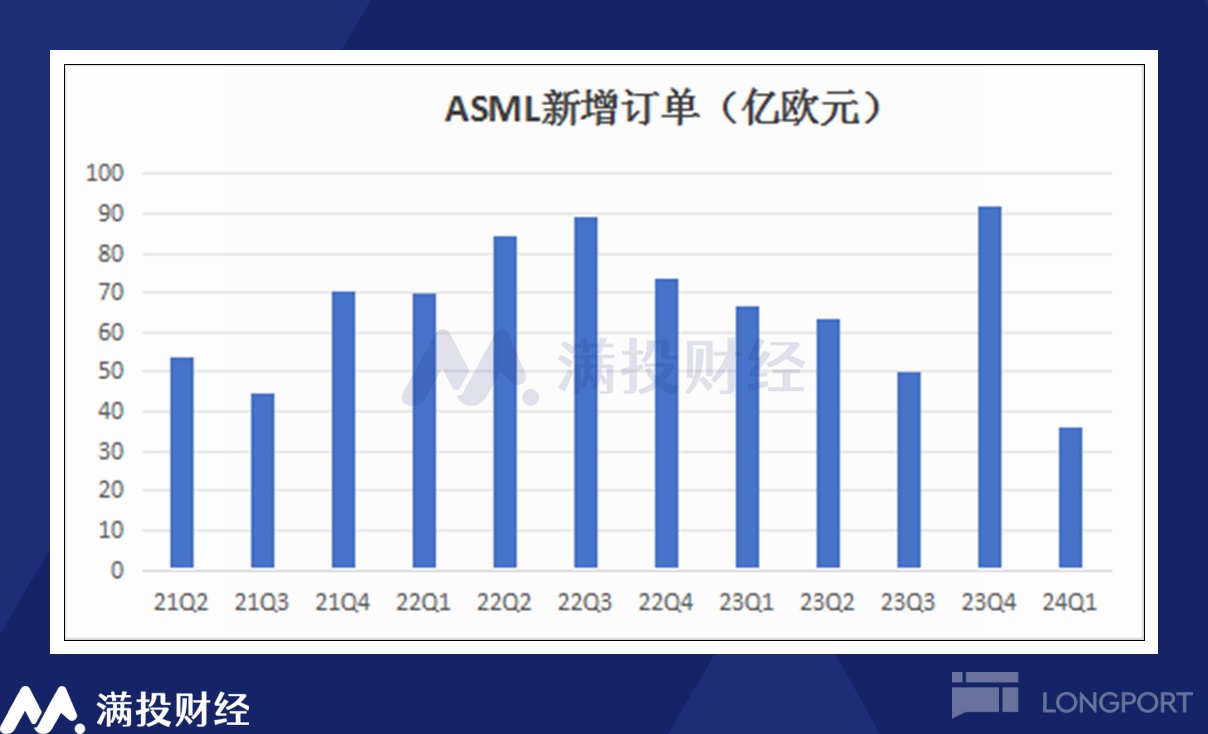
In terms of new orders, ASML received 3.611 billion euros in Q1 2024, including 456 million euros for EUV. As a leading indicator of future revenue, ASML's Q1 new orders were disappointing, down 61% quarter-on-quarter from 9.186 billion euros in Q4 2023 and 46% year-on-year from Q1 2023.
ASML explained that order intake is inherently volatile. If combined with Q4 2023 orders, the total new orders over the past six months amounted to 13 billion euros, a substantial figure.
(Source: Company Report)
The company remains optimistic about 2024, describing it as a "transition year" with revenue expected to be flat compared to 2023. However, momentum is building, suggesting stronger performance in the second half. Signs of industry recovery are emerging, including improved equipment utilization and declining downstream inventories, indicating a rebound in 2024 and robust growth in 2025. ASML is preparing for this by expanding capacity and advancing technology.
For Q2 2024, ASML expects revenue between 5.7 billion and 6.2 billion euros, including 1.4 billion euros from installed base business, with a gross margin of 50% to 51%.
Looking ahead to 2025, ASML targets revenue of 30 billion to 40 billion euros, with a midpoint of 35 billion euros. Achieving this will require new orders exceeding 4 billion euros per quarter over the next three quarters.
04
Semiconductor Cycle May Have Bottomed, New Growth Drivers Emerging
The semiconductor industry is cyclical yet growth-oriented. Since 2000, it has experienced five cycles, each lasting about four years. From late 2019, explosive demand in 5G and new energy vehicles led to a "chip shortage," with sales peaking in Q2 2021. However, as chipmakers ramped up production, oversupply emerged, leading to a slowdown in growth and a decline in global sales in 2023. The industry is still in a destocking phase.
From a supply-demand perspective, the decline in semiconductor sales has narrowed significantly in 2023, signaling a potential upturn. Historical cycle patterns suggest the industry may have bottomed, with a turning point approaching for improved supply-demand balance, rising prices, and stronger earnings.
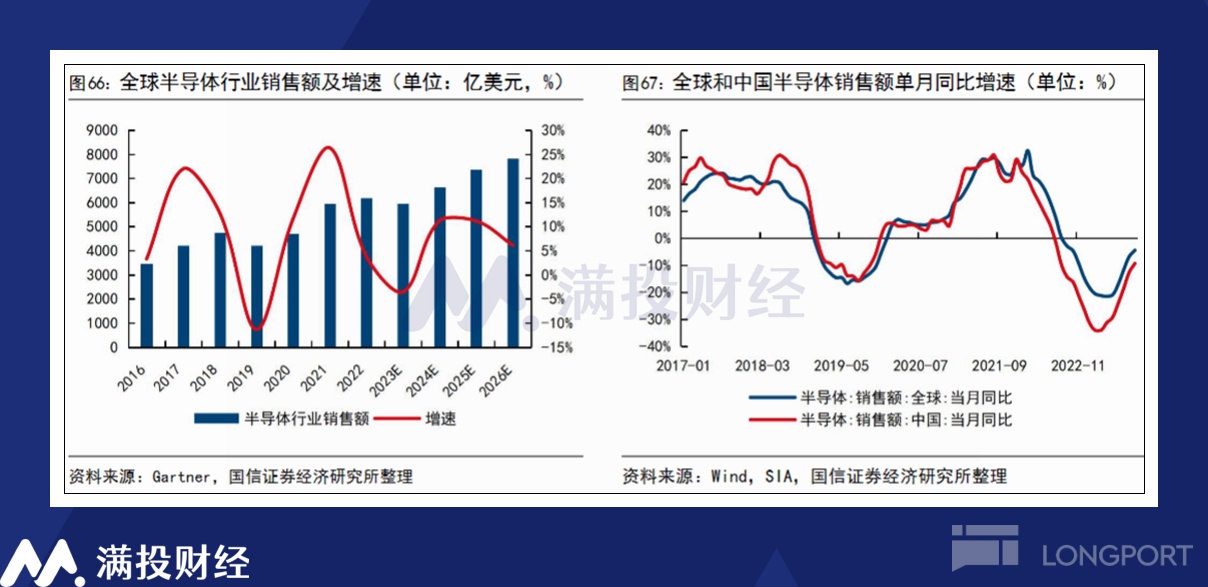
If the last semiconductor upcycle was driven by demand for PCs, tablets, and servers during the pandemic, the recent explosion of ChatGPT has ushered in a new AI era. Meanwhile, new energy vehicles are entering the smart driving phase, and IoT, AR/VR, and other fields are creating new growth drivers for the semiconductor industry, catalyzing the next upcycle.
As ASML noted in its long-term outlook, the semiconductor industry's growth momentum remains strong, fueled by AI, electrification, and energy transition.
Furthermore, global wafer fab capital expenditures suggest a recovery in industry sentiment. According to IC Insights, global semiconductor capital spending in 2023 was $146.6 billion, down 19.3% year-on-year—the steepest decline since 2010. However, SEMI's latest global fab forecast report indicates that as semiconductor inventory adjustments conclude, demand for chips in generative AI, HPC, and other applications is rebounding, supported by government incentives. This is expected to drive significant growth in fab construction and equipment investments across major chipmaking regions.
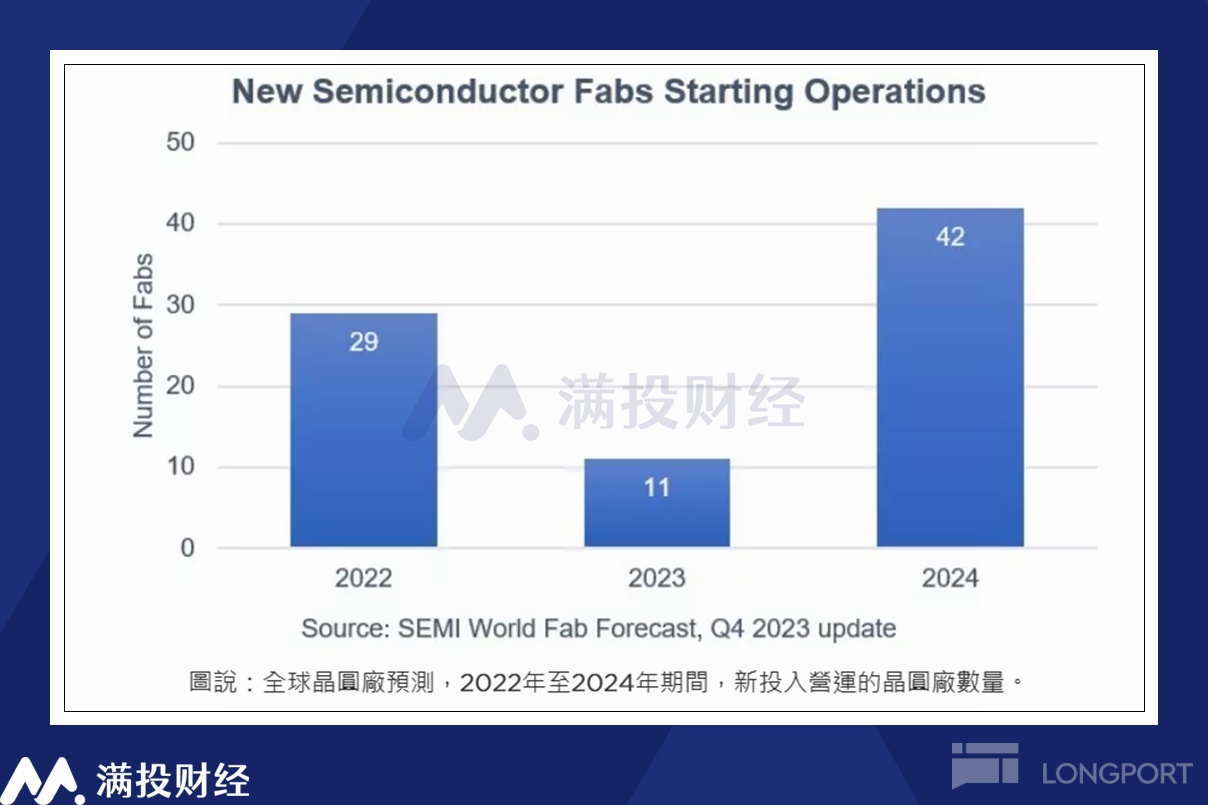
(Source: SEMI)
Between 2022 and 2024, 82 new semiconductor facilities are slated to begin production globally, with 11 in 2023 and 42 in 2024, covering 4-inch (100mm) to 12-inch (300mm) wafer lines. SEMI projects a 6.4% increase in global semiconductor capacity in 2024, suggesting the industry may achieve the strong growth ASML anticipates in 2025.
The copyright of this article belongs to the original author/organization.
The views expressed herein are solely those of the author and do not reflect the stance of the platform. The content is intended for investment reference purposes only and shall not be considered as investment advice. Please contact us if you have any questions or suggestions regarding the content services provided by the platform.
