


Nvidia's market value evaporated $200 billion in a single day. Is the 'glory and dream' of Jensen Huang still there?

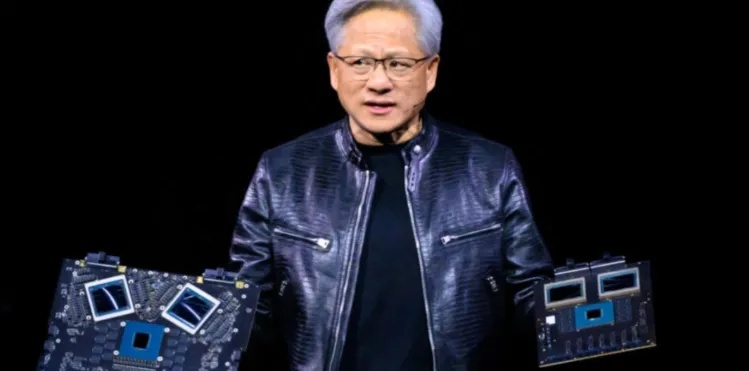
NVIDIA and recent U.S. stocks have indeed experienced a "jaw-dropping" market trend:
Although the Federal Reserve paused rate hikes in June 2023, the federal benchmark rate remained at its highest level in 20 years. Generally, asset prices fall as interest rates rise, but since late 2023, NVIDIA and major U.S. stock indices have hit record highs, leaving academics somewhat baffled.
Since the explosion of ChatGPT, NVIDIA's stock price has skyrocketed, rising nearly 100% in the first three months of 2024 alone. Meanwhile, recent market opinions on NVIDIA's future trajectory have diverged. Some believe NVIDIA's stock will break the $1,000 mark, continuing to write a stock market legend (a symbol of new productivity), while skeptics compare it to Cisco before the dot-com bubble, arguing that the current euphoric market sentiment has clearly overvalued the stock.
On April 19, NVIDIA's stock plunged 10% in a single day, wiping out $200 billion in market value. This obviously caused significant turmoil among optimists. Over the following weekend, major global financial media and investor platforms debated whether this was a "temporary adjustment" or a "turning point."
This article focuses on identifying the key factors influencing NVIDIA's stock price to make a clearer judgment about its market value trajectory:
First, the main reasons for the recent surge in U.S. stocks are: the foreign exchange market releasing dollars, increased market risk appetite, and rising expectations for AI development, which together fueled the rise in stock indices and NVIDIA's stock.
Second, after March 2024, with the release of higher-than-expected inflation data, the Federal Reserve and the market's narrative underwent a major adjustment, significantly impacting U.S. stocks and NVIDIA, with some positive factors already fading.
Third, we must be wary of linear growth expectations for corporate prospects.
There Are Still Clues to the U.S. Stock Rally
As mentioned earlier, academic textbooks regard interest rates as the "weighing scale" for assets: the higher the interest rate, the greater the pressure on asset prices to contract. This is also the main reason global markets closely watch the Federal Reserve. Under the rate hike path, U.S. stocks have hit new highs, which is truly hard to comprehend.
Before explaining the logic behind NVIDIA's stock price rise, we must first understand the inflation mechanism of this U.S. stock rally.
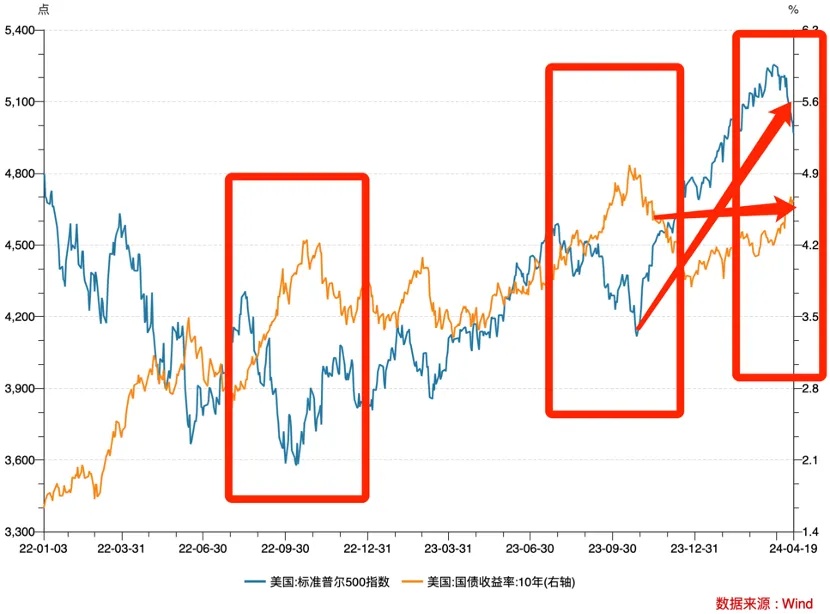
The U.S. 10-year Treasury yield is known as the "anchor" of global assets, and it has risen during the Federal Reserve's rate hike process. The chart above shows the trends of the U.S. 10-year Treasury and the S&P 500 index since the start of rate hikes in early 2022. It clearly reveals:
1) Although the federal benchmark rate remains at its highest in 20 years, the U.S. 10-year Treasury yield peaked in 2024 (briefly approaching 5%) and has since fallen to lower levels, even dipping below 4% in early 2024.
2) The surge in the U.S. 10-year Treasury yield did have a significant negative impact on the S&P 500 index. However, over a longer timeline, the S&P 500 hit record highs amid rising interest rates. After entering 2024, the S&P 500 suddenly surged when the interest rate market was relatively calm.
The federal benchmark rate, 10-year Treasury yield, and U.S. stocks are theoretically predictable in textbooks, but reality has left analysts deeply conflicted. I, too, once doubted what I had learned.
The U.S. 10-year Treasury yield reflects market interest rates. Its trajectory is influenced not only by the federal benchmark rate (the "price factor") but also by quantity factors. In practical analysis, we often recognize the former but overlook the latter.
Generally, quantity factors in the monetary market include endogenous and exogenous markets. The former mainly involves central banks directly injecting liquidity into the market, such as the Federal Reserve buying Treasury bonds (also known as QE, quantitative easing). During a rate hike cycle, this tool is suppressed, so the focus shifts to the exogenous market—the foreign exchange market.
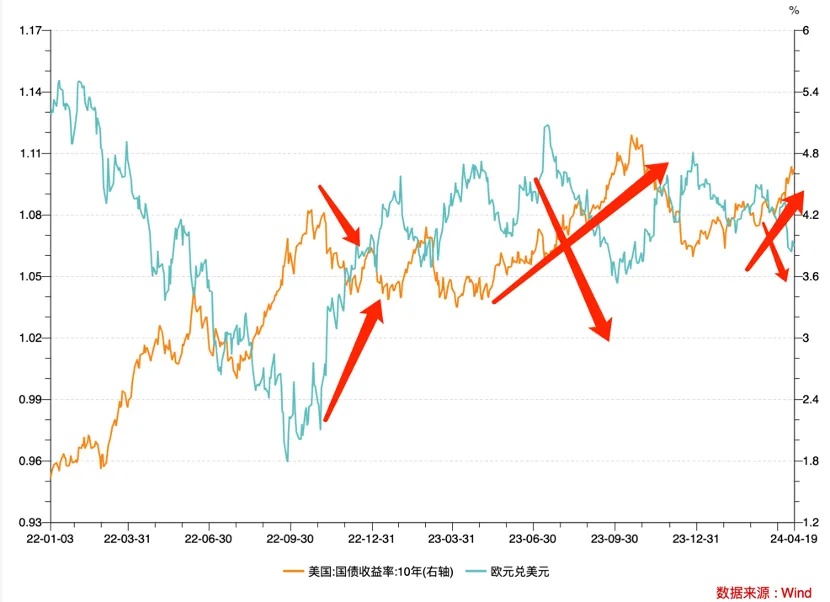
The European financial market has been tumultuous over the past two years, especially when the Federal Reserve's rate hikes coincided with the "Russia-Ukraine war," causing the euro to depreciate sharply in early 2022. By September 2023, the euro hit a historic low against the dollar. In trading, the strategy was to "sell euros—buy dollars," leading to a massive withdrawal of dollars from the foreign exchange market. Under the dual influence of price and quantity factors, dollar liquidity was severely constrained, and the 10-year Treasury yield entered a fast lane of increase.
Later, as the European economy stabilized and the negative effects of the war were gradually digested by the market (correcting earlier excessive pessimism), the euro began to appreciate. In trading, this meant "sell dollars—buy euros," releasing a large amount of dollars back into the market, with some flowing back to the U.S., improving market liquidity.
The essence of the Federal Reserve's rate hikes is to guide the interest rate center upward through window pricing, curbing demand to control inflation. However, in reality, the dollars released by the foreign exchange market buffered this policy through quantity factors. Notably, due to financial market stability concerns (e.g., the Silicon Valley Bank incident in March 2023 caused by rapidly rising rates), the Federal Reserve adopted a conservative stance on selling Treasury bonds, greatly alleviating market liquidity tensions.
By now, we've discussed an alternative narrative for U.S. bonds, the foreign exchange market, and U.S. stocks beyond rate hikes: rising euro expectations—buy euros, sell dollars—some dollars flow back to the U.S.—buy U.S. bonds and stocks—asset prices rise.
Simply put, the appreciation or depreciation of non-dollar currencies acts like a dollar siphon outside the market, significantly amplifying or offsetting the impact of Federal Reserve rate hikes.
Since 2023, the U.S. stock market has experienced a bull run, which can be interpreted as follows:
1) In the second half of 2023, the Federal Reserve paused rate hikes, and optimistic inflation control led to extremely bullish rate cut expectations, with the most optimistic predicting six 25-basis-point cuts in 2024, easing price factor pressures.
2) After October 2023, the euro also rose, further contributing to liquidity through quantity factors.
3) In 2024, discussions about a U.S. economic soft landing became widespread. The mainstream view is that the Federal Reserve's 调控 was very skillful, with the U.S. economy maintaining strong growth in 2023. Under the rhetoric of "AIGC 全面提升生产力" (AIGC 全面提升生产力), market risk appetite fundamentally shifted, meaning the market became more willing to "bet" on high-risk assets, driving the stock market rally.
NVIDIA's Market Logic Needs Restating
Earlier, we spent considerable time detailing the mechanisms behind the U.S. stock rally. With improved risk appetite and liquidity, U.S. stocks regained "chips" to hit record highs.
For NVIDIA, the high growth potential of its industry and the "water, electricity, and coal"-like importance of GPU chips for AI are indeed crucial and form the foundation of its current scale. However, we must emphasize that the realization of a company's intrinsic value (or theoretical value) requires liquidity 配合. Discussing market value without considering liquidity is meaningless.
NVIDIA's 资本市场神话 is half due to its product value and half to the 利好刺激 from the U.S. stock market explained earlier.
Whether NVIDIA's 奇迹 can continue depends on whether these two 利好 factors persist.
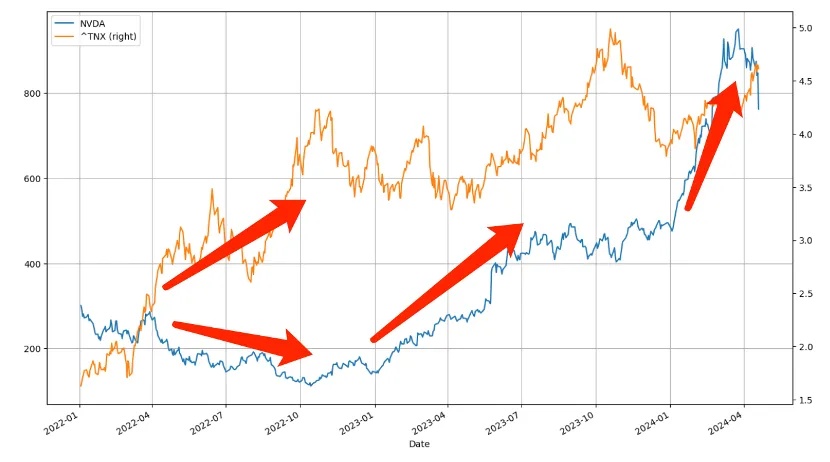
In the chart above, NVIDIA and the U.S. 10-year Treasury yield diverged in 2023 when ChatGPT went viral, AI computing demand surged, and GPU demand exploded. NVIDIA became the hottest stock, with both 市盈率和利润预期 rising in the "market value = profit * P/E ratio" formula.
Later, as the U.S. economy 软着陆 and Federal Reserve rate cut expectations strengthened, NVIDIA gained high-risk 溢价筹码,配合基本面预期, leading to rapid 市值膨胀。
However, with the release of U.S. inflation data in February and March 2023, the Federal Reserve admitted that curbing inflation was no easy task. The earlier 喊话 of 150-basis-point rate cuts vanished, replaced by expectations of just one 25-basis-point cut in 2024.
Against this backdrop, the narrative since late 2023 risks being 颠覆:
1) Price factor pressures are back on the market.
2) Delayed Federal Reserve rate cut expectations mean interest rates and the foreign exchange market must 重新消化 this information, leading to asset price 重估, such as the euro and yen depreciating due to rising 美元利率中枢预期 (the foreign exchange market absorbing dollars).
3) As mentioned earlier, the U.S. economy hasn't experienced such high interest rates in nearly 20 years. Although the current U.S. economic performance remains strong, concerns linger that 某些行业 may become 高息的牺牲品, such as whether events like the Silicon Valley Bank incident in 2023 will recur. This could 冲击实体经济 and, with persistently high interest rates, alter market risk appetite, prompting 避险 investments into safer assets.
Under the new narrative, market 风格切换, and NVIDIA cannot remain untouched.
Some may argue: as long as NVIDIA maintains its technological 领先 and indispensability, liquidity shocks are temporary and won't 改变 a great company's 基本走势—大道至简。
We mostly agree but caution that today's 展望 for NVIDIA are all "expectations": expecting linear AI industry growth and NVIDIA's continued 先进性。
If the U.S. economy faces severe 下行压力,实体经济对 AI 的需求 may contract. Additionally, factors like energy and geopolitics could constrain GPU 产能. For example,近期《经济学人》列举了 NVIDIA's uncertainties, such as TSMC's 产能 issues, potential restrictions on Chinese components due to geopolitics, and 芯片耗能 challenges straining power grids. Industry growth may not be linear.
In bullish markets, we focus on corporate strengths, but during downturns, uncertainties 放大, prompting 资金重新分配 and reduced "bets" on high-risk assets.
NVIDIA's April 19 plunge 本质上 reflects the market's reclassification of the company under the new narrative. Until this logic reverses, excessive optimism is unwise. Key 观察 include:
1) Anti-inflation 成效;
2) Rate cut expectations;
3) Whether a soft landing occurs.
A company's greatness and its 资本市场成就 often don't coincide—they may lag,提前兑现, or 经历高估到重估. We shouldn't 投射 admiration for a company unconditionally into the market, as too many complex factors influence it.
Now is the time for 冷静, not 亢奋。
$NVIDIA(NVDA.US)
The copyright of this article belongs to the original author/organization.
The views expressed herein are solely those of the author and do not reflect the stance of the platform. The content is intended for investment reference purposes only and shall not be considered as investment advice. Please contact us if you have any questions or suggestions regarding the content services provided by the platform.
