


An overlooked dark horse sector

In 2024, the property market still hasn't rebounded as expected. The capital market voted with its feet, and the real estate sector continued to decline, with the current price down 60% from the peak in 2020. The leading company Vanke has fallen back to levels seen a decade ago.
At the same time, upstream and downstream sectors closely related to real estate have also suffered. Among them, the leading cement company Anhui Conch Cement has retreated 56% from its historical peak, the leading waterproofing company Oriental Yuhong has retreated nearly 80%, and the leading home furnishing company Oppein has retreated over 60%.
Surprisingly, however, the home appliance sector, also a downstream sector of real estate, has managed to buck the trend and rise, with the current price rebounding nearly 40% from the low in 2022 and now less than 20% below the historical peak in 2021. Among them, Midea Group has rebounded nearly 40% from December last year, Hisense Home Appliances' stock price has continued to hit new highs, surging over 270% from the low in October 2022, while Gree Electric Appliances and Haier Smart Home have also rebounded significantly from their lows.
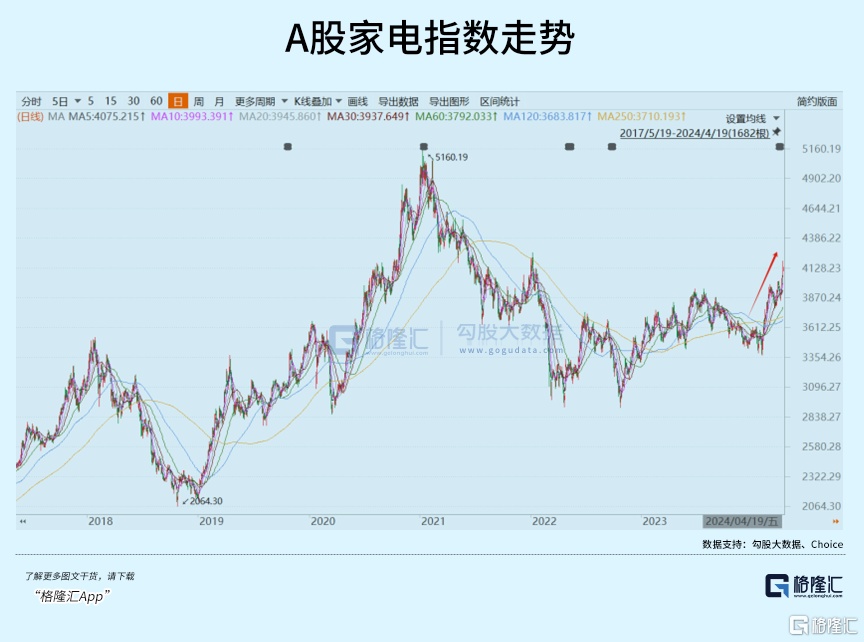
So, why have home appliances managed to buck the trend and rise sharply?
01
In China, the home appliance market has long been dominated by a few giants, with market share firmly controlled by Midea, Gree, Haier, and Hisense. During the years of significant decline in real estate sales, the fundamentals of these four giants have shown remarkable resilience.
In 2023, Midea, Haier, and Hisense all achieved record-high revenue, with cumulative growth of 30.9%, 24.7%, and 76.9% compared to 2020, respectively, and net profit attributable to shareholders growing by 23.9%, 86.8%, and 79.7%, respectively. Gree performed relatively the weakest, with last year's revenue and profits unlikely to surpass the historical records set in 2019.
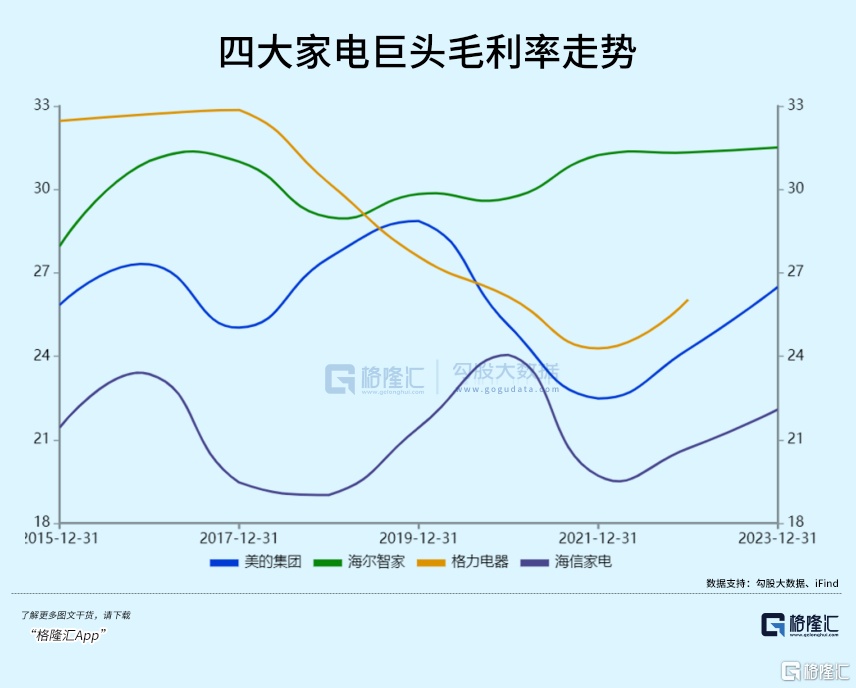
Looking at profitability, the latest gross profit margins for the four giants are 26.5%, 31.5%, 29.25% (2023Q3, with the other three being year-end 2023 data), and 22%. Compared to past years, Haier performed the best, with steady and rising margins, surpassing Gree to take the top spot. Gree performed the weakest, with gross margins on a declining trend, once dropping to 24% in 2021. The other two maintained fluctuating trends, performing moderately.
In terms of net profit margins, the latest figures for the four are 9%, 6.4%, 12.6%, and 5.6%, with little change from past years. Gree has the highest net profit margin, mainly due to higher profit margins for its air conditioning products compared to other categories.
In terms of return on equity (ROE), Hisense leads with 22.6%, up significantly from 9.7% at the end of 2021, mainly due to improvements in both net profit margins and asset turnover. Midea and Haier are at 22% and 16.9%, respectively, showing slight declines. Gree Electric's ROE in 2022 was 24.5%, down 13% from 2017, mainly due to declines in net profit margins and asset turnover, while the equity multiplier actually increased.
On the balance sheet, Midea's contract liabilities last year were 41.77 billion yuan (up 49% year-on-year), up 127% from 18.4 billion yuan in 2020, significantly higher than the 31% revenue growth over the same period. This shows that, under years of steady operations, Midea has gradually gained stronger bargaining power in the upstream and downstream of the industrial chain. The other three companies showed little change.
Looking at dividends, Midea has increased its dividend payout ratio for two consecutive years, climbing to over 60% last year, after maintaining around 40% for many years. Midea's latest dividend yield is 3.5%, higher than Gree's 2.5%, Haier's 1.9%, and Hisense's 1.4%.
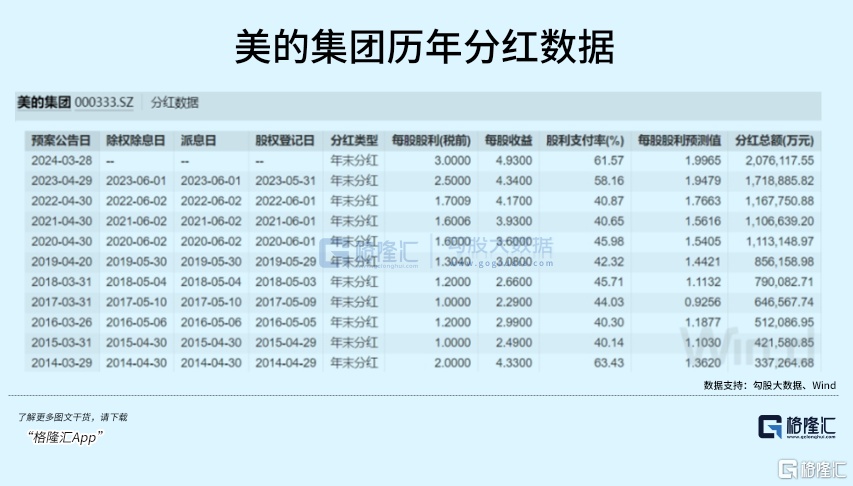
From the above core operational data, Hisense Home Appliances has the fastest growth, followed by Midea and Haier, while Gree performed relatively poorly. However, overall, they have shown resilience, unlike the real estate, cement, and home furnishing sectors, which have seen significant slowdowns.
In addition to fundamentals, the sustained rise of the four major home appliance giants is also related to market trends over the past two years. Since February 2021, due to macroeconomic pressures and valuation disparities, market trends have shifted from growth to value. The relatively stable home appliance sector has been viewed by the market as having dividend attributes, similar to banks, coal, and hydropower, leading to significant valuation repairs.
In recent years, Midea's PE once fell to 10 times but has now rebounded to 14.5 times, returning to the median level of the past decade. Additionally, Hisense's latest PE is 17.8 times, Haier's is 16.3 times, and Gree's is only 8.6 times, all showing some recovery. In the long run, the market is a weighing machine: Hisense has the best growth prospects and the highest valuation, while Gree has obvious performance ceilings, the weakest growth, and the lowest valuation.
02
Over the past decade, China's real estate market has undergone dramatic changes. After a new round of policy stimulus in 2015, the real estate sector was highly prosperous in 2016, with commercial housing sales area increasing by over 22% year-on-year.
By 2018, real estate sales growth had slowed to 1.3%, and Vanke famously declared its "survival" slogan that year.
From 2020 to 2021, despite the pandemic, real estate sales maintained slight growth due to monetary policy and other factors.
In 2022, the property market turned around, marking a historic inflection point, with sales area plummeting by over 24%. Even after the pandemic restrictions were lifted, real estate sales remain under pressure.
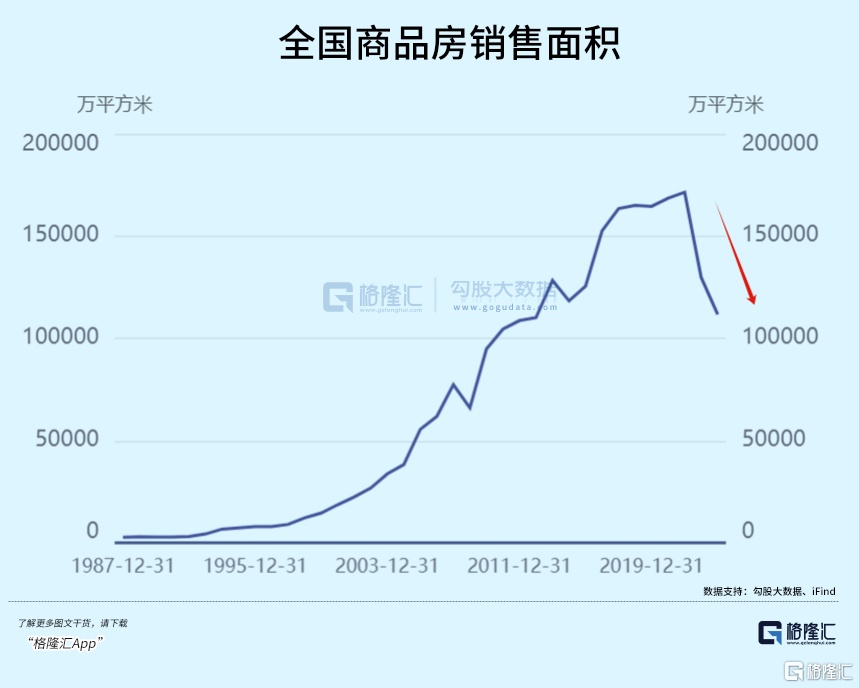
From 2021 to 2023, commercial housing sales area decreased by a total of 600 million square meters, a cumulative drop of 35%. This reduction is significant, and real estate sales have yet to bottom out. There is a 1-2 year lag between selling commercial housing and generating demand for home appliances.
Take air conditioners as an example. In 2023, China's air conditioner sales reached 170 million units, up 11.2% year-on-year. Domestic sales were 99.597 million units, up 13.8% year-on-year. This strong performance contrasts sharply with the weak real estate sales, mainly due to the time lag between property sales and home appliance demand.
However, replacement demand, driven by policies, is expected to offset the slowdown in new demand. On February 23 this year, the Central Financial and Economic Affairs Commission emphasized the replacement of traditional consumer goods like home appliances. On March 1, the State Council executive meeting approved the "Action Plan for Promoting Large-Scale Equipment Updates and Consumer Goods Replacement," calling for active efforts to replace cars, home appliances, and other consumer goods.
In 2022, domestic sales of refrigerators, washing machines, and TVs for replacement purposes were 30.39 million, 29.49 million, and 28.42 million units, accounting for 56%, 53%, and 83% of total domestic shipments, respectively. The implementation of the replacement policy is expected to accelerate the release of replacement demand.
From the perspective of domestic demand, starting in 2024, major home appliance giants will face increasingly significant growth pressures compared to the past, despite the substantial replacement demand. Gree, in particular, with its single business focus, will face greater pressure.
More importantly, home appliance companies also have overseas business as a growth driver, which can partially offset domestic challenges. We boldly speculate that without overseas expansion, home appliance companies might face the same lack of growth imagination as cement, waterproofing, building materials, and home furnishing sectors, leading to increasingly cheaper valuations.
Midea was the earliest home appliance giant to globalize, with overseas revenue accounting for 35% in 2014. By 2023, this had risen to 41.6%. Haier has seen strong overseas growth, with overseas revenue rising from 12% in 2014 to 51.9% in 2023. Hisense's overseas revenue was 32.6% in 2023, little changed over the past decade. Gree has the weakest globalization, with overseas revenue at only 12% in 2022, down from 15% in 2016.
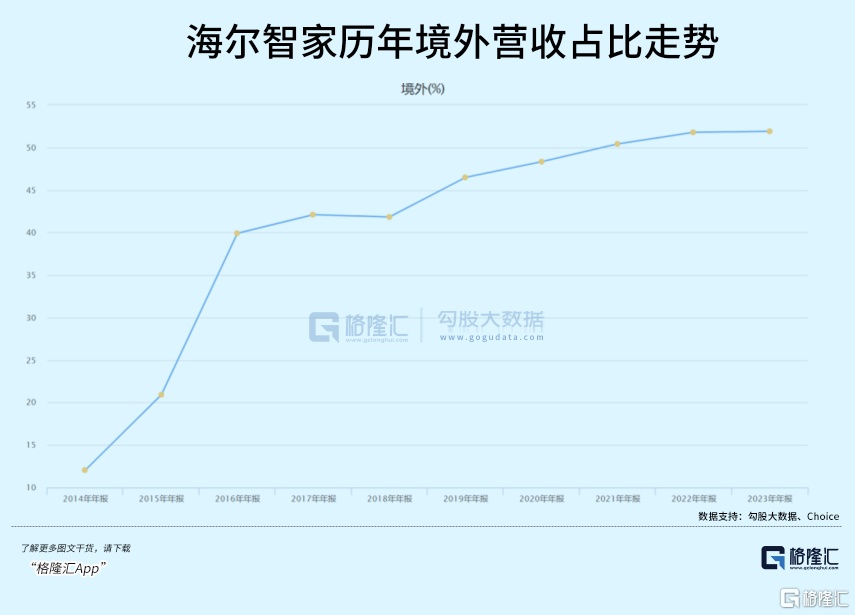
Chinese home appliance giants have demonstrated increasingly strong competitiveness in global markets, leveraging their complete supply chains, technological innovation, and product iteration capabilities. From 2019 to 2023, China's white goods exports to South Asia, Southeast Asia, and Latin America grew for five consecutive years, with export value rising from 24.3 billion yuan to 32.2 billion yuan in the former and from 11.9 billion yuan to 20.6 billion yuan in the latter.
Exports to Europe also grew in most years, except for a slight decline in 2022. Exports to the U.S. have declined slightly in recent years but remain at high levels.
According to Euromonitor data, China's share of global home appliance manufacturing reached 44% in 2021, while self-owned brands (including acquisitions) accounted for less than 20%, indicating significant room for growth in market share.
In addition, home appliance giants have diversified business growth strategies. For example, Haier has expanded into commercial refrigeration, Hisense has entered the automotive air conditioning market through the acquisition of Japan's Sanden, and Midea has diversified into robotics, elevators, medical devices, and new energy components.
However, these diversified businesses are still too small compared to the massive home appliance sector and are unlikely to become major growth engines in the future.
03
Northbound capital has long been bullish on China's home appliance industry, holding a total of 172.9 billion yuan in the sector, accounting for 10% of the industry's total market capitalization and 9.5% of Northbound's total market value. Among them, Midea's holdings are valued at 99.3 billion yuan, second only to Kweichow Moutai and accounting for over 20% of Northbound holdings. Additionally, Gree, Haier, and Hisense are held at 25.56 billion yuan, 17.5 billion yuan, and 2.18 billion yuan, respectively.
Given the scale of foreign holdings, retail investors need not worry too much about the impact of the ongoing real estate downturn on the fundamentals of home appliance giants, as overseas markets offer significant growth potential.
Of course, home appliance companies should be differentiated. Gree's business is primarily domestic and focused on air conditioning, facing greater growth pressure. Hisense, Midea, and Haier have relatively better growth prospects.
However, the reality is that China's home appliance giants have largely transitioned from growth to maturity, implying lower potential returns in the future. Moreover, valuations have recovered significantly in recent years, warranting caution against potential pullbacks. (End of article)
The copyright of this article belongs to the original author/organization.
The views expressed herein are solely those of the author and do not reflect the stance of the platform. The content is intended for investment reference purposes only and shall not be considered as investment advice. Please contact us if you have any questions or suggestions regarding the content services provided by the platform.
