


 Likes Received
 Posts
PostsThe performance has increased significantly, with net profit exceeding 10 billion! Is Changan Automobile 'stable'?

On April 17, Changan Automobile released its 2023 financial report.
According to the financial report, Changan Automobile achieved revenue of 151.3 billion yuan in 2023, a year-on-year increase of 24.78%; net profit reached 11.33 billion yuan, up 45.25% year-on-year. Notably, this marks the first time since 2016 that Changan Automobile's net profit has exceeded the 10 billion yuan threshold. Judging solely by the net profit figures, Changan Automobile has successfully emerged from the slump in its joint venture business.
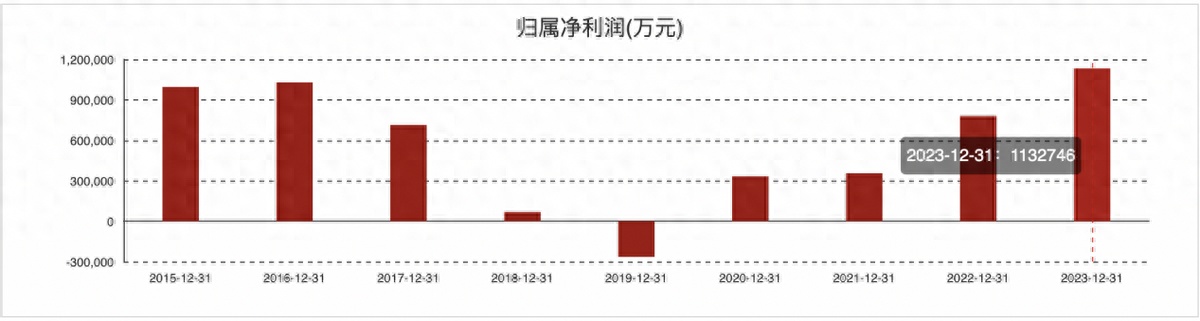
Over the past year, competition in the automotive market has intensified. Achieving "double growth" under such circumstances is no small feat, making Changan Automobile's financial report particularly impressive.
However, despite the significant growth in both revenue and net profit, Kanjian Finance observed that the capital market's response to Changan Automobile has been lukewarm. In the two trading days following the earnings release, Changan Automobile's stock price fluctuated and declined, with a cumulative drop of 0.58%.
Behind the 10 Billion Yuan Net Profit
A closer look at the financial report reveals that Changan Automobile's 10 billion yuan net profit wasn't entirely derived from operations.
Examining the non-GAAP net profit, Changan Automobile reported 3.782 billion yuan in 2023, a year-on-year increase of 16.19%. While this also represents growth, the gap between this figure and the 11.33 billion yuan net profit is substantial.
Why such a large discrepancy? The answer lies in the "Non-Recurring Gains and Losses" table. Of the 11.33 billion yuan net profit, 440 million yuan came from the disposal of non-current assets, 1.463 billion yuan from government subsidies, and most notably, over 5 billion yuan from the acquisition of a stake in Changan New Energy. Excluding these items, Changan Automobile's operational performance isn't as stellar as the headline figures suggest.
So, what is Changan Automobile's actual situation? We can analyze it from two perspectives: profitability metrics and sales figures.
First, profitability: in 2023, Changan Automobile's gross margin was 18.36%, and its net margin was 6.28%. In 2022, these figures were 20.49% and 6.39%, respectively. While the gross margin declined slightly in 2023, the net margin remained stable. In fact, Changan Automobile's profitability metrics are relatively strong compared to peers. For context, BYD, Great Wall, and Geely reported gross margins of 20.21%, 18.73%, and 15.3% in 2023, respectively. Among these four major domestic automakers, Changan Automobile's gross margin is the highest, outpacing Geely by over 5 percentage points.
Next, sales: in 2023, Changan Automobile sold 2.553 million vehicles, up 8.8% year-on-year. While this represents growth, the overall Chinese automotive market grew by 12% to 30.094 million vehicles during the same period, meaning Changan Automobile's growth lagged behind the industry. Regionally, domestic revenue accounted for 130.8 billion yuan (86.43% of total revenue), while overseas revenue reached 20.54 billion yuan (13.57%). Compared to 2022, overseas revenue saw significant growth—rising from 13.41 billion yuan (11.06% of total revenue) in 2022.
Beyond revenue growth, overseas gross margins also improved dramatically. In 2022, Changan Automobile's overseas gross margin was just 6.25%, but by 2023, it had surged to 24.75%, nearly quadrupling.
Overall, if one word could describe Changan Automobile's financial report, "steady improvement" might be apt. Despite heightened industry competition, Changan Automobile's profitability metrics remain competitive among peers, and its overseas business emerged as the standout highlight of 2023, with both revenue and gross margins soaring.
Accelerating Electrification
For Changan Automobile, slow progress in electrification is its most pressing challenge.
Sales data shows that Changan Automobile sold 2.553 million vehicles in 2023, of which 474,000 were new energy vehicles (NEVs) under its own brands, up 74.8% year-on-year.
While NEV growth is robust, these vehicles accounted for just 18.57% of total sales. By comparison, China's NEV penetration rate reached 31.6% in 2023, and BYD has even discontinued production of traditional fuel vehicles to go all-in on NEVs. In terms of electrification, Changan Automobile is indeed lagging behind its peers.
Currently, Changan Automobile's NEV business relies heavily on its Deepal and Avatr brands, both of which are still in development. According to the financial report, Deepal generated approximately 25.9 billion yuan in revenue in 2023 but incurred nearly 3 billion yuan in losses. Avatr, the other brand, is even smaller, with revenue of just 5.64 billion yuan and losses nearing 3.7 billion yuan.
Compared to Deepal, Avatr's situation is more precarious and disappointing—after all, Avatr was jointly developed by Changan Automobile, Huawei, and CATL under the CHN model, effectively born with a "golden spoon." Yet, several years after its launch, it has yet to deliver meaningful results. In 2023, Avatr sold just 27,000 vehicles, far short of its 100,000-unit target. Moreover, monthly sales hovered around 1,500 units in the first half of 2023, only improving significantly after steep price cuts in the second half.
That said, Changan Automobile is clearly prioritizing transformation. Marketing expenses and R&D spending reached 7.645 billion yuan and 5.98 billion yuan in 2023, up from 5.138 billion yuan and 4.315 billion yuan in 2022, respectively. Additionally, to address Avatr's sluggish progress, Changan Automobile made leadership changes. In December 2023, the company announced that Zhu Huarong, Chairman of Changan Automobile, would also serve as Avatr's Chairman to accelerate the brand's upscale positioning.
The copyright of this article belongs to the original author/organization.
The views expressed herein are solely those of the author and do not reflect the stance of the platform. The content is intended for investment reference purposes only and shall not be considered as investment advice. Please contact us if you have any questions or suggestions regarding the content services provided by the platform.
