



Tesla's net profit in the first quarter was nearly halved, and the company plans to launch low-priced models to compete in the future.

Despite gaining some ground in the stock market with the "low-cost EV" teaser, Tesla's (TSLA.US) 2024 start has been a downward spiral, riddled with concerns.
After U.S. markets closed on April 23, Tesla released its Q1 2024 financial report. Over the past six months, Tesla has been plagued by production cuts, layoffs, price reductions, declining performance, and a stock price crash. After Elon Musk's series of moves, Tesla's market cap has plummeted over 50% from its trillion-dollar peak. With intensifying competition in the EV sector, can Tesla still keep up?
01
Revenue Drops YoY, Automotive Segment Slumps
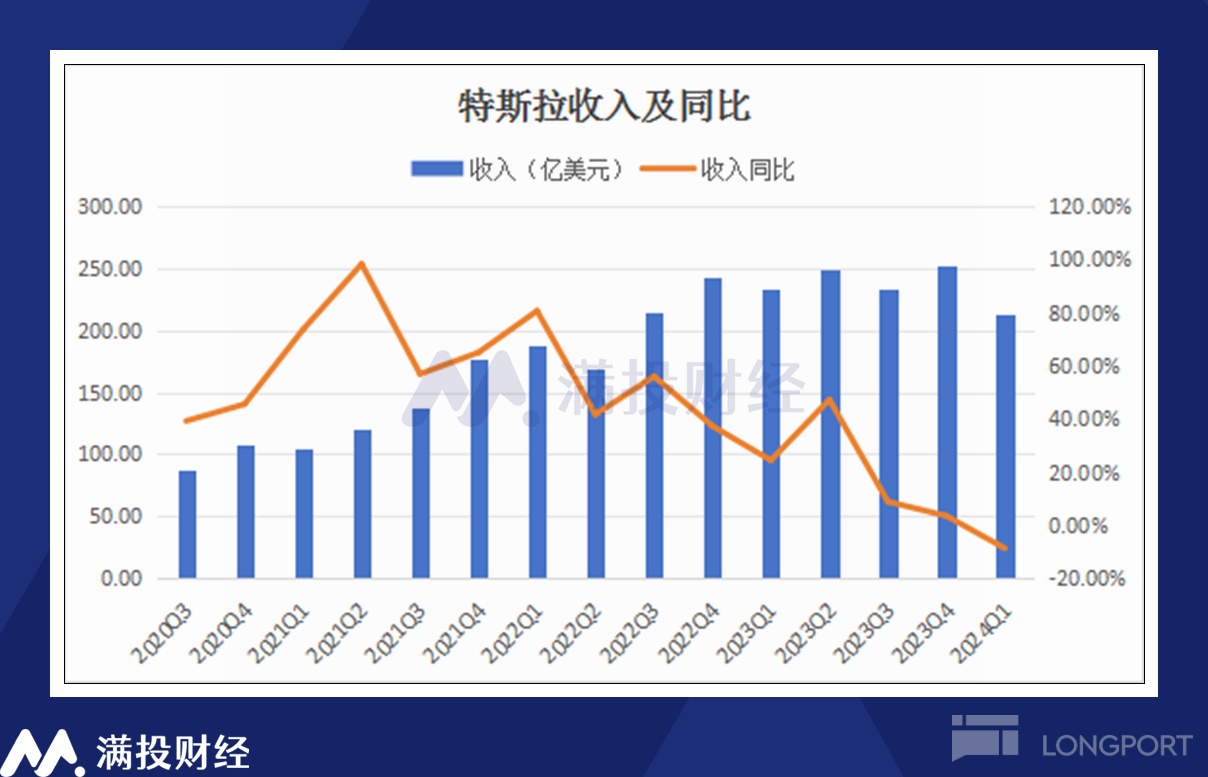
The report shows Tesla's Q1 2024 total revenue was $21.301 billion, down 8.69% YoY. Over the past few years, Tesla's quarterly revenue growth has slowed significantly, dropping to single digits in the last two quarters and turning negative this quarter—the first decline since Q1 2020—primarily due to declining revenue from its core automotive business.
(Source: Company filings)
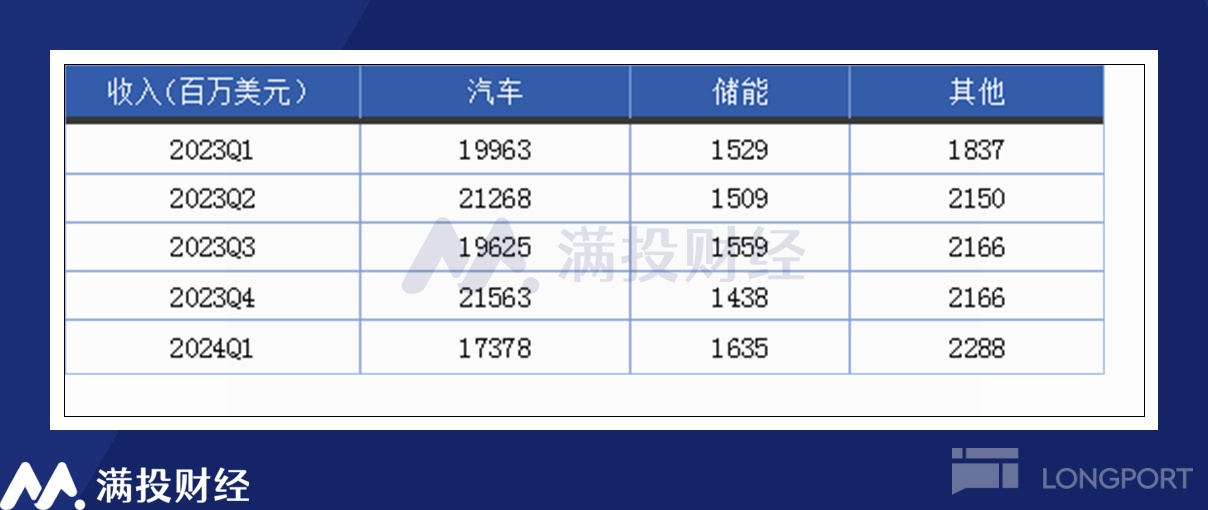
Tesla's revenue comes from three segments: automotive sales, energy storage, and services. The automotive segment mainly involves EV sales. In Q1 2024, Tesla's automotive revenue was $17.378 billion, down 13% YoY, accounting for 81% of total revenue and dragging down overall performance. This was mainly due to lower average selling prices (ASPs) and reduced deliveries.
The energy storage segment posted revenue of $1.635 billion in Q1, up 7% YoY, accounting for 9% of total revenue. It remains Tesla's most profitable business, with gross profit surging 140% YoY to $403 million and a 25% gross margin—outpacing automotive margins for three consecutive quarters. Energy storage deployments hit a record 4.1GWh in Q1.
(Source: Company filings)
02
Gross Margins Shrink Further, Net Profit Nearly Halved
In terms of profitability, Tesla's Q1 operating income fell 56% YoY to $1.171 billion, with operating margins narrowing sharply from 11.4% to 5.5%. Non-GAAP net income attributable to shareholders dropped 47.59% YoY to $1.335 billion. The profit slump exposes the downside of Tesla's frequent price cuts to boost sales.
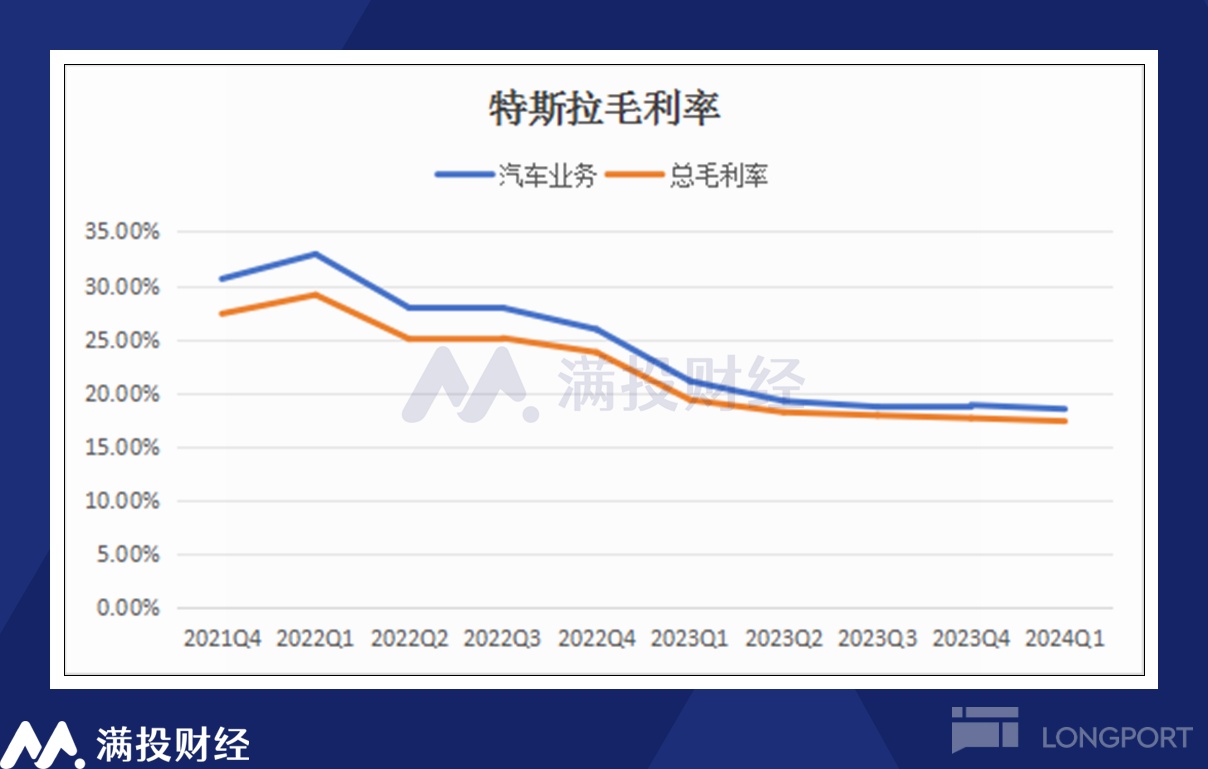
Tesla's vehicles have long been known for high gross margins, leading the global EV industry. In Q1 2022, its automotive gross margin hit 31.9%. But as the EV sector gets more cutthroat, Tesla's price cuts have become a go-to tactic, dragging down automotive margins and overall profitability.
In Q1, Tesla's automotive gross profit fell 24% YoY to $3.212 billion, with gross margins dropping to 18%—marking six straight quarters of decline. Overall gross margins also fell to 17% from 19% a year ago.
Tesla attributed the profit decline to lower ASPs, higher operating expenses (driven by AI, battery R&D, and other projects), and rising production costs for the Cybertruck.
Q1 R&D spending surged 49% YoY to $1.151 billion, accounting for 5.4% of revenue (up 2.1pp YoY). SG&A expenses rose 27.7% YoY to $1.374 billion.
(Source: Company filings)
03
Deliveries Decline, Accelerating Low-Cost Models
As the global EV leader, Tesla has long dominated production and sales. In China—the world's largest and fastest-growing EV market—Tesla has rapidly gained share, pressuring local rivals while facing heat from their growth. But as competition intensifies and EV penetration plateaus, Tesla's output is slipping.
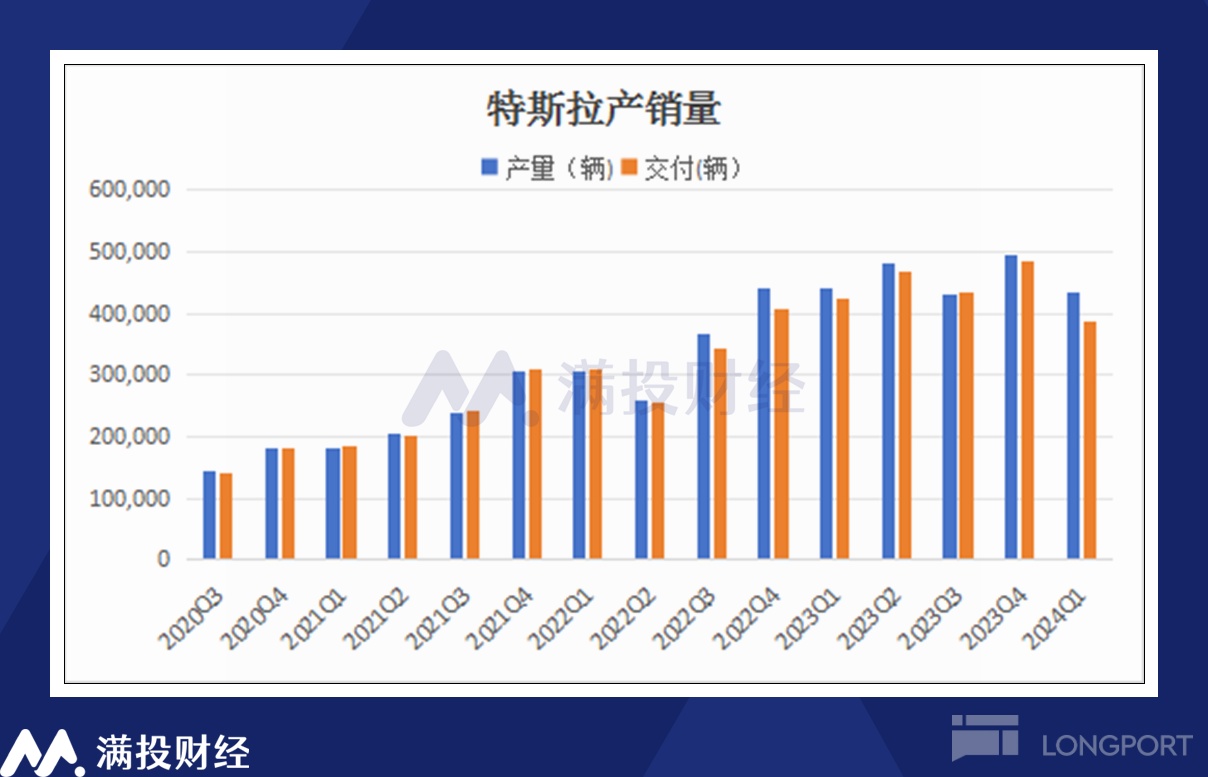
In Q1 2024, Tesla produced 433,400 vehicles globally and delivered 386,800—down 2% and 9% YoY, respectively. Model 3/Y accounted for most of this, with 412,000 produced and 370,000 delivered.
Tesla blamed the delivery drop on Model 3 production line upgrades in Fremont, disruptions at its Berlin Gigafactory (due to Red Sea conflicts and arson), and seasonal factors (including Chinese New Year shutdowns) at its Shanghai plant.
Notably, Tesla's Q1 production-delivery gap widened to 46,000 units (vs. 10,000 last quarter and 18,000 a year ago), suggesting demand issues beyond production hiccups.
(Source: Company filings)
Per China's auto association, March 2024 EV sales hit 883,000, with penetration at 32.8%. As penetration crosses 30%, growth may slow, hitting a demand ceiling.
Musk admitted EV adoption faces headwinds as rivals pivot to hybrids—a shift he dismissed, urging the industry to push electrification while hyping Tesla's FSD V12 ambitions.
Amid fierce competition, Musk said Tesla is updating its lineup to accelerate affordable EVs, with a low-cost model due by early 2025. Tesla also vowed to focus on profit growth via cost cuts and leveraging existing factories.
Capital expenditures rose to $2.8 billion in Q1 (from $2.3 billion last quarter) for AI infrastructure, Superchargers, and capacity. Cash and equivalents fell $2.2 billion to $26.9 billion.
04
Bottom Line
Tesla's Q1 report was grim. Facing slowing demand, peak EV penetration, cutthroat competition, and subsidy cuts, Tesla's performance and sales crashed. Reliance on price cuts is unsustainable—it must win on product and service value.
While Musk calls Tesla "an AI/robotics company," the market sees a carmaker. With EV sector woes and Tesla underperforming, its bubble is deflating.
The copyright of this article belongs to the original author/organization.
The views expressed herein are solely those of the author and do not reflect the stance of the platform. The content is intended for investment reference purposes only and shall not be considered as investment advice. Please contact us if you have any questions or suggestions regarding the content services provided by the platform.
