



Looking back at history, why must we participate in national-level thematic investment opportunities?

By reviewing history, we can see the wealth effect and market influence brought by national-level thematic investment opportunities.

On the afternoon of February 27, at a helipad not far from the Shekou Cruise Home Port in Shenzhen, two uniquely designed eVTOL aircraft took off, circled over the waters of Shekou Port, and then released colored smoke. One of them crossed the Pearl River estuary and flew to Zhuhai, landing safely at the Jiuzhou Port Terminal 20 minutes later.
Coincidentally, on March 8, a spectacular aerial display took place in Guangzhou's CBD area, with several companies showcasing their eVTOL models. The performance was not only visually stunning but also sparked heated discussions on social media.
The frequent appearance of eVTOLs in the sky gives people a strong sense that "the future has arrived."
You might be unfamiliar with the term "eVTOL," but you’ve probably heard its other name—flying cars.
As a key component of the low-altitude economy, flying cars are seen as a potential game-changer for our lifestyles, representing a trillion-dollar blue ocean market. As a result, investors have been quick to act. Not only have flying car manufacturers raised massive funding, but related concept stocks in the A-share market have also attracted significant capital inflows.
The market’s enthusiasm for flying cars is evident, and the reason is simple: no one wants to miss out on this national-level thematic investment opportunity.
01 The Wealth Code
Unlike ordinary speculative themes, national-level thematic investments typically come with top-tier policy backing, involve industries with vast growth potential, and attract large-scale capital inflows.
(1) Top-Tier Policy Backing
Generally, national-level thematic investment opportunities are underpinned by top-tier policy support.
Policy-backed investment opportunities are closely tied to the country’s macroeconomic strategies and development plans. To promote certain industries, the government often introduces a series of preferential policies, including tax breaks, financial subsidies, industry regulations, and legal protections.
This support is not a one-time event but a continuous and evolving process. Thematic investments with sustained policy backing tend to exhibit strong market resilience and growth potential.
However, not all thematic investments enjoy the same level of policy favor. Some popular investment themes may simply be market-driven hype, lacking substantive policy support—or even facing regulatory crackdowns.
(2) Industries with Broad Growth Prospects
National-level thematic investments typically target industries with vast development potential and market space. These industries are often critical to the country’s economic and social progress, such as renewable energy, high-tech manufacturing, biotechnology, healthcare, and infrastructure.
Government investment in these sectors reflects not only a response to current market needs but also foresight into future trends.
Given that some industries are closely tied to national strategic security and long-term development, they consistently receive high-level government attention and substantial funding. For example, as global focus on sustainability grows, the development and application of new energy have become key areas for national investment.
Other industries, with their massive and growing demand, offer high-profit potential and strong economic returns, making them prime candidates for national-level thematic investment. Take healthcare, for instance: as global aging accelerates, demand for medical services and biotech has surged, driving rapid industry growth and technological innovation.
(3) Large-Scale Capital Inflows
Another defining feature of national-level thematic investments is their larger market capacity.
We often see ordinary themes driven by small-scale capital, with no participation from institutional investors. In contrast, national-level thematic investments, with their broad coverage and depth, provide ample room for capital deployment, attracting large-scale funds and becoming hotspots for investment activity.
Large capital is drawn in first by the potential for higher returns—given the massive scale and promising growth prospects, investors have high expectations.
Second, the stability of national-level thematic investments is another key factor. Government backing and policy safeguards provide a degree of security.
Additionally, the potential for value appreciation further fuels enthusiasm. Driven by national policies, related industries may achieve rapid technological innovation and market expansion, offering substantial long-term returns. Thus, national-level thematic investments are not just capital magnets but also stages for value creation.
02 From TMT to New Energy
Looking back at the A-share market over the past decade, while major indices have been lackluster, thematic investments have shone brightly. Although national-level thematic opportunities have been rare, the few that emerged left a lasting impression—such as the TMT bull market of 2013-2015.
At the time, the rapid adoption of smartphones triggered a massive wave of mobile internet growth, creating unprecedented opportunities for industries like online gaming, Apple’s supply chain, and big data. By 2013, smartphone penetration had surged to 72%, driving not only hardware development (Apple and Android supply chains) but also software sectors like mobile gaming and social apps.
This mobile internet wave and its ripple effects propelled the rise of the TMT sector. In 2013, media, computer, electronics, and communications industries saw staggering gains of 107%, 67%, 43%, and 35%, respectively, ranking first, second, fourth, and seventh among all Shenwan primary industries.
In 2014, 4G technology marked the maturation of the mobile internet era, spawning a new tech cycle that benefited the entire supply chain—from upstream equipment to midstream operations and downstream applications. By late 2014, the tech cycle expanded beyond mobile internet and TMT, evolving into "internet+" and the Internet of Things.
By 2015, TMT-related industries still led the pack, with computers, media, communications, and electronics ranking first, fifth, sixth, and seventh, respectively.
While the mobile internet revolution was the driving force behind the TMT bull market, the rally was also backed by top-tier national policies.
From late 2012, when China prioritized "innovation-driven development" and "strategic economic restructuring," to January 2013, when the State Council approved the "National Major Science and Technology Infrastructure Construction Medium- and Long-Term Plan (2012-2030)" and the "Opinions on Deepening Science and Technology Reforms to Accelerate National Innovation System Development," it was clear that policy support for technology was intensifying.
Beyond TMT, another classic example of national-level thematic investment was the new energy bull market of 2019-2021, with new energy vehicles (NEVs) as the standout.
Between 2020 and 2021, the NEV industry not only outlined a clear development trajectory but also entered a rare boom cycle. Government support was comprehensive, covering the entire supply chain—from talent development to tax breaks and consumer incentives—creating a full-fledged support framework.
These policies fueled the NEV theme, sustaining industry buzz and driving sales breakthroughs. Over these two years, NEV sales grew robustly, while reliance on government subsidies gradually declined, signaling a shift toward self-sustaining growth.
Looking back, this national-level thematic investment began in March 2020 and lasted until December 2021—a 21-month run. Its longevity stemmed not just from policy support but also from rising market demand.
03 The Rise of New Quality Productive Forces
By reviewing history, we see the wealth effect and market influence of national-level thematic investments.
Does the current market offer similar opportunities? Let’s start with policy.
This year, the government work report prioritized "building a modern industrial system and accelerating the development of new quality productive forces," emphasizing "driving industrial innovation through technological innovation."
From its first mention in 2023 to its inclusion in this year’s national work report, the concept of "new quality productive forces" has gradually taken shape as a key driver of high-quality development—and a potential focal point for the next wave of national-level thematic investment.
Given their historical role and strategic positioning, state-owned tech enterprises are likely to lead major projects in this space, making them early beneficiaries of "new quality productive forces."
However, there are few ETF products in the market that align with the "state-owned + tech" theme.
This is partly because state-owned enterprises (SOEs) are traditionally associated with legacy industries, limiting their appeal in secondary markets.
But amid efforts to reshape the "valuation system with Chinese characteristics," market attention on SOEs has risen significantly.
On November 16, 2022, the CSI Guoxin Central SOE Technology Leadership Index was launched—the first pure-play tech SOE index. By combining "state-owned" and "tech," it not only filled a market gap but also facilitated integration between innovation-driven SOEs and capital markets.
From an industry perspective, the index focuses on strategic emerging sectors like aerospace and AI—precisely the areas where new quality productive forces are expected to thrive.
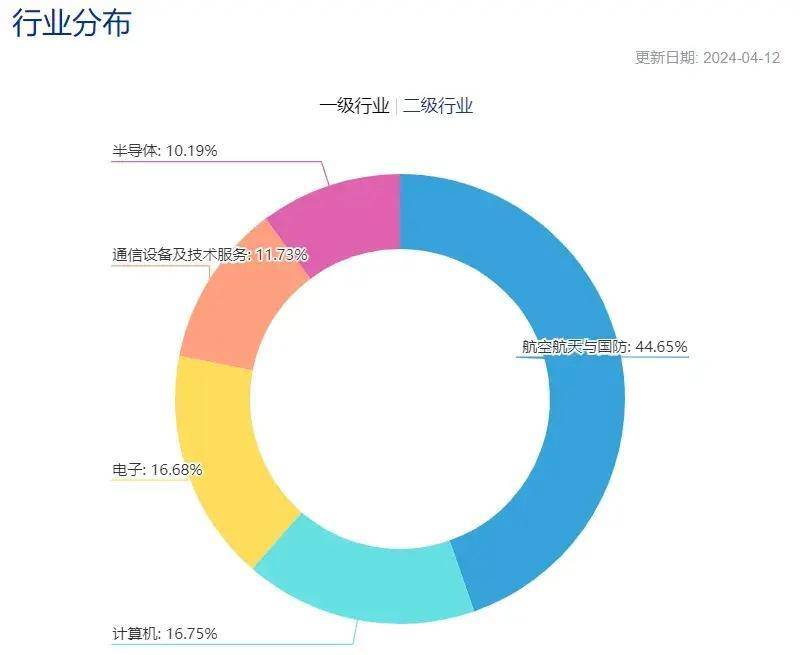
Source: CSI Index Company, data as of April 12, 2024
Another standout feature of the index is its strong hard-tech focus. Take R&D spending as a percentage of revenue—a key metric for hard-tech intensity. Wind data shows that this ratio for the index rose from 6.4% in 2017 to 8.8% in 2022.
This reflects how tech SOEs, through their high-R&D model, contribute to national self-sufficiency in critical areas and enhance technological independence.
In mid-2023, Southern Fund, E Fund, and Yinhua Fund launched ETF products tracking the CSI Guoxin Central SOE Technology Leadership Index, becoming the first batch of public funds to capitalize on this theme.
Late last year, the State-Owned Assets Supervision and Administration Commission (SASAC) held a meeting of central SOE leaders, stressing the need to channel state capital into industries critical to national security and economic development—particularly forward-looking strategic emerging sectors—to fulfill their mission in the new era.
Around the same time, the Central SOE Tech ETF (560170)$China Southern CSI Guoxin Central-SOEs Technology Lead ETF(560170.SH) began attracting long-term capital inflows. By the end of 2023, it had become the largest such ETF, with assets under management (AUM) reaching 2.54 billion yuan.
With the launch of its feeder fund (Class A 019529 / Class C 019530) earlier this year, investors now have another way to participate in this national-level thematic investment.
The copyright of this article belongs to the original author/organization.
The views expressed herein are solely those of the author and do not reflect the stance of the platform. The content is intended for investment reference purposes only and shall not be considered as investment advice. Please contact us if you have any questions or suggestions regarding the content services provided by the platform.
