



Earnings report analysis: The foundation of car sales carries Tesla's 'high-tech dream'.

"Even if aliens abduct me tomorrow, Tesla must solve the autonomous driving problem." Musk is determined in the layout of autonomous driving business.
However, to excel in autonomous driving, Musk may still need to address the most urgent performance issues. Recently, Tesla officially released its Q1 2024 financial report, showing declines in both revenue and profit.
Yet, on the day of the earnings release, Tesla's stock price surged by nearly 16%, marking its largest single-day gain since January 2022.
This may be due to Musk's announcement of manufacturing low-cost electric vehicles, which boosted market confidence. On April 29, Musk further confirmed this news: the cheapest model, Model 2, will be launched next year at a price of only $25,000.
In fact, from the market's perspective, the key to solving Tesla's "burning crisis" lies in competitive car products. Only after solidifying its core business advantage can Tesla confidently pursue a more imaginative future.
Tesla Finding a Breakthrough Amid "Involution"
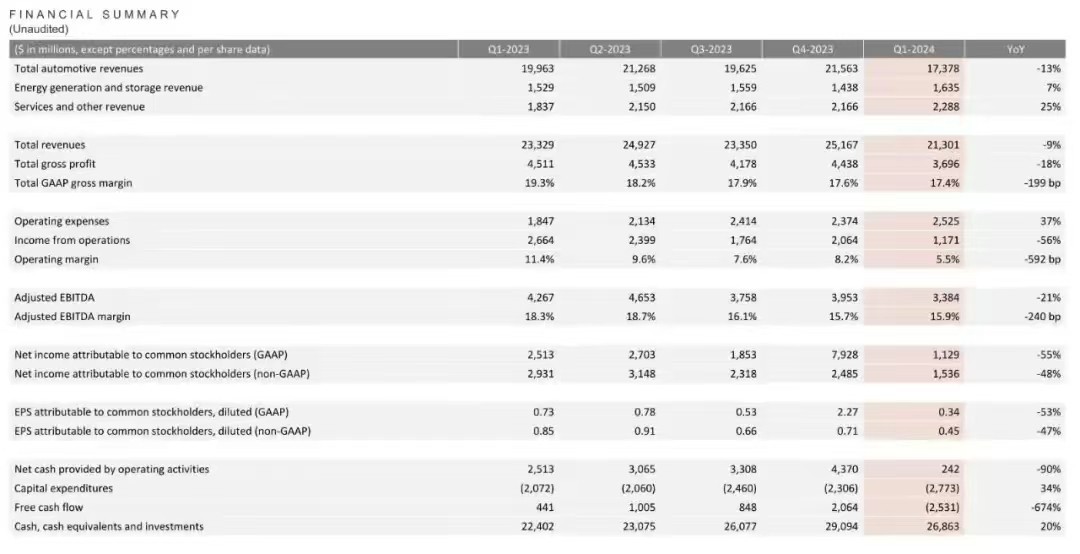
According to the financial report, Tesla's Q1 2024 revenue was $21.3 billion, down 9% YoY, while net profit was $1.13 billion, a 55% YoY decline.
This performance is clearly impacted by its core automotive business. The report shows that Tesla's automotive revenue fell 13% YoY to $17.378 billion, with only 386,810 vehicles delivered in the first three months of 2024—below analysts' expectations of 426,940.
This further reflects that Tesla's strategic adjustment period has arrived amid fierce market competition.
In China's new energy vehicle (NEV) market alone, a "one superpower, many strong players" landscape is forming, as seen in the NEV brand sales rankings for the third week of April. BYD remains far ahead, while AITO overtook Tesla and Li Auto, and newcomers like Xiaomi Motors also performed strongly. Officially, Xiaomi SU7 secured 75,723 orders within 28 days of launch, with 5,781 units already delivered.
Notably, these strong domestic players are also expanding overseas, accelerating global layouts. Data shows China exported 1.203 million NEVs in 2023, up 77.2% YoY, while Q1 2024 saw 307,000 NEV exports, a 23.8% YoY increase. At the company level, Counterpoint data reveals BYD captured 18% of the global passenger EV market in 2023, surpassing Tesla to rank first.
Facing challenges, Tesla has deployed its ultimate weapon—price cuts. Since January 2023, Tesla has slashed prices globally, with reductions reaching up to 93,000 yuan in Q1 alone. However, price cuts are not unique to Tesla. With competitors like BYD following suit, "price wars" in China's NEV sector have become the norm.
Against this backdrop, Tesla's sales growth pressure is increasingly evident: Q1 2021 saw 109% YoY growth; Q1 2022, 67%; Q1 2023, 36%; and Q1 2024, an 8.53% YoY decline.
Meanwhile, price cuts and increased R&D investments require significant costs. Tesla's Q1 2024 capital expenditure rose 34% to $2.77 billion, while free cash flow was -$2.53 billion. These signs indicate Tesla needs an effective breakout strategy.
Regarding Tesla's future, many industry experts suggest diversifying its business layout. The financial report shows some progress here: Tesla's energy generation and storage revenue grew 7% YoY to $1.635 billion, while services and other revenue rose 25% to $2.288 billion.
However, compared to its core automotive business, these segments' contributions remain marginal. NEVs are still Tesla's foundation.
Additionally, Tesla is strongly committed to high-tech fields like autonomous driving and robotics, but breakthroughs in these areas will take time.
To quickly restore investor confidence and overcome current hurdles, Tesla must focus on its core automotive business.
Stabilizing Automotive Sales Is the Top Priority
Recent moves suggest Tesla plans to leverage pricing to boost automotive sales. On April 21, Tesla China announced price cuts of 14,000 yuan across all Model 3/Y/S/X variants. Musk also stated during the earnings call that Tesla is accelerating the launch of "more affordable models" to complement its lineup.
The continuation of price cuts reflects Tesla's difficulty escaping the price war—a necessary tactic for now.
Specifically, consumers increasingly prioritize cost-performance. iiMedia Research data shows the ideal NEV price range for buyers is 100,000–200,000 yuan, followed by 210,000–400,000 yuan. In lower-tier cities, consumers prefer ultra-cost-effective models.
After repeated price wars, this mindset is even more entrenched. But as mentioned earlier, with all manufacturers wielding price cuts, how can Tesla maximize the impact of its strategy?
Currently, offering competitive prices while ensuring product quality meets user needs is critical.
Take Xiaomi SU7 as an example. Industry insiders note, "As a performance-focused large electric sedan, the SU7's pricing is indeed low (among the lowest in its category)."
The top-tier SU7 comes fully loaded: 800V fast charging, air suspension + CDC, a 101kWh Qilin battery, power doors, a 56-inch AR-HUD, an electric rear wing, plus a fridge, Nappa leather seats, and 25 speakers—strong incentives for buyers. Reports indicate 29% of SU7 orders come from BBA (Mercedes-Benz, BMW, Audi) users, while 51.9% are Apple users.
Some automakers even "cut prices while adding features." For instance, the Avatr 12 underwent upgrades in late March, introducing a new gold paint option, optimized infotainment, and improved seats—all while lowering the starting price to 265,800 yuan. This clearly aligns with consumers' dual demand for "good prices" and "quality."
Thus, while launching low-cost models, Tesla must prioritize "quality." Though details about Model 2 are scarce, as an entry-level product, it may not feature cutting-edge tech but must ensure reliability and core functionality to build brand trust among new buyers.
If Tesla balances price and quality, Model 2 could become a key driver of sales growth. Industry estimates suggest optimistic annual sales exceeding 500,000 units, with a 22% gross margin. Thanks to innovative production processes, Model 2's manufacturing cost could be 50% lower than Model 3/Y.
Of course, for balanced growth, Tesla must also focus on cost control alongside new model launches. Musk recently announced plans to cut over 10% of Tesla's global workforce.
As of December 2023, Tesla employed over 140,000 people worldwide—meaning more than 14,000 jobs will be eliminated. Long-term, this will positively impact cost control. Tesla expects 2024 capital expenditures to exceed $10 billion, with annual expenditures projected at $8–10 billion in subsequent years.
Overall, in a fiercely competitive market, automotive sales remain Tesla's top priority. Only by stabilizing this foundation through measures like cost control can Tesla's "new ventures"—like robotaxis and robotics—gain traction.
Author: Wax Big New
Source: U.S. Stock Research
The copyright of this article belongs to the original author/organization.
The views expressed herein are solely those of the author and do not reflect the stance of the platform. The content is intended for investment reference purposes only and shall not be considered as investment advice. Please contact us if you have any questions or suggestions regarding the content services provided by the platform.
