

 Posts
Posts Long-term Value Investor
May direction: Investment preparation for stocks, gold, and forex before "the East rises while the West declines" (Part 1) (May 3, 2024)

Preface: The global investment market has undergone significant changes over the past month. A month ago, few investors believed in the "East rises while the West declines" narrative. Today, $Hang Seng Index(00HSI.HK) has rebounded above 18,000, while $Dow Jones Industrial Average(.DJI.US) hovers around 38,000. More people in the market are now discussing "East rises while the West declines." Today, I’ll share with you my thoughts on global investments this month. These are just my personal opinions, and I welcome any corrections if there are any oversights.
U.S. Stocks
Last night, the three major U.S. stock indices performed strongly: $Dow Jones Industrial Average(.DJI.US) rose 322 points to close at 38,226; $NASDAQ Composite Index(.IXIC.US) surged 235 points to close at 15,841; and S&P 500 gained 45 points to close at 5,064.
A single day’s performance doesn’t reveal the trend, so let’s examine the daily charts of these three markets:
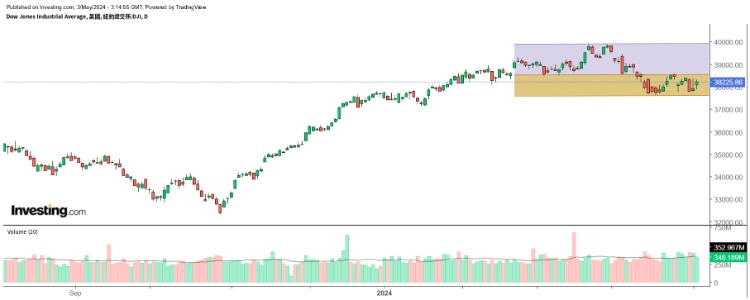
From the daily chart of $Dow Jones Industrial Average(.DJI.US), we can see that the Dow’s fluctuation range in March was around 38,500–39,600. After breaking below 38,500 in early April, the current range is 37,600–38,500. The Dow’s trend appears to be forming a top and distributing. This step-by-step decline may lead investors to believe the market is consolidating short-term, with potential rebounds or even a new upward wave. Now, let’s look at $NASDAQ Composite Index(.IXIC.US):
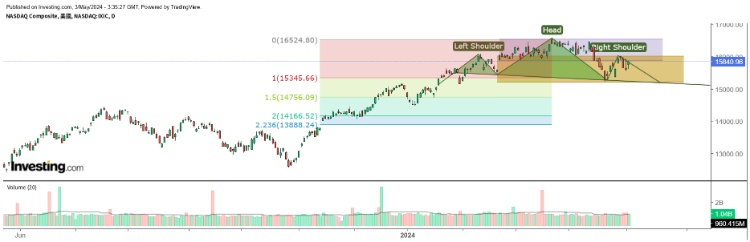
The NASDAQ’s situation is similar to the Dow’s but with a more pronounced head-and-shoulders top pattern. The NASDAQ has shifted from the 158–165 range in March to the current 152–160 range, also a downward shift. Additionally, the NASDAQ seems to be forming a head-and-shoulders top. If this pattern completes, the measured decline could target the 138–142 range, which aligns with the platform area after the gap-up in November 2023.
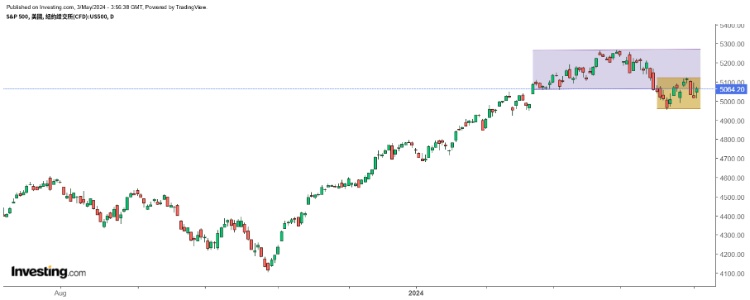
Compared to the Dow and NASDAQ, the S&P 500’s situation is less clear. The S&P 500 is expected to continue fluctuating within a 100-point range around the 5,000 mark.
May is earnings season for U.S. stocks, and the investment climate is likely to be volatile, with significant ups and downs. Besides earnings, factors like Middle East geopolitics, currency markets, U.S. Treasury sales, and economic data will add complexity to U.S. stocks this month. I’m not a surfing expert, so I’ll avoid short-term trading in these turbulent times. Instead, based on the analysis of the three major indices, I believe shorting the NASDAQ might be easier, with $Proshares UltraPro Short QQQ ETF(SQQQ.US) as my top choice. For those who don’t want to stay up late for U.S. stocks, consider Hong Kong-listed ETFs like $FI2CSOPNASDAQ(07568.HK).
Hong Kong Stocks
$Hang Seng Index(00HSI.HK) briefly challenged 18,600 this morning but pared gains by midday, closing at 18,414, up 207 points, with turnover at HKD 69 billion.
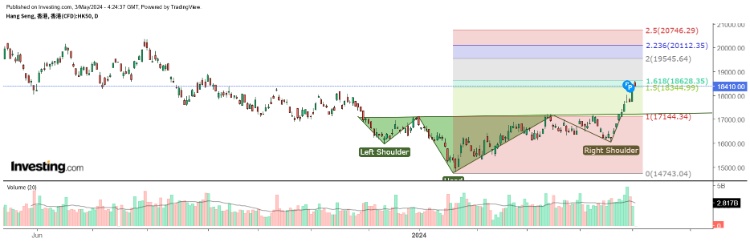
In just nine trading days, the Hang Seng Index has surged from 16,200 to this morning’s high of 18,600, a gain of 2,400 points. Such a rapid rise has refocused market attention on Hong Kong stocks. As shown in the daily chart above, the head-and-shoulders bottom pattern’s measured move aligns with my long-held view on Hong Kong stocks. For now, the Hang Seng may consolidate around 18,300. A breakout could target 19,500.
Although I’ve always favored Hong Kong stocks, I’d advise caution: if the Hang Seng reaches 19,500 this month, it’s time to reduce holdings—not sell out entirely, but trim positions. Markets rise and fall, and after a 3,300-point rally from the head-and-shoulders bottom low of 16,200 to the target of 19,500, reducing exposure is a prudent risk management move.
This article is already too long, so I’ll save my views on individual stocks, commodities, and forex for the next installment.
Good luck to all.
(The above views are solely my own. The investment strategies mentioned may not suit everyone and should not be construed as invitations or intentions to buy or sell financial products. Securities prices can rise or fall, even becoming worthless. Trading securities may not always yield profits and could result in losses. Investors and clients should exercise caution and consider these views as one of many factors in their investment decisions.)
The copyright of this article belongs to the original author/organization.
The views expressed herein are solely those of the author and do not reflect the stance of the platform. The content is intended for investment reference purposes only and shall not be considered as investment advice. Please contact us if you have any questions or suggestions regarding the content services provided by the platform.
