


 Likes Received
How to use long/short leveraged ETFs to achieve an investment goal of 15% annualized return with a maximum drawdown of 5%?


1. Product Positioning:
The drawdown requirement limits the profit potential. The product strategy is positioned as a low-to-medium volatility (long) strategy for multi-market composite assets. The investment challenge lies in achieving a Calmar Ratio of 3 (return target/drawdown target). Relying solely on a single market or asset is insufficient to meet the investment objective; it requires multi-market, multi-asset, and long-short leverage to achieve the Calmar Ratio.
2. Investment Approach:
① Significant time must be devoted to fundamental research to determine the direction and expected return potential of the assets. Historical data should be used for backtesting, and extreme values should be considered to account for marginal changes in thresholds, thereby mitigating tail risks.
② Reduce day trading operations. Day trading is an absolute return strategy that can be used to enhance returns. Asset management funds emphasize professionalism, typically involving algorithmic day trading or specialized manual day trading. Asset management requires disciplined operations, with higher standards compared to the casual day trading of retail investors. If the team is small, the day trading strategy should be de-emphasized.
3. Asset Selection:
Involving ETFs and individual stocks, considerations include the return potential, time required, and potential drawdown of each asset.
① ETF Selection: With a 15% return target, since full positions are not taken, the screening process should aim for assets with 20% return potential. Sometimes, 2x leveraged ETFs are necessary.
② Individual Stock Selection: Priority is given to deep value strategies, focusing on stocks with a margin of safety. Particularly, stocks with "strong earnings and guidance" but "misjudged" due to high market expectations—these assets offer "low risk, high return" and low waiting costs, capitalizing on valuation recovery. However, positions should be capped at 5%.
4. Drawdown Control:
The overall drawdown target is 5%. Not all assets must strictly adhere to a 5% drawdown limit. If correlation analysis, backtested portfolio data, position control, increased asset diversity, and tactical trading are applied, drawdowns of 7-8% for certain assets may be tolerable.
① Position Control: The most effective method for controlling drawdowns. Single-asset positions should ideally not exceed 20%.
② Asset Non-Correlation: Avoid simultaneous declines in assets. The downside is that more assets may fail to meet the 20% return target.
③ Strong Markets/Sectors: Winners tend to keep winning. This requires an international macro/meso analytical framework and market/industry comparisons. Single-market assets should not exceed 50%.
④ Deep Value Strategy: Low valuations and a margin of safety can "offset" some drawdowns.
⑤ Entry Timing: Each asset should have its own entry point; avoid deploying all selected assets at once.
⑥ Tactical Trading: Medium-term tactical trading avoids significant drawdowns. Short-term trading demands high technical analysis skills, has low error tolerance, tests human nature, and is speculative. Long-term trading risks volatility. My preference is medium-term trading of 2x leveraged ETFs and individual stocks, balancing error tolerance, returns, and drawdowns, with holding periods of 1 week to 2 months.
⑦ Profit-Taking: Consider trimming positions when a single asset's return exceeds 25% to prevent potential large drawdowns. Redeployed funds can be used to average down or invest in other assets flexibly.
⑧ Leverage Control: 2x leveraged ETFs may be used but require stop-loss or position control. 3x leveraged ETFs are generally too volatile, suitable for short-term trades with low error tolerance, often incompatible with 6-7% drawdown limits. Inverse leverage carries short-selling risks; avoid unless certain.
⑨ Maintain Cash Reserves: Keep 5-20% as "flexible capital" for averaging down or new investments.
⑩ Stop-Loss: Investing is a numbers game rooted in probability theory—focus on high-probability wins. If fundamentals deteriorate, consider stopping losses.
5. Portfolio Backtesting:
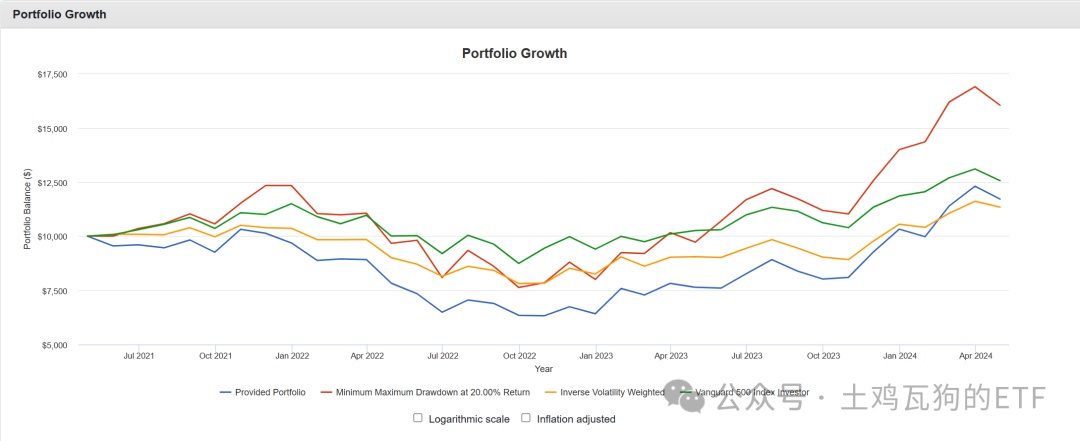
1) Note: Avoid "hindsight bias" by selecting assets with favorable past performance. Many simulations or backtests show excellent results but perform poorly in practice. Specific assets and timeframes may render backtests meaningless for medium-term tactical trading.
2) Quantitative Thinking:
① Learn from strategies like "Inverse Volatility Weighted," which allocates portfolio weights based on volatility—higher volatility assets get lower weights, and vice versa.
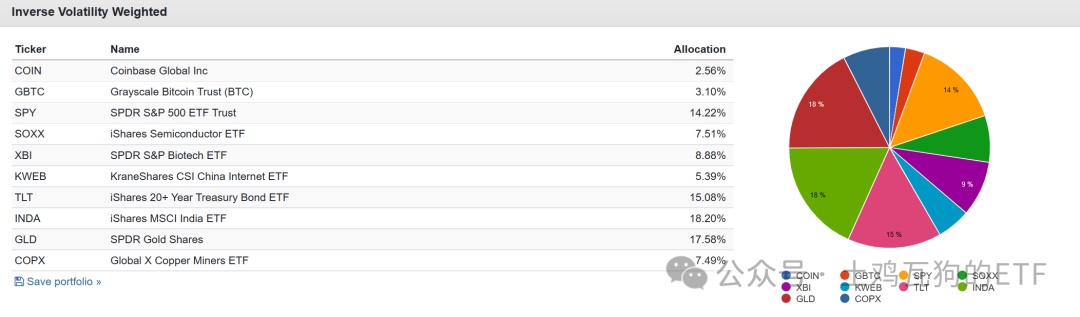
② Select low-correlation assets to effectively control drawdowns.
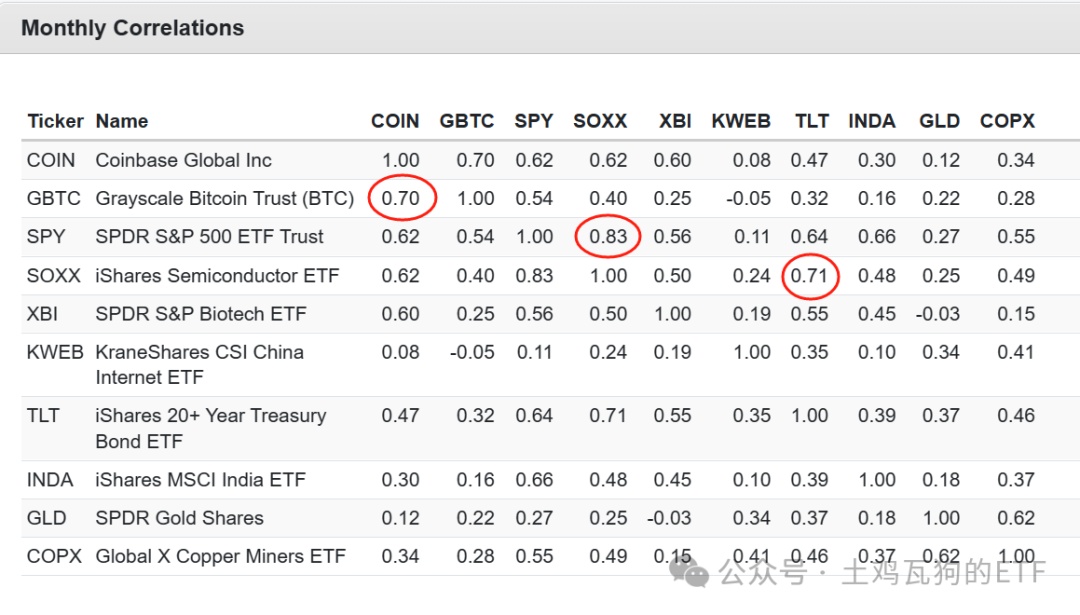
Analyze correlations over a period and their causes. For example, from May 2021 to April 2024, monthly correlations among candidate assets (COIN, GBTC, SPY, SOXX, XBI, KWEB, TLT, INDA, GLD, COPX) show three pairs with correlations above 0.7. Reasons: COIN's performance is linked to the Nasdaq (high correlation with SPY) and Bitcoin (GBTC); SPY has high tech (SOXX) weight; rate cuts (TLT up) benefit semiconductors (SOXX).
This provides reference ideas only. Outcomes vary based on familiarity with assets and individual trading habits.
The copyright of this article belongs to the original author/organization.
The views expressed herein are solely those of the author and do not reflect the stance of the platform. The content is intended for investment reference purposes only and shall not be considered as investment advice. Please contact us if you have any questions or suggestions regarding the content services provided by the platform.
