

 Commemorative
 Likes Received
Disney's 2024Q2 Earnings Report: Sluggish Revenue Growth, Better-than-Expected Profits

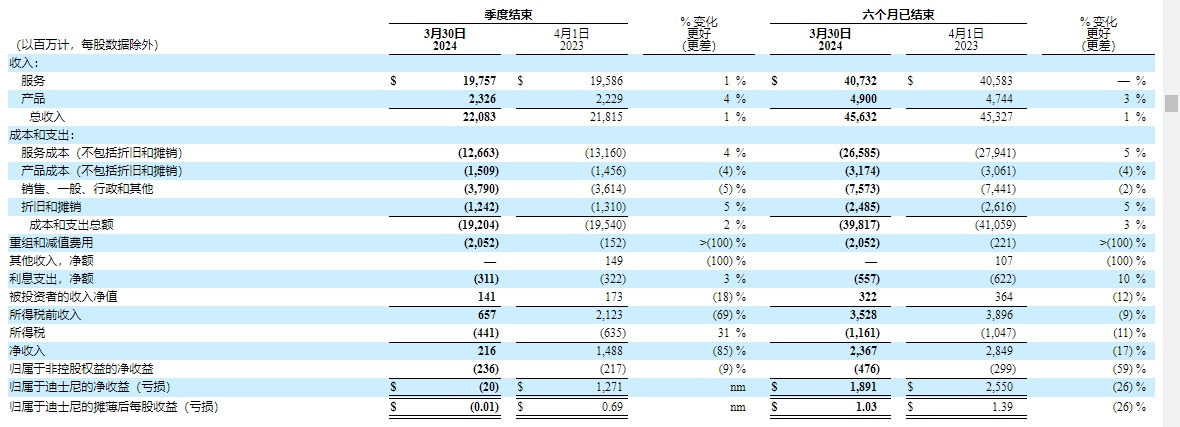
On Tuesday, May 7th, before the US stock market opened, Disney released its fiscal year 2024 second-quarter earnings report for the period ending March 30, 2024. The company reported revenue of $22.08 billion, a 1% year-over-year increase, which fell short of market expectations of $22.15 billion.$Disney(DIS.US)$Dow Jones Industrial Average(.DJI.US) $S&P 500(.SPX.US) $NASDAQ Composite Index(.IXIC.US) $Hang Seng Index(00HSI.HK) $Netflix(NFLX.US)$Invesco QQQ Trust(QQQ.US)

1. Summary of Personal Views
1. Disney's overall performance has remained stable in recent quarters, but revenue growth has shown signs of weakness. The company has significantly improved profitability through effective cost-control measures.
2. Compared to the steady growth of Disney's Parks, Experiences and Products segment, its Entertainment segment has continued to report declining revenue and low user engagement, reflecting a strategic shift toward higher-quality profitability.
3. The pandemic severely impacted Disney's offline tourism business and hindered the expansion of its streaming services. However, as the company adjusted its operational strategies, its streaming business has begun to turn profitable, and the Experiences segment has gradually regained growth momentum. Whether Disney can leverage this opportunity to reverse its downturn remains a key focus for the market.
Overall, Disney's performance has been stable in recent quarters, but revenue growth has been sluggish. The company has significantly improved profitability through cost-control measures. While the Parks, Experiences and Products segment has shown steady growth, the Entertainment segment faces challenges with declining revenue and low user engagement, aligning with its strategy to prioritize high-quality profitability. Despite the pandemic's impact on Disney's offline tourism and streaming businesses, the company's strategic adjustments have led to profitability in streaming and gradual recovery in the Experiences segment. The market will closely watch whether Disney can capitalize on this opportunity to turn things around.
2. Financial Analysis: Weak Revenue Growth, Better-than-Expected Profitability
Disney reported second-quarter revenue of $22.08 billion, a 1% year-over-year increase, falling short of market expectations of $22.15 billion. Since Disney adjusted its streaming strategy, recent revenue growth has been modest.
In terms of profitability, Disney's net income for the quarter was $216 million, compared to $1.488 billion in the same period last year. The company reported a loss per share of $0.01, compared to earnings per share of $0.70 in the prior-year quarter. Adjusted earnings per share were $1.21, up from $0.93 in the same period last year, exceeding expectations of $1.10. The improvement in profitability was primarily driven by the DTC business (mainly Disney+ and Hulu) achieving operating profitability for the first time.
3. Operational Analysis: Experiences Segment Continues Recovery, DTC Achieves Operating Profitability Ahead of Schedule, Guidance Raised
1. Disney Experiences Segment: Significant Recovery Trend
When people think of Disney, its iconic theme parks often come to mind. The Experiences segment—which includes theme parks, hotels, cruise lines, and merchandise—has been a major revenue driver in recent years. However, the global pandemic posed significant challenges.
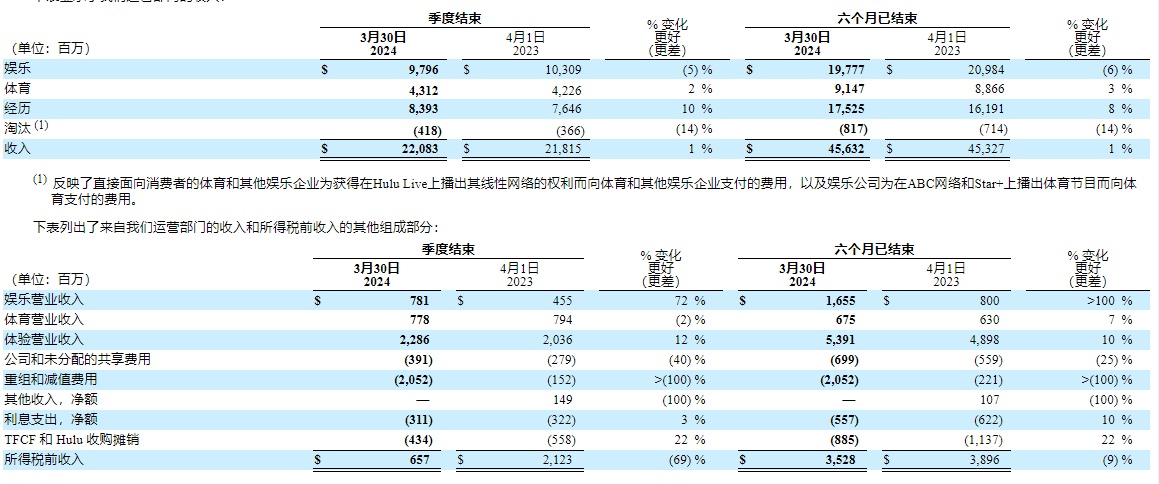
Fortunately, as the pandemic has been brought under control globally, Disney's Experiences segment has shown a notable recovery. In the latest earnings report, the segment contributed $8.39 billion in revenue, a 9.8% year-over-year increase, largely due to higher ticket prices.
In detail, the operating profit for Disney's Parks, Experiences and Products segment rose to $2.29 billion in the second quarter. This growth was primarily driven by strong performance in international markets, particularly Hong Kong, where visitor enthusiasm remains high.
2. Disney Entertainment Segment: DTC Achieves Operating Profitability Ahead of Schedule
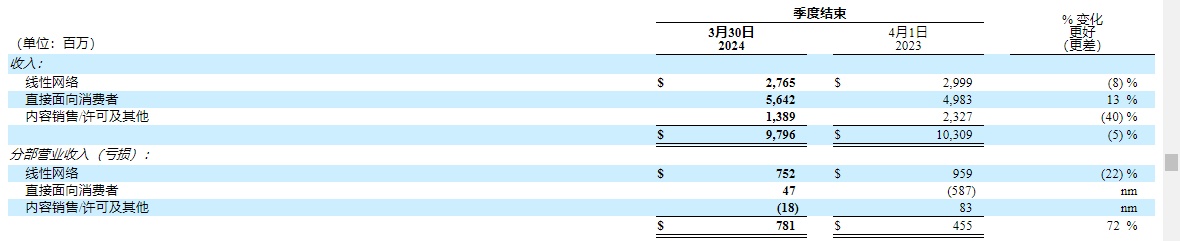
Disney's Entertainment segment reported second-quarter revenue of $9.796 billion, down 5% year-over-year. While this figure reflects market volatility, the more notable aspect is the performance of its streaming services. Although some user engagement metrics showed improvement, overall user attrition remains a significant issue, leading to a shrinking subscriber base. Since Disney announced its strategy to accelerate profitability in streaming, it has reduced marketing spending to boost user engagement.
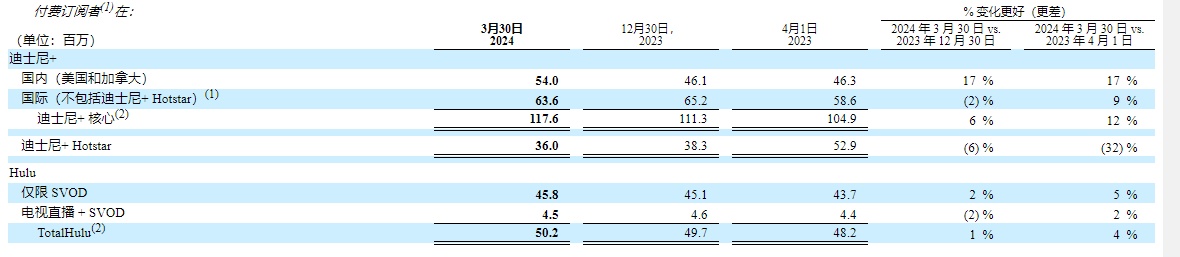
Disney has ultimately adopted a strategy similar to Netflix's, where pure subscriber growth is no longer the sole metric for success, and higher-quality profitability is the new focus. In terms of specific user data, Disney+ had approximately 117.6 million paid subscribers, up 6% year-over-year but slightly below analyst expectations. Meanwhile, Hulu's paid subscribers reached 50.2 million, up 1% year-over-year, showing steady growth but facing competitive pressures from other streaming platforms.
Within this segment, the direct-to-consumer entertainment business—which includes Disney+ and Hulu (excluding ESPN+)—reported operating income of $47 million this quarter, a significant improvement from an operating loss of $587 million in the same period last year. This marks the early achievement of a key profitability target, indicating that Disney's strategic adjustments in streaming are paying off and paving the way for more stable profit growth in the future.
3. Guidance Raised
Additionally, Disney announced that it expects full-year fiscal 2024 adjusted earnings per share to grow by 25% year-over-year. However, this forecast is slightly below the market consensus of 25.5%. While adjusted profitability this quarter was slightly better than expected, the guidance has not fully satisfied the market. Disney's stock performance in recent years has been weak, and future improvements in streaming profitability will be critical.
This article is a personal interpretation of the quarterly report, reflecting my own analysis within my capabilities. I welcome constructive feedback. Please note that this does not constitute investment advice, and readers should conduct their own independent research.
The copyright of this article belongs to the original author/organization.
The views expressed herein are solely those of the author and do not reflect the stance of the platform. The content is intended for investment reference purposes only and shall not be considered as investment advice. Please contact us if you have any questions or suggestions regarding the content services provided by the platform.
