


OpenAI's singularity moment

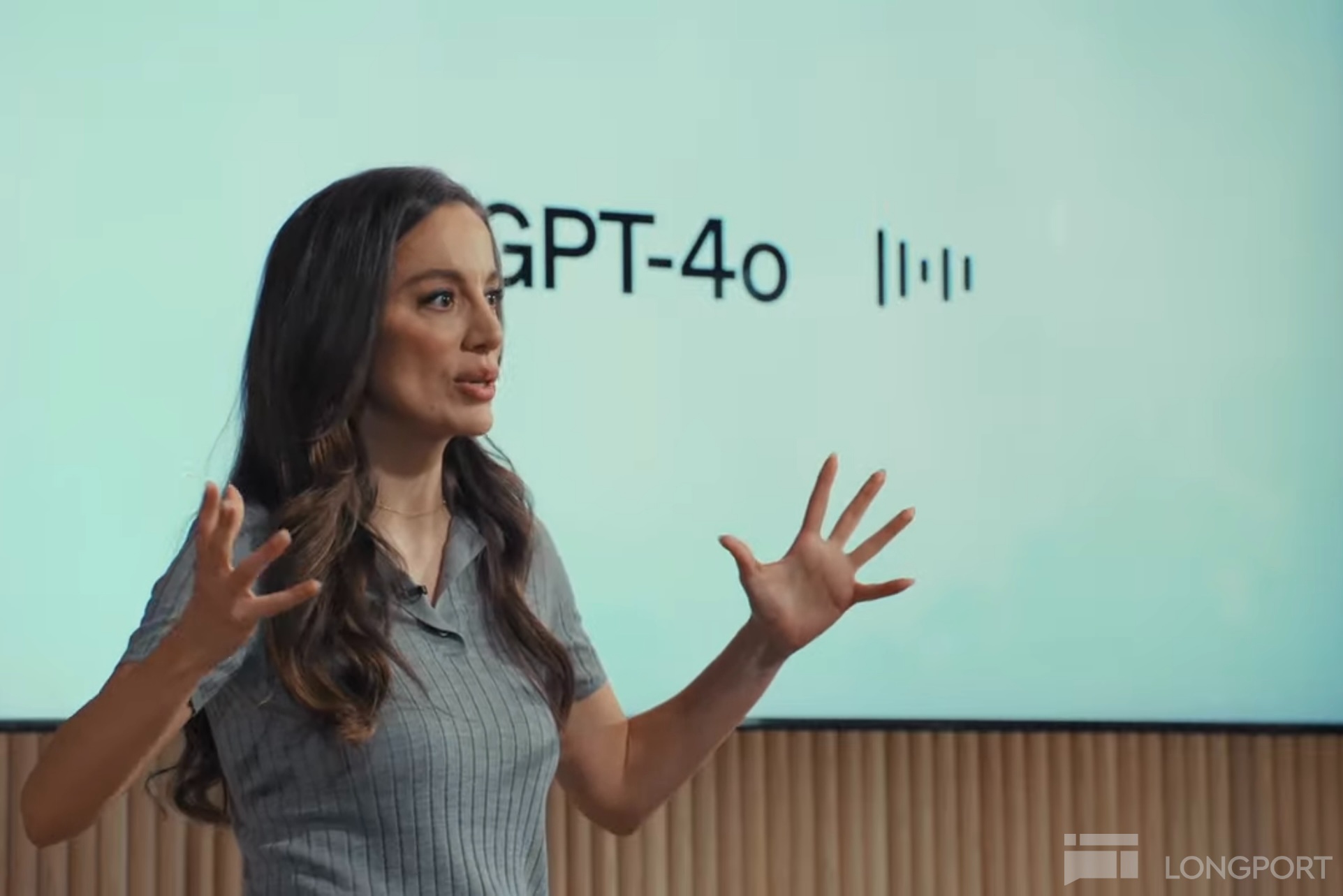
When OpenAI's Chief Technology Officer Mira Murati released the desktop version of ChatGPT and the new flagship model—GPT-4o, OpenAI's development entered a true singularity moment.
OpenAI's brief 26-minute launch event still caused quite a stir.
Whether it's ChatGPT-4o being completely free or the introduction of the PC desktop version of ChatGPT, both clearly demonstrate OpenAI's leading position.
However, blindly hyping OpenAI's lead without critical analysis is ultimately unproductive.
The reason is that OpenAI does indeed hold a relatively leading advantage in many aspects. This lead isn't just reflected in its gap with Google but also in its distance from Chinese AI players.
Through OpenAI's launch event, what we need to see more is the profound changes currently happening in the AI industry and how to identify new opportunities aligned with these trends.
If we must pinpoint the key takeaway from OpenAI's short event, I'd argue it's a direct manifestation of AI following the path of the internet.
Starting from this point, AI will truly transition from a lab-confined existence to one recognized, used, and accepted by an increasingly broader public.
If we view pre-ChatGPT-4o OpenAI as an evangelist, then post-ChatGPT-4o OpenAI is more like a practitioner.
In short, OpenAI is truly opening AI.
In the future, we'll see AI's presence in more scenarios and industries, with more players joining the process of popularizing and implementing AI.
Recognizing this, we might better grasp the deeper significance of OpenAI's 26-minute launch event.
I
The "bombshell" from OpenAI's event was the launch of ChatGPT-4o as a completely free application.
On the surface, one key reason for OpenAI going completely free is that its user growth has hit a plateau. To expand its user base, OpenAI is now adopting a free model to attract new users.
Since ChatGPT's debut last year, it peaked in May 2023 with 1.8 billion monthly visits, but traffic later declined. By March 2024, ChatGPT's visits stabilized at 1.8 billion, showing no significant growth.
By making ChatGPT-4o completely free and lowering the barrier to entry, OpenAI will immediately see user growth.
For OpenAI, which is stuck in a user growth bottleneck, this is undoubtedly a great experiment.
If we view ChatGPT-4o's free model as OpenAI's attempt to boost user numbers, then its expansion into more edge-side scenarios and code-generation applications extends OpenAI's user growth into broader domains.
This parallels the development of the internet industry.
We all know that before the internet became widespread, its usage wasn't as ubiquitous as today. In many cases, people had to pay for internet access, much like how AI is currently used.
Clearly, a paywall limits the internet's potential and prevents it from defining an era.
Thus, to unleash the internet's full potential and truly usher in an era, the key was making previously paid services free, thereby maximizing its 普及. Only then could "internet+" business models emerge.
In short, free access turned the internet into "infrastructure" and enabled the maturation of "internet+" models.
The same logic applies to AI.
Undoubtedly, OpenAI's ChatGPT has shown us AI's power and its positive impact on efficiency.
However, much of AI's current perception is still tied to 付费 models, limiting its potential.
In this context, AI can hardly become infrastructure or unleash greater potential.
Thus, if we must identify how AI is following the internet's path, going completely free to maximize 普及 and 孕育 new business models is the clearest manifestation.
Once OpenAI opens the door to free access, we'll likely see more players join, truly ushering in an era where AI is accessible to all and integrated into everything.
II
Beyond ChatGPT-4o's free model, OpenAI's event showcased GPT-4o's capabilities, benchmarks, safety, and limitations.
In terms of capabilities, before GPT-4o, ChatGPT's voice mode had average latencies of 2.8 seconds (GPT-3.5) and 5.4 seconds (GPT-4).
With GPT-4o, OpenAI trained a new model end-to-end across text, vision, and audio, meaning all inputs and outputs are processed by the same neural network.
In traditional benchmarks, GPT-4o matches GPT-4 Turbo in text, reasoning, and coding while excelling in multilingual, audio, and visual tasks.
On the MMLU (common-sense QA) test, GPT-4o scored a record 87.2%, far surpassing Google's Gemini Pro 1.5, Ultra 1.0, and even its own GPT-4T and GPT-4.
For safety and limitations, GPT-4o has built-in safeguards via filtered training data and post-training refinements. New safety systems also protect 语音输出。
Assessments of cybersecurity, CBRN, persuasion, and autonomy show GPT-4o poses no higher than medium risk in any category, with ongoing mitigation of new risks.
The core message behind these features is enabling faster, safer, and more efficient use of ChatGPT-4o by 更多 users.
Simply put, OpenAI's improvements to ChatGPT-4o aim to better commercialize its product.
This further illustrates AI's alignment with the internet's trajectory.
We know the internet evolved from DOS to Windows, then iOS and Android.
The ultimate goal of these OS upgrades was better commercialization and integration with business scenarios.
Only with such evolution did we see 门户网站, "internet+" apps, and the diverse applications of the mobile internet era.
In short, the internet's iterations directly enabled its commercial 普及。
AI is following the same path.
Ultimately, AI must anchor in commercialization to maximize its potential.
Otherwise, AI remains just a nice story for capital markets. When hype fades and self-sustainability becomes critical, its development will face challenges.
From Baidu's Robin Li to 360's Zhou Hongyi and Jinshajiang Venture's Zhu Xiaohu, many have echoed this view in different forums.
Their core argument is the same: AI must focus on scenarios, applications, and commercialization—not remain confined to labs or niche use cases.
ChatGPT-4o's launch shows OpenAI exploring commercialization methods. This marks the beginning of 更多 signs that AI is progressing along the internet's path.
III
Looking back at the internet's rise, its massive growth and integration into daily life stemmed largely from 普及。
Today, the internet is practically everyone's lifestyle.
The rise of livestreaming and short videos has pushed its 普及率 to new heights.
For AI to advance and become a new lifestyle, it must retrace the internet's steps—replicating its 普及 strategies.
If we seek new 启示 from OpenAI's event, its push for AI 普及 and acceptance by both B2B and B2C users is another key takeaway.
When OpenAI debuted ChatGPT as a chatbot, it was limited to conversational scenarios and basic reasoning.
Today, ChatGPT is far more than a chatbot—it can chat, generate images and videos, and even interact at human-like speeds.
OpenAI states GPT-4o ("o" for "omni") is a step toward more natural human-AI interaction—accepting any combination of text, audio, and image inputs to generate any combination of outputs.
GPT-4o responds to audio inputs in as little as 232 milliseconds (avg. 320 ms), matching human response times.
It matches GPT-4 Turbo in English text/code while significantly improving non-English performance. Its API is also 50% faster/cheaper, with 尤其 strong vision/audio understanding.
In short, OpenAI is lowering human-AI interaction barriers to boost 普及。
Comparing OpenAI's 交互 upgrades to the internet's evolution, their shared goal is 普及—making AI a new lifestyle.
Thus, another key 启示 from OpenAI's event is its push for AI 普及 along the internet's path.
As OpenAI CEO Sam Altman wrote post-event:
"I'm incredibly proud that we're offering the world's most advanced model in ChatGPT for free, without ads or distractions. OpenAI was founded to develop AI for global benefit. While we've built the tech, others have used it to create amazing outcomes. As a business, we charge for many services—but that doesn't stop us from providing free, cutting-edge AI to billions."
"The new voice/video mode is the best computer interface I've used. It feels like movie AI—it's surreal. Human-like speed and expressiveness mark a major shift. Original ChatGPT showed language interfaces' potential; this new tech is a qualitative leap. It's fast, smart, fun, natural, and useful. I've never felt such natural computer 对话 before. As we add personalization, info access, and action-taking, I foresee a thrilling future where computers help us achieve the unimaginable."
Conclusion
If we must distill OpenAI's 26-minute event into one message, it's clear: OpenAI is walking the internet's path.
Through this event, OpenAI completed its transition from AI evangelist to practitioner.
AI needs this shift toward free access,普及, and commercialization.
Thus, OpenAI begins truly opening AI.
Only through such 普及 and commercialization can AI transcend labs and niche status to become an internet-like force deeply integrated across industries.
This marks ChatGPT's true "iPhone moment" (as Nvidia CEO Jensen Huang put it), with GPT-4o being OpenAI's singularity moment.
—END—
Author: Meng Yonghui, Senior Writer, Columnist, Industry Observer, Influencer, Digital Economy Scholar.
The copyright of this article belongs to the original author/organization.
The views expressed herein are solely those of the author and do not reflect the stance of the platform. The content is intended for investment reference purposes only and shall not be considered as investment advice. Please contact us if you have any questions or suggestions regarding the content services provided by the platform.
