


After 30 months of reducing losses, Ele.me is feeling a bit tired.

@新熵 Original
Author 丨 Gu Nian Editor 丨 Yi Ye
Alibaba's local services sector, despite reducing losses, remains unprofitable with a deficit of 3.2 billion yuan.
Since Q4 2021, Ele.me has been telling a story of narrowing losses for 30 consecutive months. However, in the latest financial report, local services still rank as Alibaba Group's second-largest loss-maker, surpassed only by the international business segment, which is aggressively expanding globally with a high investment loss of 4.1 billion yuan.
In terms of growth rates, the international business appears more cost-effective despite its losses. The international segment's 4.1 billion yuan loss yielded a 45% year-on-year revenue increase, while local services' 3.2 billion yuan loss only brought a 19% growth. The former is trading money for growth potential, while the latter is simply burning cash.
The contrast in the group's attitude toward these two loss-makers is stark. For the international business—Alibaba's "ocean of stars" for the future—the focus is on growth rather than short-term profits. Meanwhile, after multiple adjustments, local services must prioritize sustained loss reduction and profitability.
Unfavored internally, Alibaba's local services also struggle externally. Its longtime rival Meituan achieved its third annual profit in 2023, with core local commerce revenue growing 29%—proving that profitability doesn't hinder growth.
In the same arena: Meituan profits while growing; Ele.me shrinks losses while stabilizing. These contrasting operational rhythms challenge the industry assumption that internet businesses can easily turn profitable by "squeezing"—slowing expansion and cutting user subsidies.
Yet even without aggressive competition, focusing on existing markets doesn't guarantee profitability. Amid cost-cutting and profit-focused strategies, Ele.me is losing its edge as an independent platform, becoming just a component of Alibaba's local services alongside Amap.
Under former Local Services Group CEO Yu Yongfu's focused strategy, Amap emerged as Alibaba's most aggressive local services app.
In March 2023, Alibaba merged its dine-in platform Koubei with Amap, embedding the business into the navigation app's 100M+ user base to boost transactions and GMV. This split local services into two: Amap for dine-in, Ele.me for delivery.
As super apps trend, Meituan consolidated its delivery and dine-in services in April. While the map war is settled, Ele.me—still battling fierce competition—is left in the toughest spot.
Per Jiuqian data, Meituan Instashopping (34%), Ele.me (non-food, 26%), and JD Daojia (15%) led 2022's instant retail market by GMV.
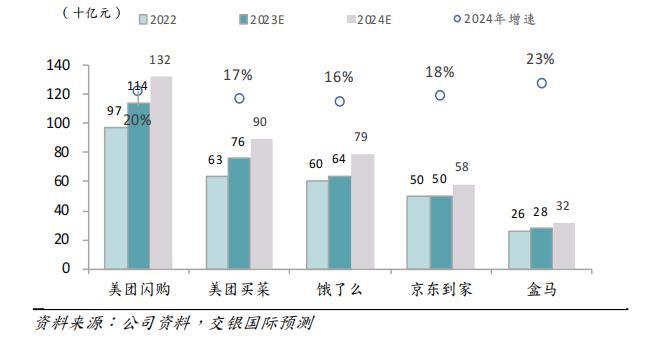
Though second place is respectable, Ele.me shows fatigue against Meituan and JD's resource-backed offensives. BOCOM International predicts 2024 GMV growth rates: Meituan Instashopping (20%) > JD Daojia (18%) > Meituan Grocery (17%) > Ele.me (16%).
With lagging growth, Ele.me's ability to defend its position in instant retail—local services' hottest battleground—will determine its value within Alibaba.
The copyright of this article belongs to the original author/organization.
The views expressed herein are solely those of the author and do not reflect the stance of the platform. The content is intended for investment reference purposes only and shall not be considered as investment advice. Please contact us if you have any questions or suggestions regarding the content services provided by the platform.
