


[Must Read] NVIDIA Stock Split: What You Need to Know About the Impact

Following $NVIDIA(NVDA.US)'s stock price soaring to 1100 after its Q1 2024 earnings report, NVIDIA will complete its sixth stock split after the market closes on June 7 and begin trading at the post-split price on June 10. If you're wondering "what impact does a stock split have," this article will provide the answers. It covers the following topics:
1. The impact of a stock split on the underlying stock
2. The impact of a stock split on options
3. The impact of a stock split on ETFs
4. Research on the post-split market impact—using Tesla's 2020 stock split as an example
5. Dolphin Research's latest analysis on NVIDIA
1. The impact of a stock split on the underlying stock
1. Trading schedule and position changes before and after the split
- NVIDIA's stock split will take effect after the after-hours trading session on June 7;
- There will be no overnight trading for NVIDIA on June 7, 10, and 11;
- Trading will resume at the post-split price during the pre-market session on June 10, and your positions will be automatically adjusted before the market opens.

2. Impact on stock liquidity
NVIDIA has undergone five stock splits in its history. Here’s a look at the split dates, plans, and post-split stock performance:
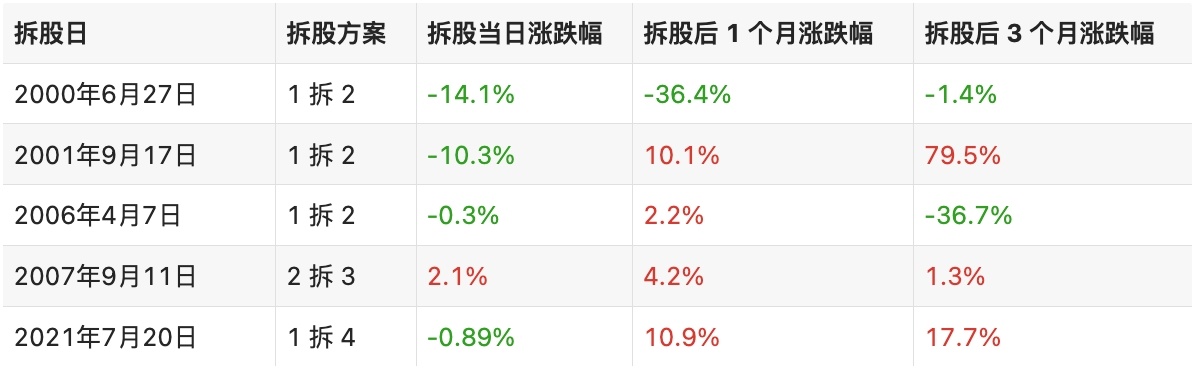
A stock split does not change the company's total market capitalization but adjusts the number of shares held by shareholders and significantly reduces the stock price per share. The company previously stated that stock splits make it easier for employees and investors to purchase shares.
The market generally believes that although the company's fundamentals remain unchanged, investors psychologically tend to react positively to stock splits, perceiving the stock as "cheaper." Splits can improve liquidity and attract more buyers. On a split-adjusted basis, if NVIDIA had not undergone five splits, its current stock price would be approximately $55,000—a price that would deter most retail investors.
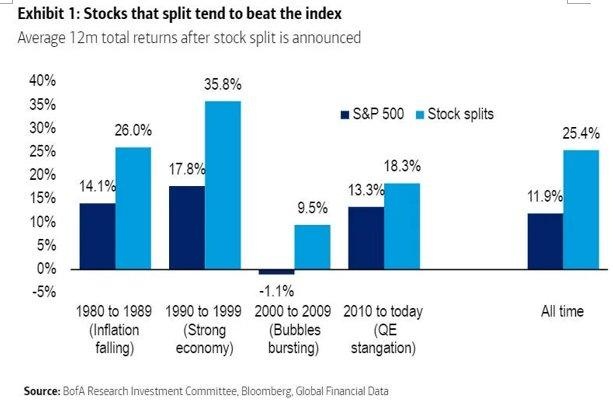
Bank of America's analysis shows that historically, stock splits are often viewed as bullish signals. According to BofA's data since 1980, S&P 500 companies that announced stock splits outperformed the index over the subsequent 3, 6, and 12 months, with an average 12-month gain of 25.4% compared to the S&P 500's average gain of 11.9%.
3. Increased likelihood of inclusion in the Dow Jones Index
The Dow Jones Index is a price-weighted average of 30 prominent U.S.-listed companies representing various industries. As the leading semiconductor company, NVIDIA should be included, but its high stock price would distort the index.
Some analysts speculate that unlike the two-month gap between NVIDIA's announcement and execution of its 2021 split, this split is scheduled just two weeks after the announcement with a large ratio, possibly to align with a potential Dow Jones component adjustment on June 14.
However, looking at the past two "Big 7" companies, it took 1 to 2 years from their split announcements to their inclusion in the Dow. Will NVIDIA be added quickly this time?
- Amazon announced a 1-for-20 split on March 9, 2022, and was added to the Dow on February 20, 2024—a two-year gap;
- Apple announced a 1-for-7 split on April 23, 2014, and was added to the Dow on March 6, 2015—a one-year gap;
4. Post-split stock performance of the "Big 7"
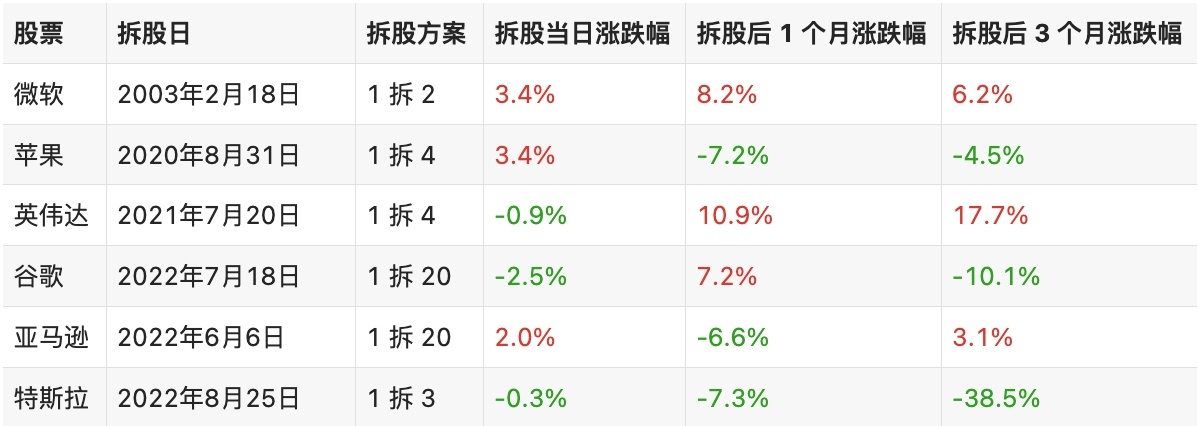
*Note: Meta has no history of stock splits.
2. The impact of a stock split on options
1. NVIDIA's options split plan
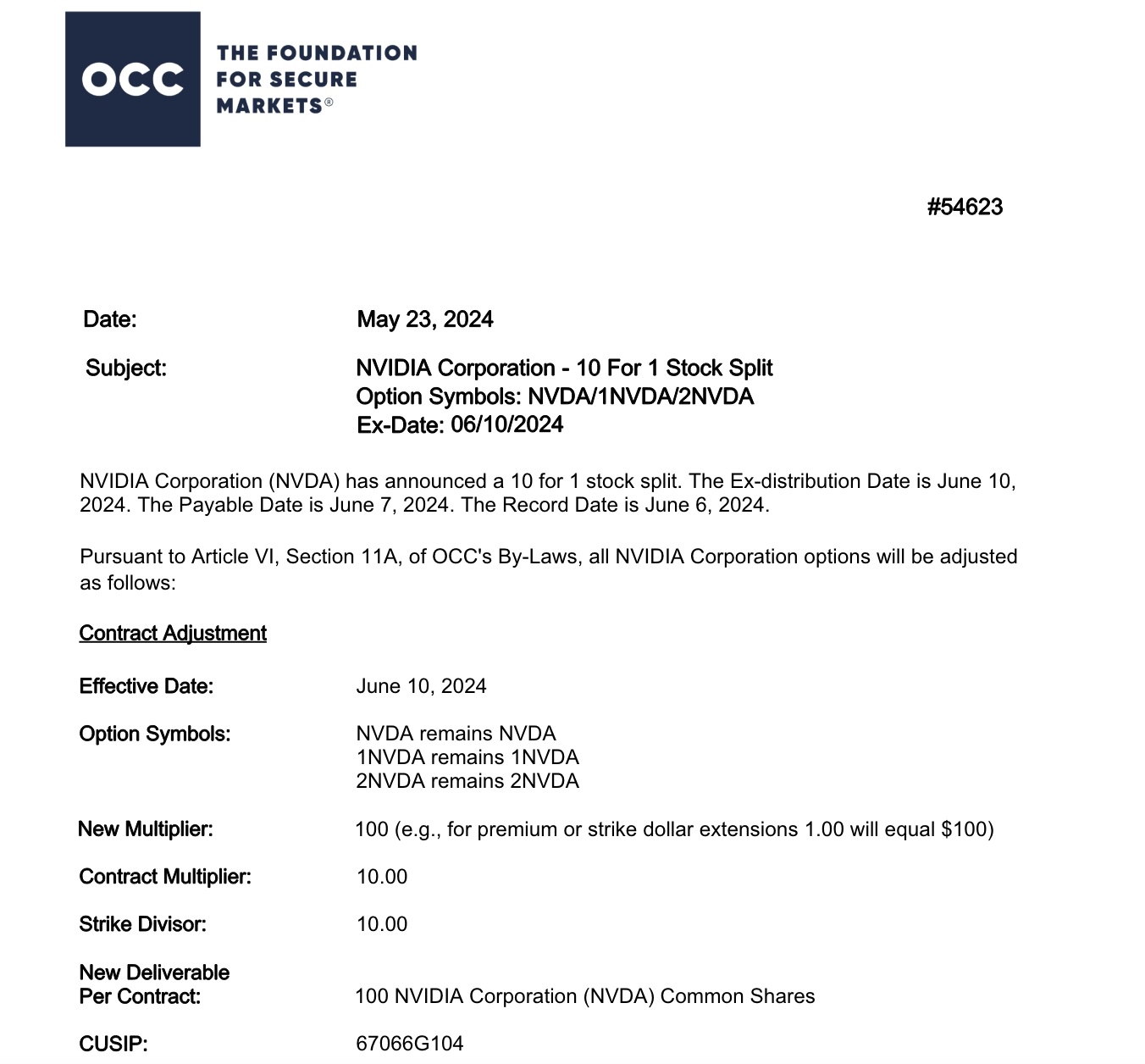
According to the Options Clearing Corporation (OCC)'s announcement on NVDA options contract adjustments, after the stock split takes effect on June 10, the number of options contracts held by investors will increase tenfold.
2. Options position adjustment schedule
Under this split plan, if you hold one unexpired NVIDIA options contract after the market closes on June 7, your contract will be adjusted before the U.S. market opens on June 10: the strike price will be reduced to 1/10, and the number of contracts will increase to 10.
3. Impact on options liquidity
Some analysts believe the split will boost investor interest in options trading, improving liquidity for new contracts:
For example, the "NVDA 240621 1150 Call" option currently costs around $4,200 per contract—a high barrier for retail investors. Post-split, the cost is expected to drop to 1/10 of the current price.
3. The impact of a stock split on ETFs
1. Leveraged and inverse ETFs
The following leveraged/inverse ETFs* will not adjust for NVIDIA's split:
- 2x Long ETF: $GraniteShares 2x Long NVDA Daily ETF(NVDL.US)
- 1x Short ETF: $Direxion Daily NVDA Bear 1X ETF(NVDD.US)
- 1.25x Short ETF: $AXS 1.5X NVDA Bear Daily ETF(NVDS.US)
- 2x Short ETF: $GraniteShares 2x Short NVDA Daily ETF(NVD.US)
*This is a partial list for reference only.
2. NVIDIA-related ETFs
Covered call ETFs like $YieldMax NVDA Option Income Strategy ETF(NVDY.US) and index ETFs holding NVIDIA will not be affected.
4. Research on the post-split market impact—using Tesla's 2020 stock split as an example
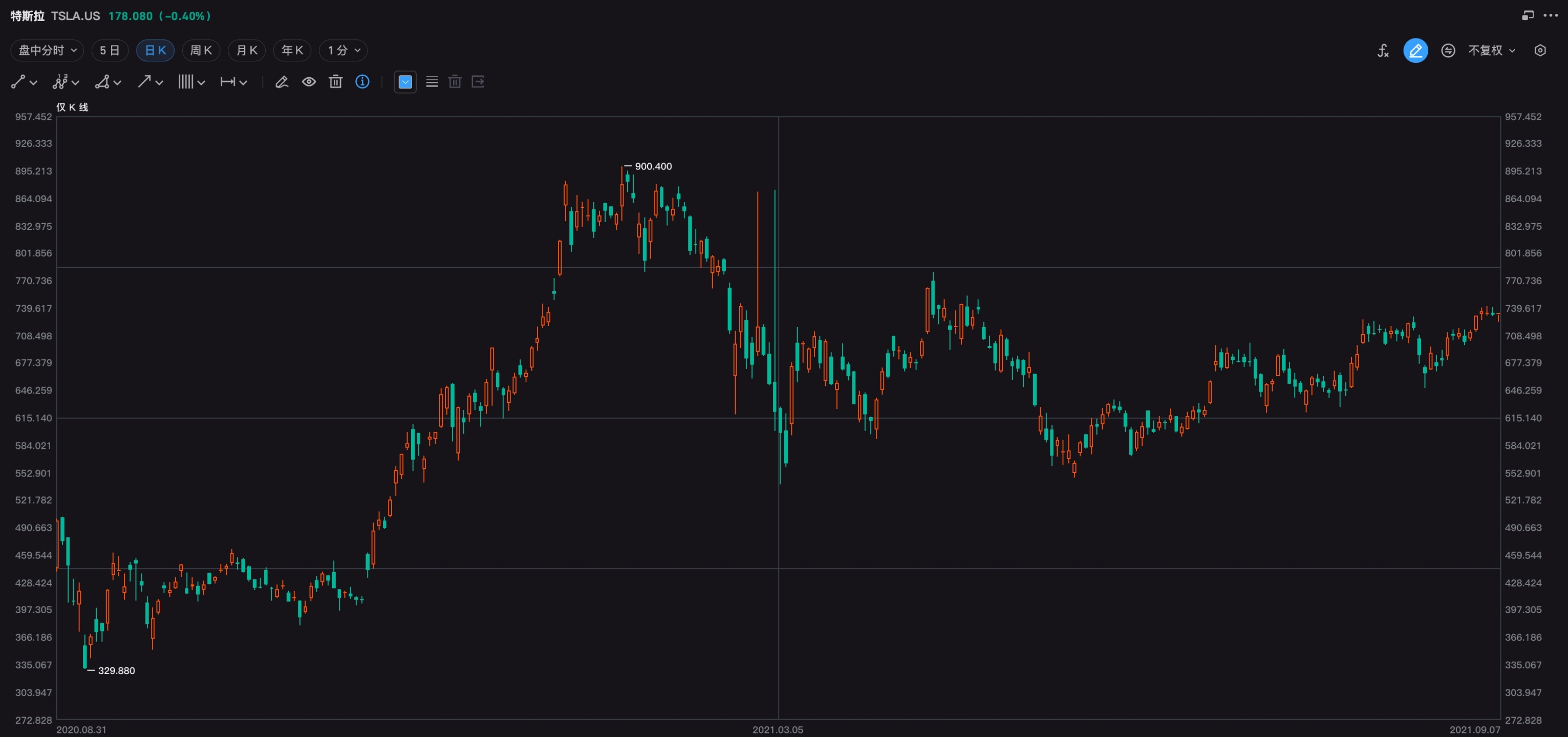
NVIDIA's split comes amid skyrocketing stock performance (up 239% in 2023 and 120% YTD in 2024), similar to Tesla's 743% surge in 2020 before its split on August 31, 2020. Here’s a look at Tesla's post-split performance:

5. Dolphin Research's latest analysis on NVIDIA
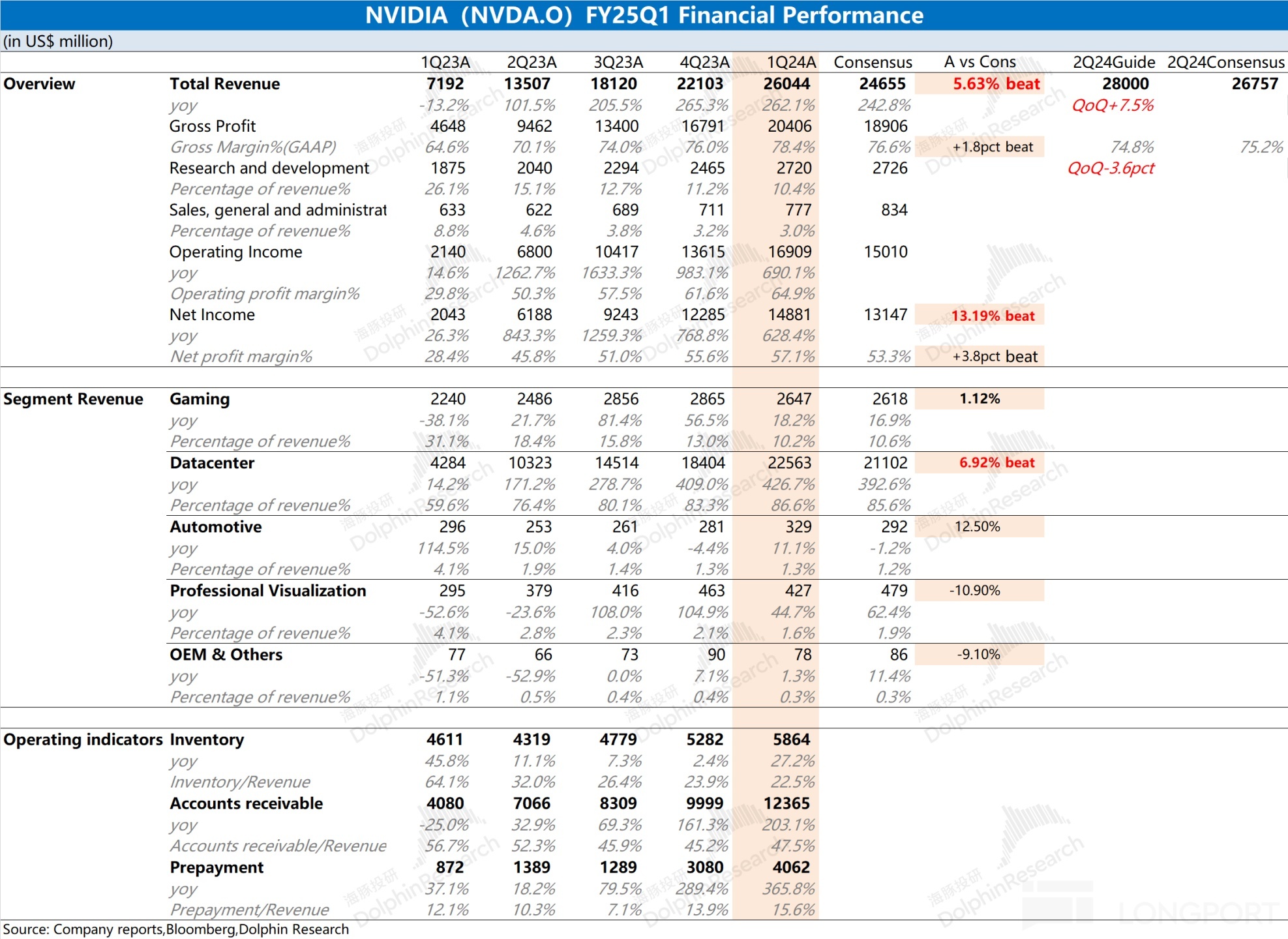
Key takeaways from the latest earnings report:
NVIDIA delivered another stellar quarter, with revenue and gross margins hitting record highs. The outperformance was primarily driven by its data center segment. With leading product capabilities, NVIDIA's results demonstrate strong alpha. Even as peers (AMD & Intel) reported lackluster numbers, NVIDIA's growth remains robust.
Management guided for Q2 revenue of $28 billion (±2%) and gross margins of 74.8% (±0.5%). The company will begin shipping Blackwell in Q2, further driving growth. While margin guidance wasn't raised, maintaining ~75% is still impressive.
NVIDIA is now heavily focused on data centers, which account for ~85% of revenue. Its sustained growth stems from technological leadership and rapid product iteration, with annual releases keeping it ahead of competitors.
Major tech firms like Microsoft, Google, and Amazon are increasing capex, signaling growing demand for data centers and AI. Unlike AMD and Intel's weak results, NVIDIA continues to thrive by capturing the lion's share of AI chip investments.
Despite NVIDIA's stock surging multiple times from its lows, its earnings fully justify the valuation. The 1-for-10 split announced for June will lower the investment barrier, potentially boosting trading volume. With unmatched computing power and innovation, NVIDIA remains the undisputed leader in AI chips.
Detailed NVIDIA earnings analysis:NVIDIA: The "Universe's" Strongest Stock, Delivering Gifts Nonstop
Risk Disclaimer: The above content represents the author's personal views and does not reflect the stance of Longbridge or constitute investment advice. Investors should consider risks and consult professionals before making decisions. Longbridge does not guarantee the accuracy or originality of this content.
NVIDIA's split-related adjustments for stocks, options, and other products may differ from the timelines mentioned. This material is for educational purposes only.
The copyright of this article belongs to the original author/organization.
The views expressed herein are solely those of the author and do not reflect the stance of the platform. The content is intended for investment reference purposes only and shall not be considered as investment advice. Please contact us if you have any questions or suggestions regarding the content services provided by the platform.
