
 Likes Received
 Posts
PostsDidi Chuxing IPO analysis: The best fundamentals in the ride-hailing sector, with favorable valuation expectations, subscribe now!

The A-share market ultimately lost its defensive battle. Unlike the sluggish performance of the broader market, IPO subscriptions in Hong Kong stocks remain exceptionally hot.
Six new stocks were listed in just two days, with four of them seeing overwhelming demand—each oversubscribed by over 100 times.
Today, let’s analyze China’s first ride-hailing platform: DiDi Chuxing.$DiDi(DIDIY.US)
1. Fundamental Analysis
① What does the company do?
Most of you have probably used DiDi Chuxing, so I won’t quote the prospectus verbatim.
But even if you’ve used it, without carefully reading the prospectus, you might assume DiDi Chuxing is similar to other ride-hailing platforms, right?
In reality, DiDi Chuxing’s business model is quite different from traditional ride-hailing companies—it’s fundamentally distinct!
Here’s a practical trick to spot the difference without reading the prospectus:
Just look at the gross margin!!!
DiDi Chuxing consistently maintains a gross margin of 75%-80%, while traditional ride-hailing platforms hover around 15%-18%—there’s no comparison!
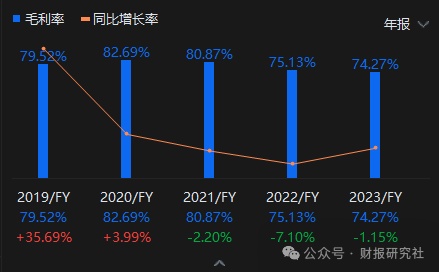
So, let’s correct a common mistake made by some online influencers: comparing DiDi Chuxing’s valuation directly with other ride-hailing platforms is fundamentally flawed!
Now, let’s dive into the prospectus to understand why DiDi’s business model stands apart.
On page 166, we learn that China’s passenger vehicle market can be divided into three segments: traditional taxis, ride-sharing (顺风车), and ride-hailing (网约车).
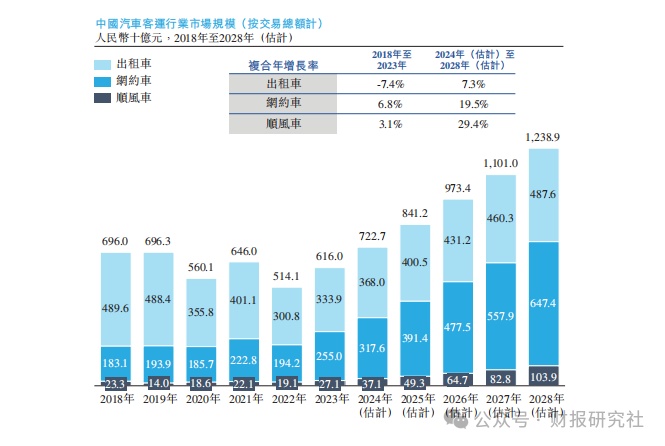
From a long-term investment perspective, ride-sharing adds no additional vehicles to the road—it meets demand by sharing empty seats. This model aligns with the global carbon-neutral trend and carries ESG benefits.
DiDi Chuxing primarily earns revenue from ride-sharing and taxis, making its core business fundamentally different from platforms focused on ride-hailing.
So, what’s the operational difference? Check out the chart on page 170:
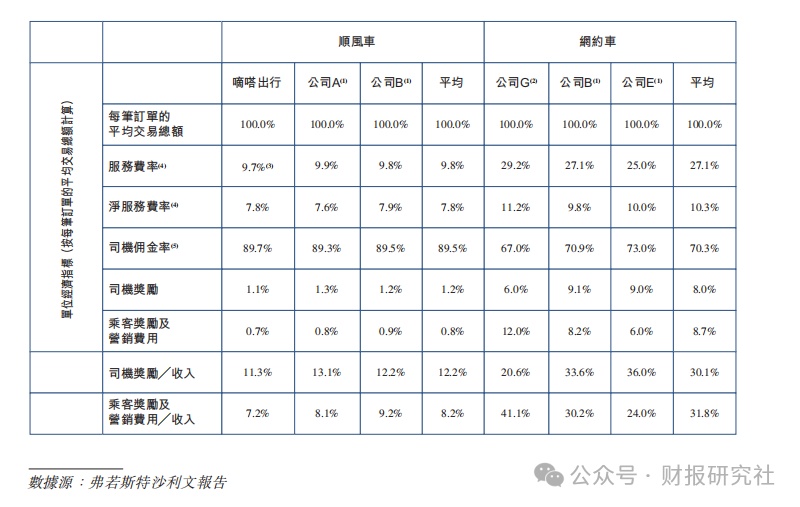
Ride-hailing platforms spend heavily on passenger incentives and marketing to boost engagement, leading to higher operational costs and lower driver commissions.
In contrast, ride-sharing platforms have lower operational costs, allowing them to charge drivers lower fees while increasing their take-home pay.
Thus, ride-sharing drivers earn a higher percentage of fares compared to ride-hailing drivers.
Conclusion: Ride-sharing platforms enjoy significantly higher gross margins!
Having explained DiDi’s business model at length, let’s examine its financials.
② How’s the company’s performance?
Revenue for 2021-2023 was RMB 781M, 569M, and 815M, respectively. The 2022 dip was COVID-related, so we’ll compare 2021 and 2023 directly:
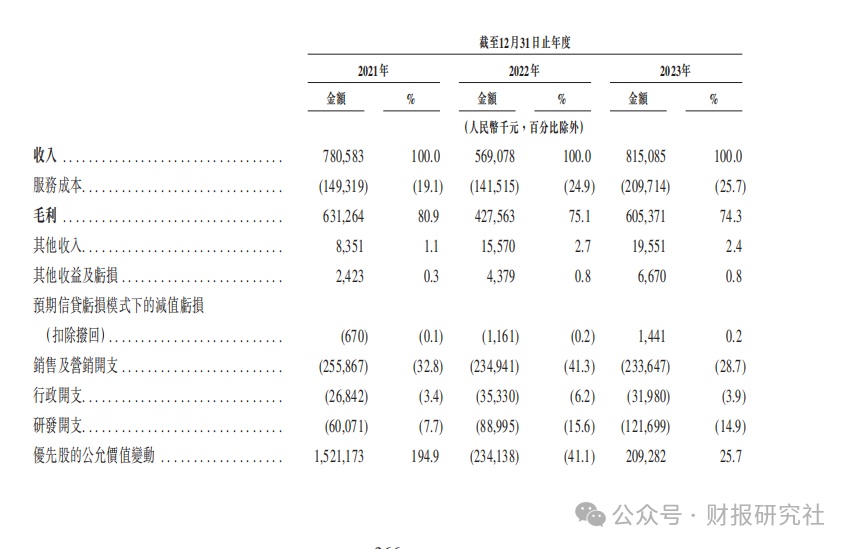
2023 revenue grew 4.4% YoY vs. 2021.
Adjusted net profit (excluding 2022) declined 5.3% over the same period.
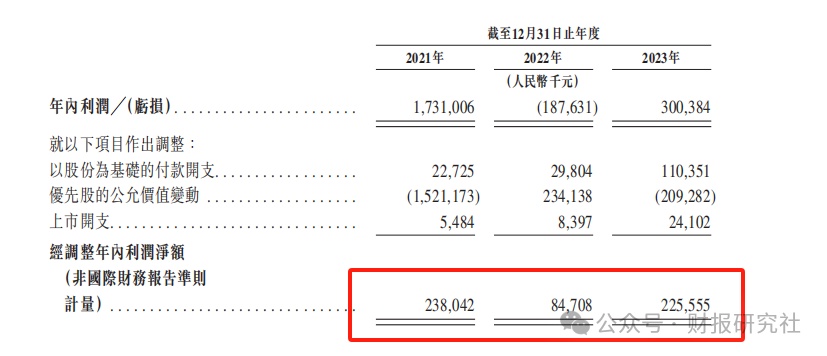
While DiDi Chuxing’s growth appears modest, it’s the only ride-hailing company with five consecutive years of positive adjusted profits!
DiDi Global (DIDIY) is perennially unprofitable. CaoCao Mobility’s gross margins for the past three years were -24.4%, -4.4%, and 5.8%; Ruqi Mobility’s were -24.2%, -10.7%, and -7.0%.
Only ride-sharing leader Hello Mobility’s profitability remains unclear.
Operating cash flow—a truer performance metric—was RMB 135M, 107M, and 230M for 2021-2023.
Valuation, however, is tricky.
Using 2023’s adjusted net profit of RMB 226M, DiDi trades at a static P/E of 20.5x-28.6x.
Most ride-hailing peers are listed in the U.S. (e.g., DiDi Global and Uber).
Frankly, their models differ (recall the business model section). DiDi’s 75% gross margin dwarfs DiDi Global’s 16% and even Uber’s 39%.
① If the market compares DiDi to Uber, it looks cheap based on P/E.
DiDi’s static P/E is 20.5x-28.6x vs. Uber’s 111x.
② Given DiDi’s net cash position, we also apply EV/EBITDA.
Formula: EV = market cap - net cash. The company held RMB 1.42B in cash (net RMB 800M after payables), implying an EV of HKD 4.2B-6.2B. Adjusted EBITDA was RMB 256M (HKD 275M), yielding an EV/EBITDA of 15.3x-22.56x.
Analysts project 2024 net profit near RMB 300M (EBITDA ~RMB 350M or HKD 390M), lowering 2024 EV/EBITDA to 10x-15x.
Conclusion: At the lower pricing bound, DiDi is undervalued; at the upper bound, it’s fairly priced.
This IPO pricing shows genuine 诚意。
Let’s see how the market responds!
③ Competitive Advantages
As established, DiDi operates in ride-sharing—a highly concentrated sector:
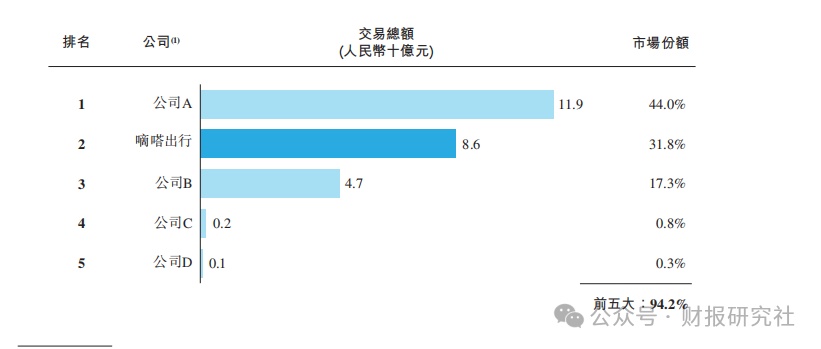
The top three players—Hello Mobility (leader), DiDi (second), and DiDi Global (third)—control 96.1% of the market.
Translation: Smaller players can’t survive; these three will dominate industry growth.
Thus, industry growth (~29.4% CAGR from 2024-2028) directly fuels DiDi’s revenue trajectory.
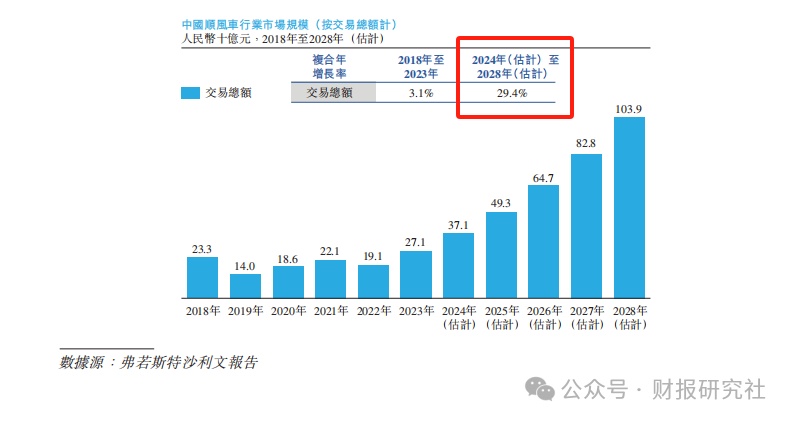
With its #2 position, DiDi is poised for 25%+ annual revenue growth—a true growth stock.
2. Underwriters + Float Size
At the midpoint valuation, the float is just 3.93%—the smallest among recent IPOs. Small floats historically outperform.
Three underwriters are involved:
Haitong Securities (2/2 recent wins), CICC (3/3), and Nomura (weak track record but last led a deal in 2020).
Net positive for DiDi.
3. Subscription Plan
DiDi stands out with five years of profitability and positive cash flow. Its ride-sharing niche—growing at 29% CAGR—offers clear upside, though valuation requires nuance. With strong underwriters and a tiny float, I’m subscribing with margin.
$LAOPU GOLD(06181.HK) $METASURFACE(08637.HK) $TIANJUDIHE(02479.HK)
The copyright of this article belongs to the original author/organization.
The views expressed herein are solely those of the author and do not reflect the stance of the platform. The content is intended for investment reference purposes only and shall not be considered as investment advice. Please contact us if you have any questions or suggestions regarding the content services provided by the platform.
