


Scale bottleneck is hard to break, RoboTaxi services like Baidu's Apollo Go find it difficult to disrupt ride-hailing in the short term.


Recently, Robo-taxi has become a hot topic in Wuhan, and Tesla's Robotaxi is also on the agenda (scheduled to be released on October 10, 2024). This has sparked a series of discussions around the industry. Some view it as a sign of another technological revolution, while opponents express concerns about its potential impact on the employment of ride-hailing and taxi drivers.
Many institutions have already praised Robotaxi (autonomous ride-hailing) and begun to envision a trillion-dollar market if Robotaxi completely replaces taxis and ride-hailing services. Leading companies are expected to benefit significantly (some institutions have even started predicting the "market size" of representative companies).
However, the launch and popularization of a new technology or business model never depend solely on the "technology" itself but are closely tied to the economy, policies, and society. While Robotaxi is technologically impressive, it still faces numerous obstacles in implementation and rapid adoption, many of which cannot be solved by technological iteration alone.
With these questions in mind, we wrote this article, with the following key points:
First, Robotaxi has low driving costs but operating costs still exceed those of ride-hailing services like Didi Express;
Second, scaling and networking are necessary conditions for Robotaxi to achieve profitability, and currently, only Wuhan has this potential;
Third, against the current employment backdrop, local governments will be more cautious about Robo-taxi, making it difficult to break through the bottlenecks of scaling and networking. The expectation of full profitability for companies may be delayed.
Scaling is a necessary condition for profitability
The recent popularity of Robotaxi is not only due to its impressive high-tech appeal but also because it has created a new societal consensus: autonomous taxis are cheaper (no labor costs) and machines don’t tire, so pricing will inevitably be lower than human-driven taxis and ride-hailing services. This has caused significant panic in society.
So, how much of a cost advantage does Robotaxi really have? JAZZ Research and Guohai Securities previously compared its costs with fuel and electric ride-hailing services, and the findings have been widely circulated in the market. See the chart below:
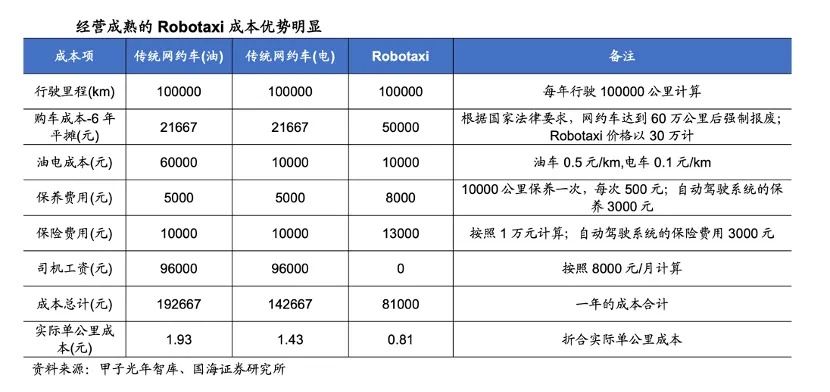
The chart above visually demonstrates Robotaxi’s cost advantages over fuel and electric ride-hailing services, though there are some flaws in the details:
1) For the foreseeable future, Robotaxi cannot be completely "driverless";
According to the "Guidelines for the Safety Service of Autonomous Vehicles (Trial)" issued by the Ministry of Transport in November 2023, fully autonomous vehicles engaged in taxi services may use remote safety officers in designated areas with the approval of municipal governments, ensuring safety. The ratio of remote safety officers to vehicles must not be lower than 1:3, meaning each vehicle will bear 1/3 of the safety officer’s labor cost;
2) The procurement price of the new-generation Robo-taxi has dropped to 200,000 yuan. Assuming the cost of a safety officer is similar to that of a ride-hailing driver (96,000 yuan per year), each vehicle would bear 32,000 yuan. Considering these variables, Robotaxi’s cost per kilometer would be approximately 0.96 yuan, about 70% of that of electric ride-hailing services.
So far, Robotaxi has been deployed in many cities (Beijing, Chongqing, Shanghai, Wuhan, etc.), but it remains limited to specific areas. Wuhan has the largest operational area, covering 3,000 square kilometers (Wuhan’s total area is 8,569.15 square kilometers).
Limited operational areas restrict both the distance per ride and overall demand.
The profitability of ride-hailing services is essentially a product of network effects. For electric ride-hailing, the operating cost per kilometer is about 1.43 yuan. Theoretically, if the order frequency and density are high enough, the pricing floor would be 1.43 yuan. While Robotaxi has a cost advantage in driving, without sufficient scale, vehicles would have high idle rates. To break even, the pricing would have to be much higher than the 0.96 yuan we analyzed earlier, making operating costs relatively high.
Guotai Junan Securities compiled the pricing standards for Robo-taxi in representative regions. See the chart below:
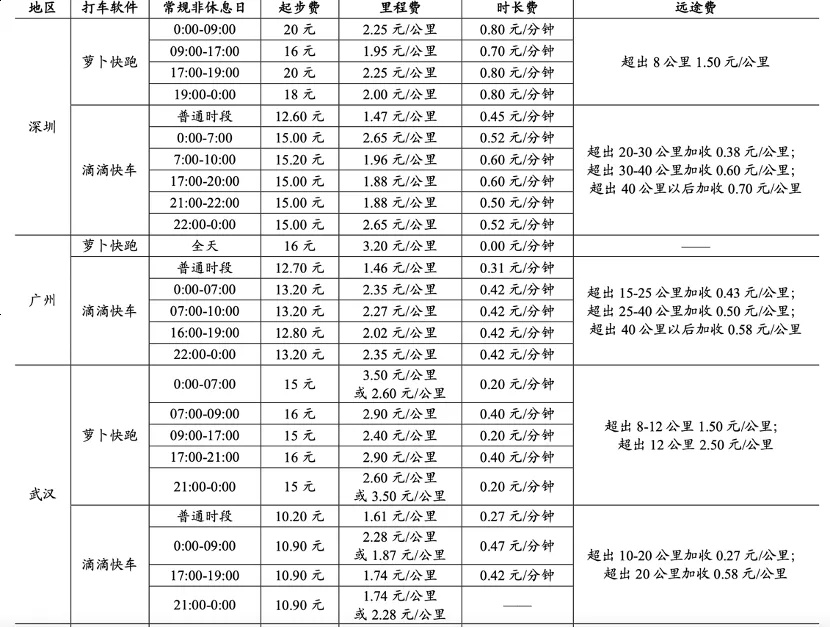
The public generally believes that autonomous ride-hailing has lower costs and thus a crushing price advantage. Unfortunately, Robo-taxi’s pricing in most regions is still significantly higher than Didi Express, which is an inevitable result of limited scale effects (Robo-taxi’s operating costs are likely higher than those of regular ride-hailing services).
In early July, media widely discussed Robo-taxi’s low-price dominance in Wuhan. This reflects the company’s attempt to use subsidies to increase user and market acceptance and quickly address the aforementioned shortcomings. However, subsidies are a reactive measure and unsustainable (recent reports indicate that Robo-taxi’s subsidies in Wuhan have decreased).
Wuhan is indeed Robo-taxi’s "stronghold," with the largest operational area and the most vehicles (currently over 400). Subsidies are reasonable here and underpin management’s claim of "profitability in Wuhan by 2025." Wuhan’s uniqueness allows Robo-taxi to achieve networking and scaling through subsidies. The question is: Can Wuhan’s scenario be replicated in other regions in the short term?
Employment context: Short-term caution toward Robotaxi
When analysts envision Robotaxi’s future, they often romanticize it by stating, "Assuming Robotaxi replaces all ride-hailing and taxi services," portraying it as an incredibly bright industry.
But can Robotaxi replace all ride-hailing and taxi services in the medium term? Next, we analyze this from an employment perspective.
According to Ministry of Transport data, China currently has about 1.3913 million taxis and 2.95 million ride-hailing vehicles, with 6.964 million ride-hailing driver licenses issued. This is a workforce of millions. Next, we examine how this group will influence policies.
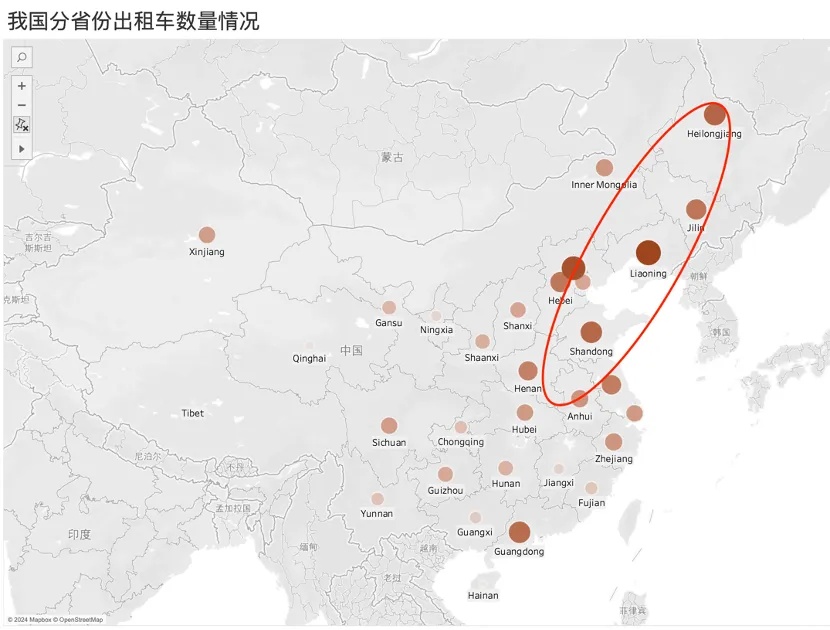
We compiled taxi numbers by province and marked them on a map, with darker colors indicating higher quantities. Northern regions have the most taxis. For example, Heilongjiang has a higher taxi count than Hubei or Sichuan, despite its lower population density. This may be due to the industry absorbing large numbers of workers during economic reforms in the late 20th and early 21st centuries.
In contrast, southern regions, with more vibrant economies, offer more flexible employment options, resulting in relatively lower taxi numbers. To some extent, taxis represent China’s early "flexible employment" industry, reflecting the economic characteristics of different provinces.
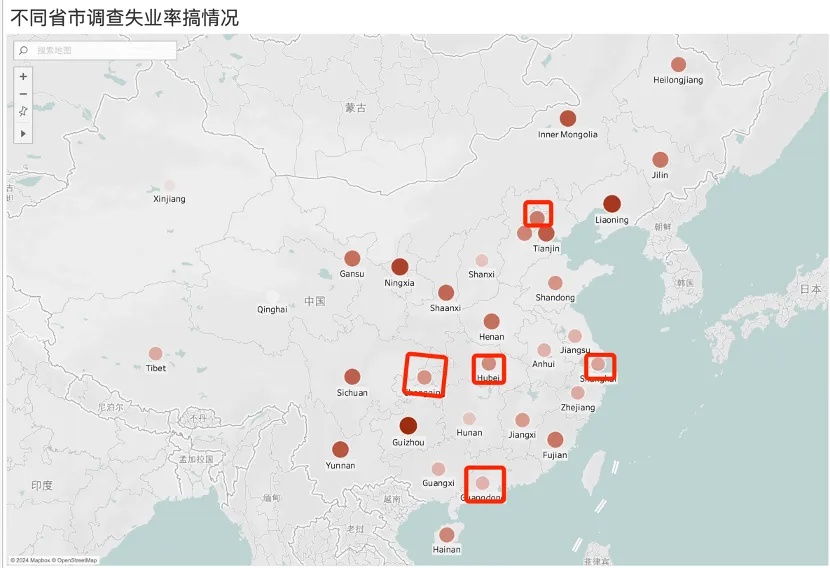
Following this logic, we also compiled 2022 surveyed unemployment rates by province, with darker colors indicating higher rates. We highlighted regions most friendly to Robo-taxi.
In summary, these regions share:
1) Relatively low taxi numbers;
2) Very low surveyed unemployment rates.
In other words, in economically active regions, taxi and ride-hailing drivers may have more employment options, making Robotaxi’s impact on employment relatively manageable. Governments focus more on the positive aspects of new technology (e.g., urban governance, smart transportation). Conversely, in regions with large numbers of taxi and ride-hailing workers and higher unemployment rates (fewer employment alternatives), local governments must consider Robotaxi’s negative effects and weigh whether the benefits outweigh the drawbacks.
In northern and southwestern regions, societal attitudes toward Robotaxi are likely to be conservative, which is also a key reason for Robo-taxi’s slow progress in the north.
Against the backdrop of tight employment, ride-hailing and taxis have become important components of flexible employment. Therefore, the popularization and promotion of Robotaxi must consider its positive societal value. We can thus conclude:
1) Northern, southwestern, and northwestern regions will adopt a more conservative stance toward Robotaxi;
2) In regions where Robotaxi is already operational, the likelihood of expanding operational areas in the short term is low.
As mentioned at the beginning, the implementation and popularization of a technology depend not only on the "technology" itself but also on its societal impact. Some factors cannot be measured solely by economic or efficiency metrics. We also oppose statements like "a technology will change employment structures, and workers in the original industry will find jobs in other derivative industries." This may have been possible historically, but with today’s rapid digitalization, new business models can grow explosively in a short time, leaving many unemployed before they can adapt. Whether derivative industries can absorb such a large workforce in the short term remains unclear. For these reasons, authorities will remain cautious about Robo-taxi (when ride-hailing emerged, taxi drivers could switch to ride-hailing; what can they do if Robotaxi takes over?).
Frankly, Robotaxi’s complete replacement of taxis and ride-hailing services is a distant story.
Earlier, we explained that networking and scaling are necessary conditions for Robo-taxi to achieve profitability and low-price competitiveness. In the current environment, this is a very difficult goal (without expanding operational areas, subsidies won’t even have room to work).
Finally, we emphasize that we do not deny Robotaxi’s advancement. Its value to the tech industry and societal governance is undeniable. However, we disagree with the notion that a technology’s implementation follows a linear path. Many non-efficiency factors will constrain its popularization.
While Robotaxi is technologically alluring, its commercial viability still has a long way to go.
$Baidu(BIDU.US)
The copyright of this article belongs to the original author/organization.
The views expressed herein are solely those of the author and do not reflect the stance of the platform. The content is intended for investment reference purposes only and shall not be considered as investment advice. Please contact us if you have any questions or suggestions regarding the content services provided by the platform.
