

 Buffett Apprentice
Tencent Holdings 2024Q2 Review: Time to Simplify

On August 14, 2024, after the market closed in Beijing time, Tencent, the internet tech giant, released its Q2 and first-half 2024 financial results.
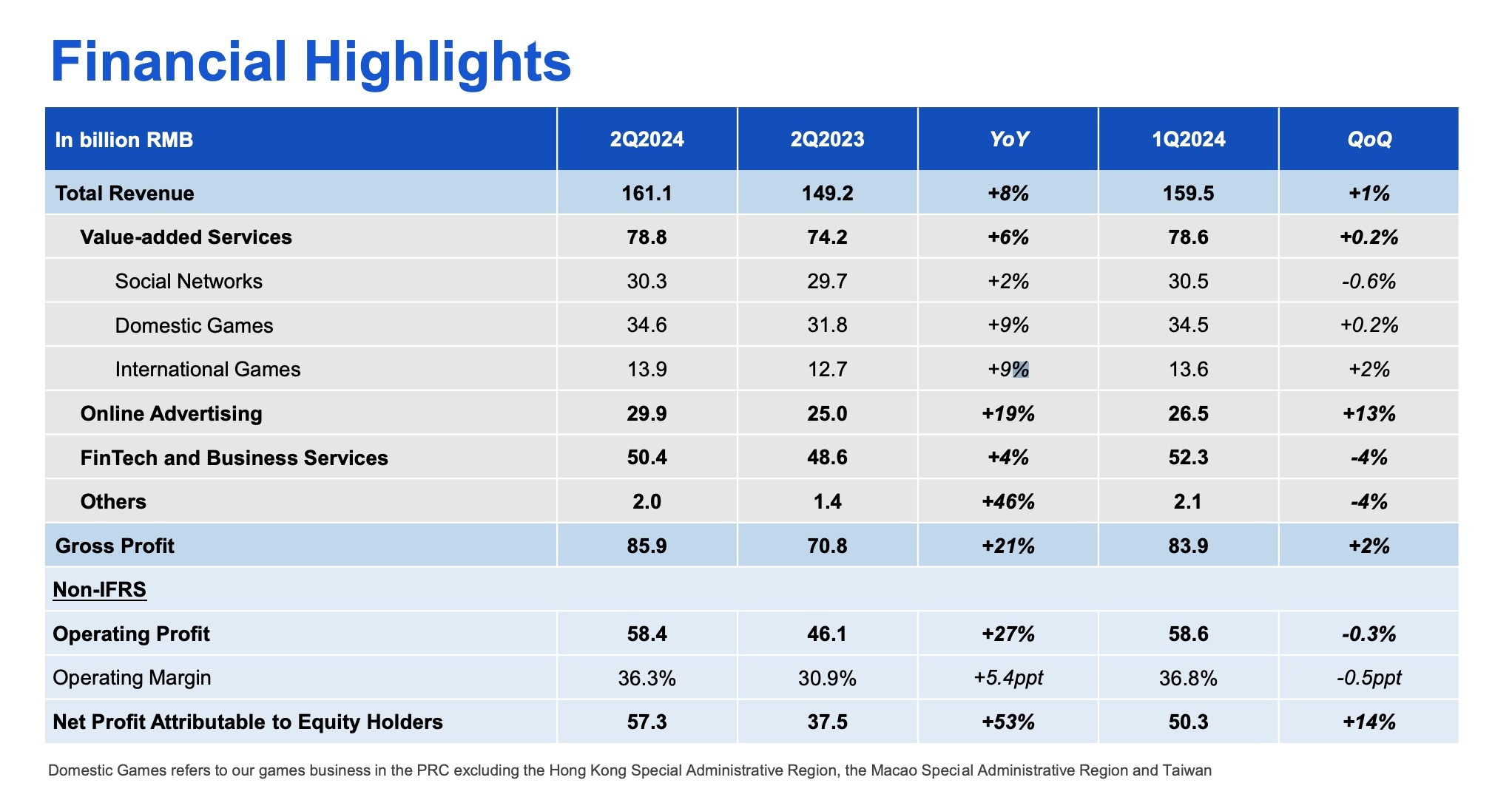
Financial data shows that in Q2 2024, Tencent Holdings achieved total revenue of 161 billion yuan, up 8% year-on-year and 1% quarter-on-quarter.
Gross profit was 86 billion yuan, up 21% year-on-year and 2% quarter-on-quarter. Operating profit under non-IFRS was 58 billion yuan, up 27% year-on-year and flat quarter-on-quarter. The combined monthly active users (MAU) of its four major communication and social networks, including WeChat groups, reached 1.37 billion year-on-year and quarter-on-quarter.
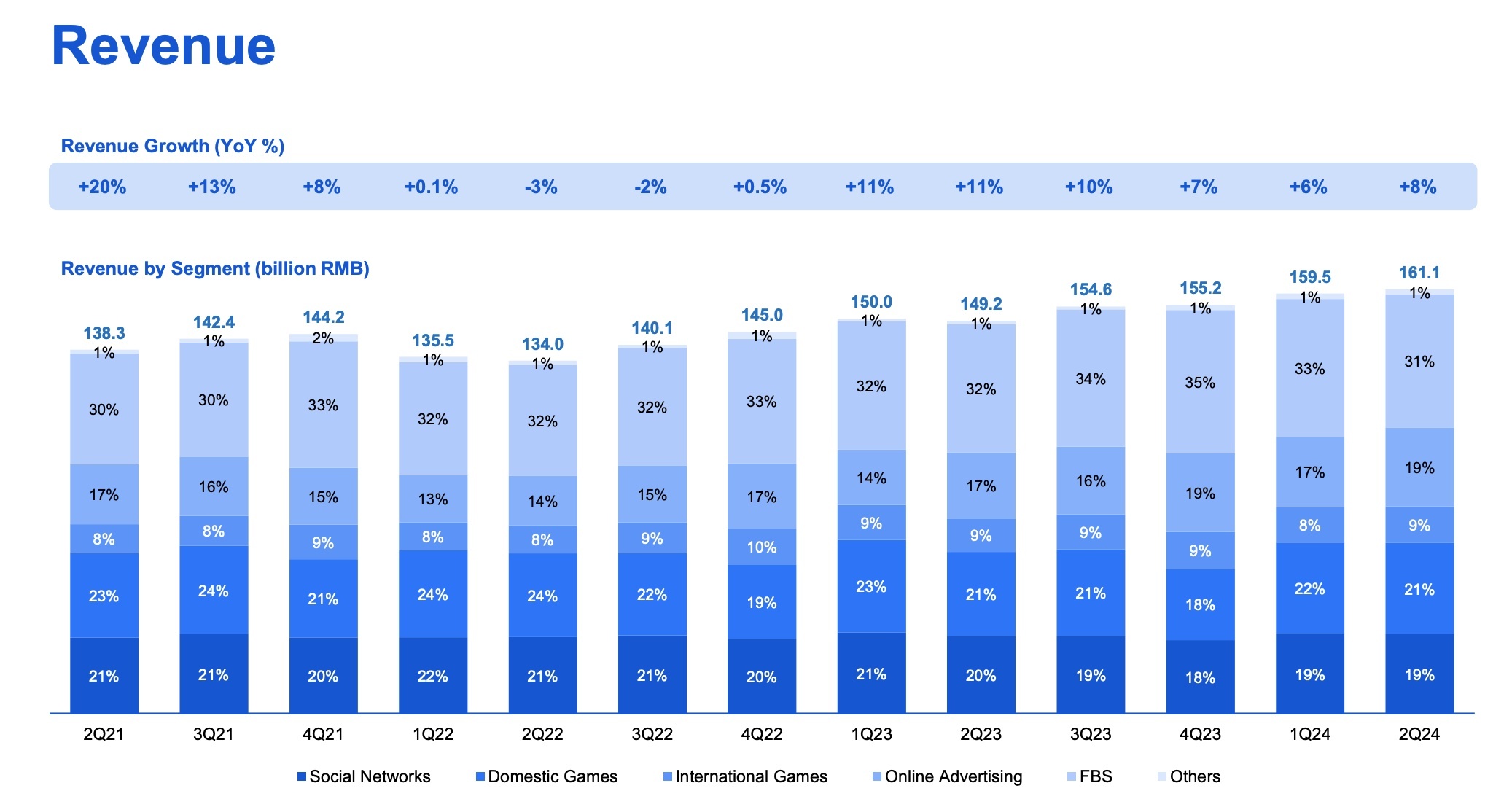
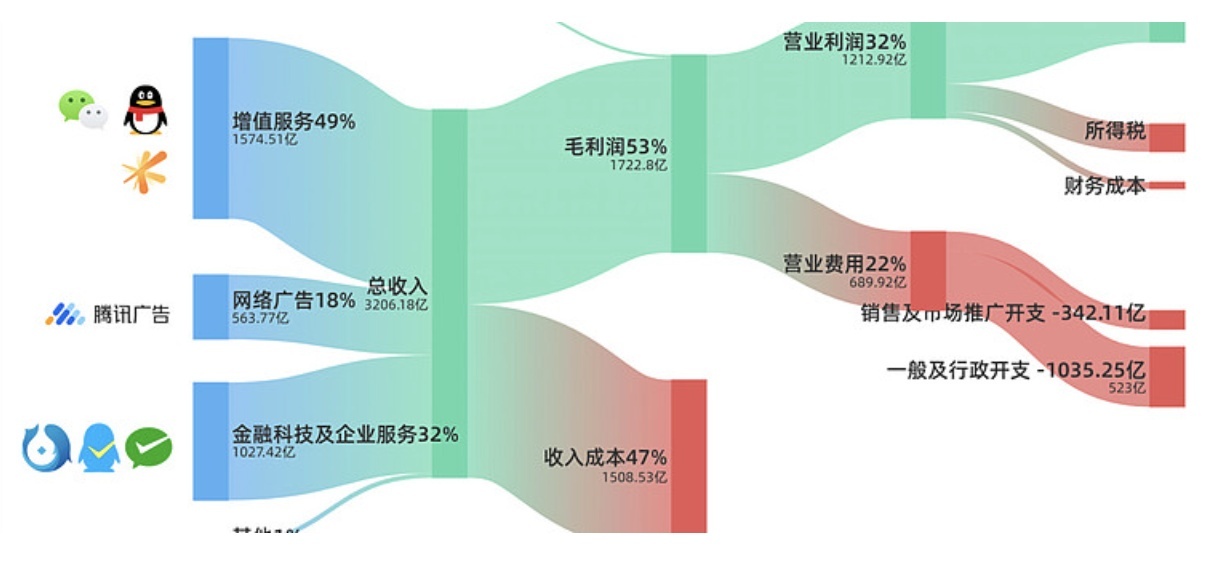
Specifically, the company's value-added services accounted for 49% of total revenue, with social networks contributing 19%. Domestic games accounted for 21%, and international games 9%. Online advertising contributed 19%, while fintech and business services made up 31% of total revenue.
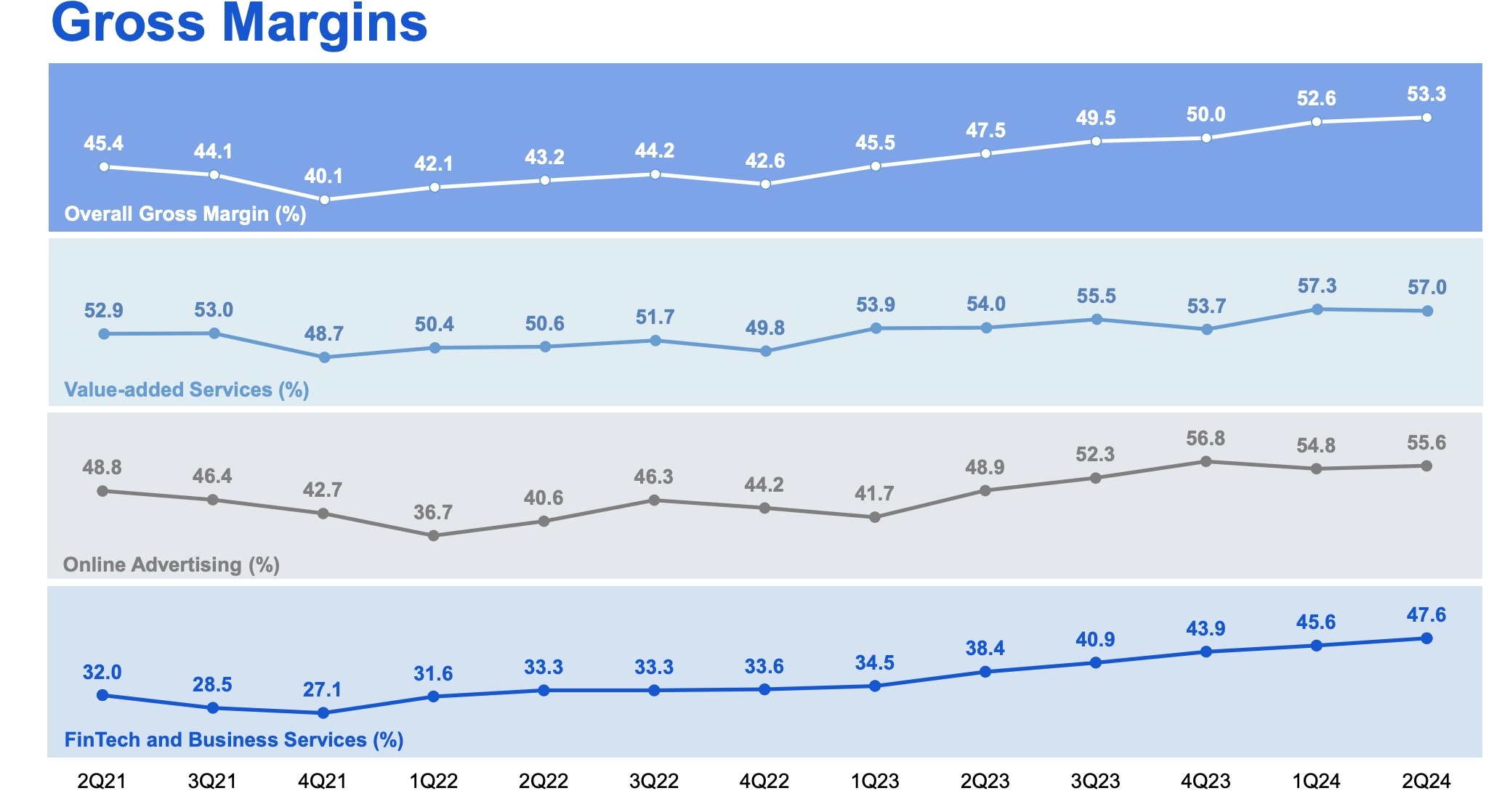
The overall gross profit growth in Q2 was 21%, driven by high-margin revenue sources such as domestic game income, video accounts, advertising revenue, mini-games, platform service fees, and e-commerce technical service fees within video accounts, as well as cost-saving measures.
Gross profit from value-added services (VAS) increased 12% year-on-year to 45 billion yuan, accounting for 52% of total gross profit. Online advertising gross profit rose 36% year-on-year to 17 billion yuan, contributing 19% to total gross profit. Fintech and business services gross profit grew 29% year-on-year to 24 billion yuan, making up 28% of total gross profit.
Breaking down the VAS segment, revenue was 79 billion yuan, up 6% year-on-year. Social network revenue returned to positive growth, rising 2% year-on-year, mainly driven by increased music and video subscriptions, mini-game platform service fees, and in-app game item sales, partially offset by declines in music and game-related live streaming revenue.
Long-form video subscription revenue grew 12% year-on-year, with daily video subscriptions up 13% year-on-year to 117 million yuan.

Domestic game revenue returned to growth, rising 9% year-on-year to 35 billion yuan, driven by VALORANT and the new game DNF Mobile. International game revenue also grew 9% year-on-year, reaching 14 billion yuan in both reported and fixed currency terms, boosted by the strong performance of PUBG and contributions from Supercell games. Among its various businesses, the previously weak gaming segment achieved a 9% growth rate this quarter, becoming a rare bright spot. Accounting for 30% of total revenue, gaming has become the largest segment in Tencent's revenue portfolio.
As the world's largest gaming company, Tencent has long faced criticism in the domestic market for its product quality—"mostly passable, but lacking masterpieces." This is partly due to Tencent's gaming development history.
Tencent's games are largely built on a social foundation, from early card and board games to nurturing games and mobile titles. Social interaction is a key pillar of Tencent's gaming strategy.
The social network-based gaming system gives Tencent's games a lightweight characteristic. Titles like Honor of Kings and PUBG, with matches lasting around 20 minutes, have become iconic products. Unlike NetEase, Lilith Games, or miHoYo, which focus on long-term operations of large-scale games, Tencent emphasizes delivering quick dopamine and endorphin hits to users.
This might be Tencent's inevitable choice after learning from past mistakes.
As a latecomer to the gaming industry, Tencent has a fundamentally different DNA when it comes to long-term game operations. The overseas expansion of these lightweight games could help the company tap into broader growth opportunities.
However, another unavoidable issue is the changes in Tencent's gaming distribution channels.
First, some lightweight mini-games can be accessed via Tencent's Mini Programs, which were among the earliest active use cases for the platform. However, this segment has remained lukewarm.

Second, the company has been making efforts in the AAA game space. Although the WeGame platform has faced criticism, Tencent's investments in this area are commendable. Additionally, the Epic Games Store, closely tied to Tencent, provides strong support for AAA game distribution. On August 20, Black Myth: Wukong, a game backed by Tencent's investment, will launch. This highly anticipated title is expected to sell well and could boost Tencent's confidence in investing in and developing domestic AAA games, creating a positive feedback loop.
Third, and most importantly, in mobile gaming, Tencent announced this year that it would no longer pay the "Apple Tax" or "Android Tax," marking the first round of confrontation between developers and major platform operators. These distribution costs can account for up to 50% of software expenses, leading to ongoing negotiations between software providers and Apple/Android. During the earnings call, Tencent executives confirmed they are in talks with Apple on the matter.
This will have significant implications for Apple, Tencent, and the broader industry ecosystem. Apple's 30% cut was once a highly profitable business with minimal costs. Tencent's challenge could inspire other software developers to follow suit, creating new dynamics for all parties involved.
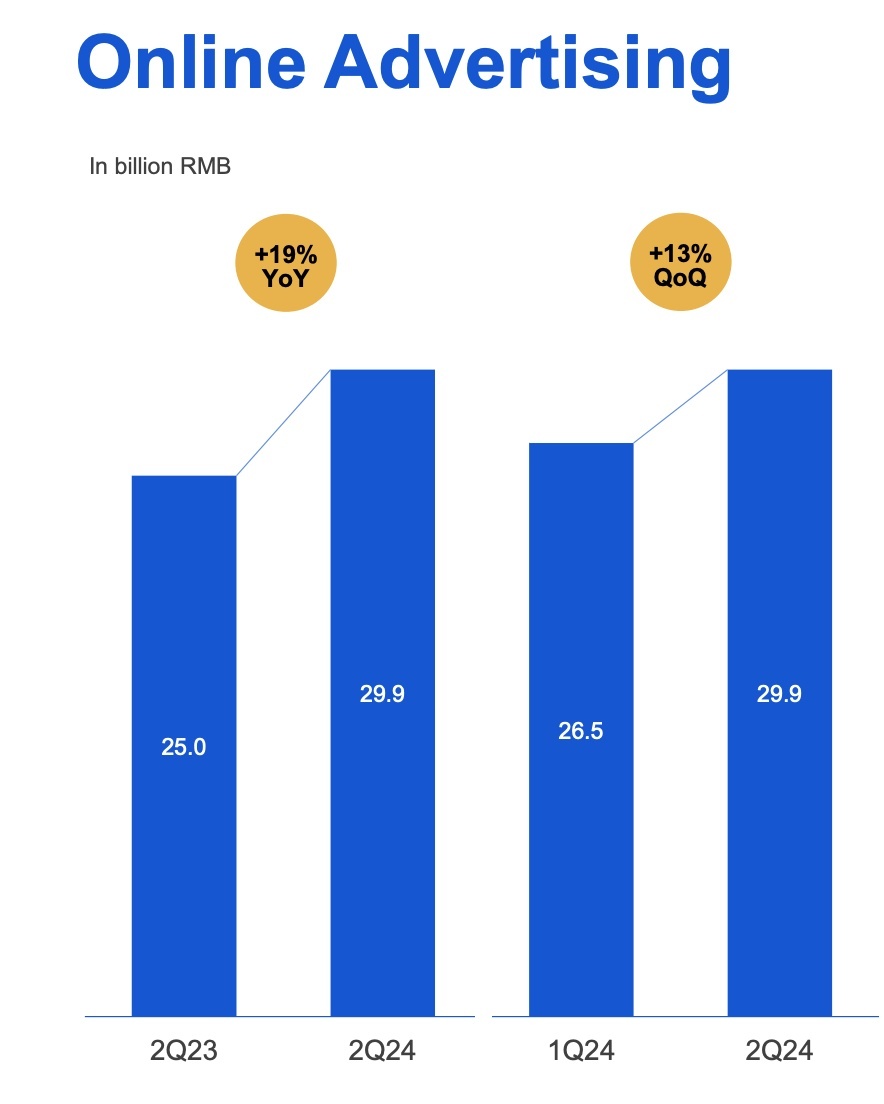
Online advertising revenue grew 19% year-on-year, driven by increased ad spending across most categories, particularly gaming, e-commerce, and education. Tencent Video's ad revenue surged over 30% year-on-year.
In its Q1 2024 earnings report, Tencent's ad business showed signs of recovery, a trend that continued into Q2.
In the late stages of the mobile internet era, the rise of short-video platforms like Douyin and Kuaishou has threatened giants like Tencent. Although Tencent has tried to compete in short videos, the failure of products like Weishi seemed to mark the end of its ambitions in this space.
However, leveraging video accounts with the support of its social network has become Tencent's key to entering the short-video era, allowing it to capture the last wave of 红利 (dividends).
As a major player in the social network era, Tencent's business model differs significantly from Meta's, yet comparisons are inevitable.
Meta's recent quarterly report showed double-digit growth, largely driven by its ad business—a feat Tencent has struggled to replicate.
Another interesting development is that live e-commerce via video accounts could help Tencent re-enter the e-commerce space, a sector where it has failed multiple times. Whether this attempt will succeed remains to be seen.
Fintech and business services (FBS) segment revenue was 50 billion yuan, up 4% year-on-year. Fintech service revenue growth slowed to low single digits. Commercial payment transaction volume continued to grow at a healthy pace year-on-year, but the average value per transaction declined, further dampening revenue growth.
Enterprise services gross profit rose significantly year-on-year, driven by higher contributions from high-margin revenue sources and improved efficiency of WeCom.
Notably, Tencent's financial services, including WeChat Pay, reflect the sluggish domestic consumer market, aligning with recent statistics bureau data.

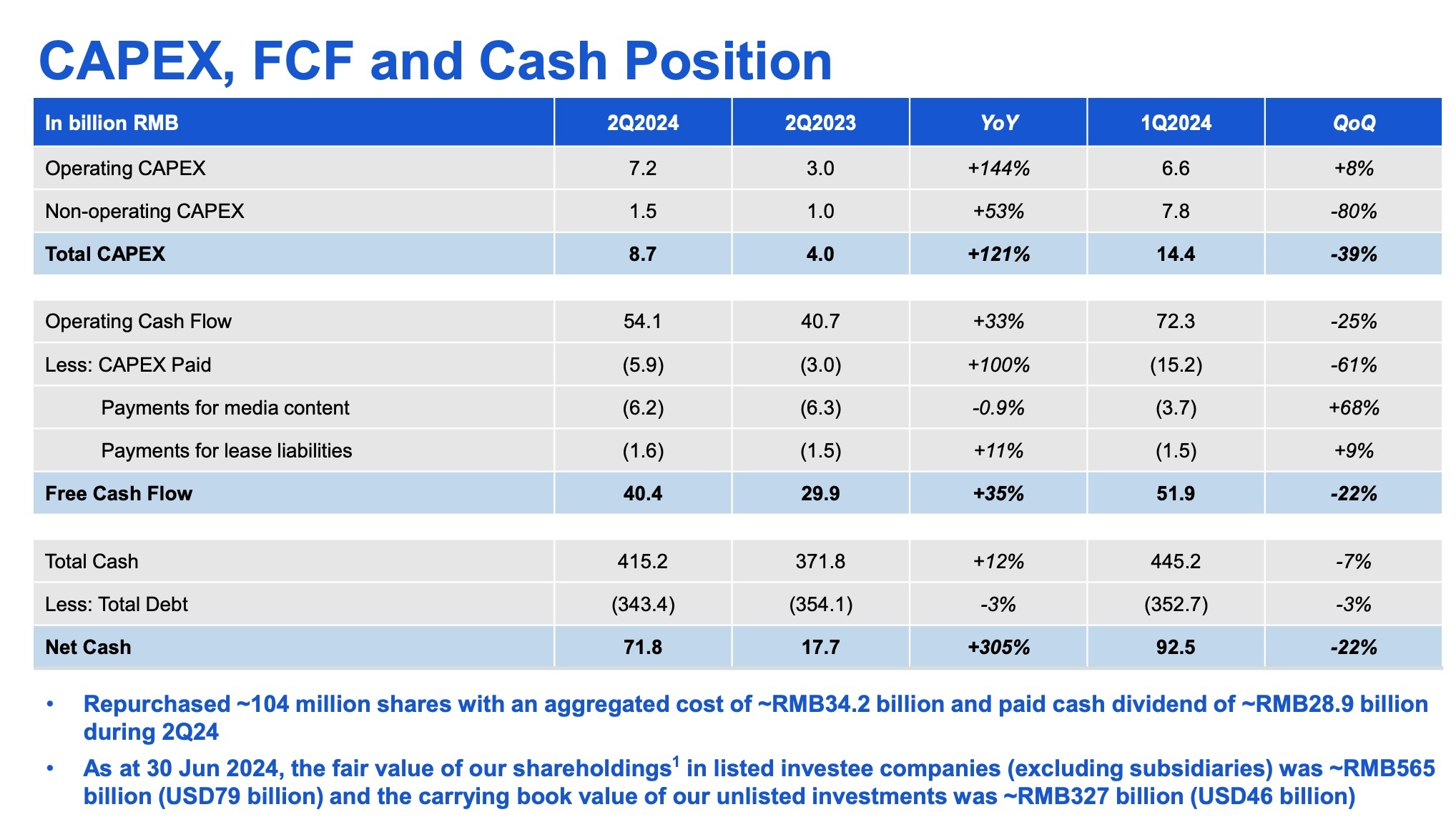
Turning to profitability, in Q2 2024, Tencent Holdings' share of profits from associates and joint ventures was 7.7 billion yuan, a significant increase from 1.2 billion yuan in the same period last year. Under non-IFRS, the share was 9.9 billion yuan, benefiting from improved performance of domestic associates like Pinduoduo and certain overseas gaming studios.
Income tax expenses fell 9% year-on-year to 10.1 billion yuan, mainly due to a high base effect from deferred tax adjustments at overseas subsidiaries last year. However, domestic corporate income tax expenses still rose year-on-year, partially offsetting the decline overseas. In 2023, Tencent's effective tax rate was 22%, and it is expected to drop to 18%-20% in 2024. Overall, the tax rate trend remains upward.
Non-IFRS operating profit was 58.4 billion yuan, up 27% year-on-year. Net profit attributable to equity holders was 57.3 billion yuan, up 53% year-on-year.
Administrative expenses grew 8%, while headcount increased by about 1,000 compared to Q2 2023.
Tencent stated that for full-year 2024, R&D expenses are expected to grow by high single digits, while non-R&D administrative expenses will also increase by single digits under IFRS. The latest estimates suggest full-year growth will reach high single digits, primarily due to rising employee costs—indicating higher individual incomes.
This raises concerns for Tencent. With headcount up just 1%, administrative expenses grew disproportionately. Since 2023, cost-cutting and efficiency improvements have been Tencent's top priorities, leading to questions about potential redundancies in personnel and management.
For an internet company that has undergone four organizational restructurings over two decades, this poses significant challenges.
Through these restructurings, Tencent has expanded from QQ to WeChat, from social networking to gaming, and then to fintech and enterprise services, growing increasingly complex.
Bureaucracy is inevitable in such large organizations and may not be resolved by restructuring alone. In recent years, most of Tencent's innovations have relied on platforms like WeChat, which is unsustainable.
Although fintech and enterprise services have first-mover advantages, its cloud business is lagging, showing signs of decline that warrant attention.
Another troubling issue is Tencent's struggle in the AI wave, a common challenge for Chinese internet firms. Due to U.S. export controls, Chinese tech companies cannot access NVIDIA's most advanced hardware, a fact that cannot be ignored. This has left the "large models" of Alibaba, Tencent, and Baidu as castles in the air, overshadowed by lesser-known players like Kimi. This remains a Sword of Damocles hanging over China's tech industry.
Some insiders suggest developing domestic chips for niche applications. With the world's largest unified user base, Chinese internet companies could quickly train large or small models.
In this space, Tencent's Hunyuan and Yuanbao models seem less useful than Kimi. Fortunately, in AI, Tencent only needs to keep pace and avoid falling behind. Like in e-commerce and short videos, it could leverage its traffic advantage for a comeback—though this will take time.
Finally, the fluctuating macro environment looms large over Chinese internet valuations. In 2024, dozens of countries, including major powers like the U.S., U.K., Japan, and Russia, will see leadership changes. This geopolitical uncertainty ties Tencent's fate to the broader economy.
Currently, Alibaba, Baidu, Pinduoduo, and other Chinese tech giants trade at low valuations, partly due to these factors. When human effort alone can no longer drive growth, cost-cutting and efficiency become paramount.
The room for cost-cutting is shrinking, while efficiency improvements offer better returns.
After years of development, Tencent increasingly resembles a state-owned enterprise. To sustain rapid growth, it must streamline operations and undergo painful reforms.
Fortunately, as a private company, Tencent faces less pressure to maintain growth than banks, which sometimes manipulate financial statements to create illusions of "cost-cutting" and "business optimization."
The copyright of this article belongs to the original author/organization.
The views expressed herein are solely those of the author and do not reflect the stance of the platform. The content is intended for investment reference purposes only and shall not be considered as investment advice. Please contact us if you have any questions or suggestions regarding the content services provided by the platform.
