


Is Meituan's group-buying service a 'benefit' or a 'drawback'?


In our continuous observation and analysis of Meituan, we have established the following analytical framework:
1) The local living sector remains relatively sluggish, with merchants prioritizing customer acquisition and cash flow improvement. They hope to extend their lifecycle through online platforms like Meituan, leading to a surge in marketing demand and recognition of the platform's value.
2) In 2024, Meituan launched services such as "Pin Hao Fan," "Brand Satellite Stores," and "Shen Qiang Shou," focusing on low prices to boost user demand and regain traffic leverage, which has been a key factor in recent performance improvements.
The above framework is generally objective (and has been validated by recent performance). However, discussions about new services like "Pin Hao Fan" often attract criticism and skepticism. Many argue that excessively low prices compress merchant profits, adding to their struggles in a challenging environment.
Within this framework, we have little to interpret from Meituan's Q2 2024 earnings report, but we are increasingly interested in the rationale behind "Pin Hao Fan." The core points of this article are:
First, "Pin Hao Fan" essentially adopts the "hosted" model from e-commerce, where restaurants only provide meals while the platform handles the rest, with restaurants relinquishing pricing power.
Second, "Pin Hao Fan" resembles a traffic-driving product in e-commerce, so its effectiveness depends not just on product margins but also on its ability to drive conversions for stores—a high bar.
Third, Meituan's market value remains a reflection of overall industry sentiment, and a full industry recovery is a prerequisite for its stock price to rise.
Fully Adopting the "Hosted E-commerce" Model
We previously summarized the catering industry as follows:
1) Increasing chainization, with the industry entering a capital-intensive phase.
2) Continued downturn in industry sentiment, especially for high-end dining.
3) Low-price strategies becoming essential to attract customers and offset pressure.
Many are inherently wary of "low prices," fearing they erode profits and lead to a "race to the bottom." Restaurants should compete on food quality, but with "low price" as the sole gimmick, won’t the "inferior" prevail? "Pin Hao Fan" has taken price wars to a new low, seen by some as "platform evil."
In short, "Pin Hao Fan" applies the e-commerce "hosted" model to local living services. Restaurants declare a minimum profit margin but cede pricing power to the platform, which sets final prices based on bids and delivery costs. Restaurants receive their declared profit (actual payout, excluding platform discounts or subsidies), and "Pin Hao Fan" orders don’t affect store ratings (reviews are separate).
Operationally, "Pin Hao Fan" borrows from e-commerce:
Hit product mindset: Local living previously centered on "stores," with users ordering from store pages. "Pin Hao Fan" is purely a hit product model, where restaurants turn standardized, mass-produced dishes into low-margin hits. Beyond profit, their key role is "traffic diversion," making "Pin Hao Fan" a marketing tool.
Hosted mindset: Local living has evolved into a platform model where merchants handle pricing, marketing, and operations while platforms provide traffic and delivery. With "Pin Hao Fan," pricing and marketing shift to the platform, leaving restaurants to supply food—at the cost of low margins. Thus, "Pin Hao Fan" dishes are highly standardized and pre-made, distinct from dine-in or regular delivery items.
This forms "Pin Hao Fan's" core logic: Use low-price hits to drive traffic, reduce marketing costs, and rely on higher-margin items for later profits.
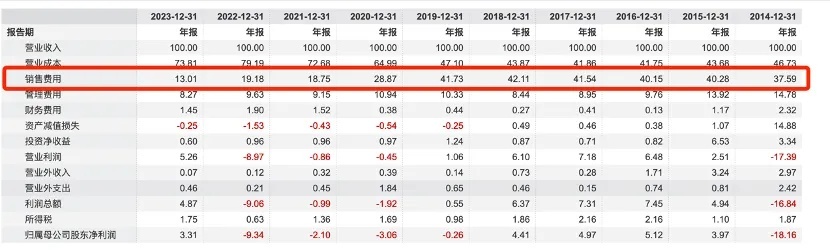
This aligns with shifts in China’s chain restaurant strategies. Mobile internet’s rise gave individual stores major marketing opportunities, with group buys and coupons exploding sales expenses. The chart shows cost and expense ratios for listed chain restaurants (including NEEQ and mainboard), with sales expenses nearing 50% of revenue since 2016.
This traps the industry in a "traffic-buying loop." Large chains, with ample budgets and cost controls, can afford short-term spending, accelerating chainization. But small street shops face worsening conditions, relying on delivery (cutting dine-in space and rent) or pre-made ingredients to survive high marketing costs.
Post-2023, the industry slump spread from small shops to major players.
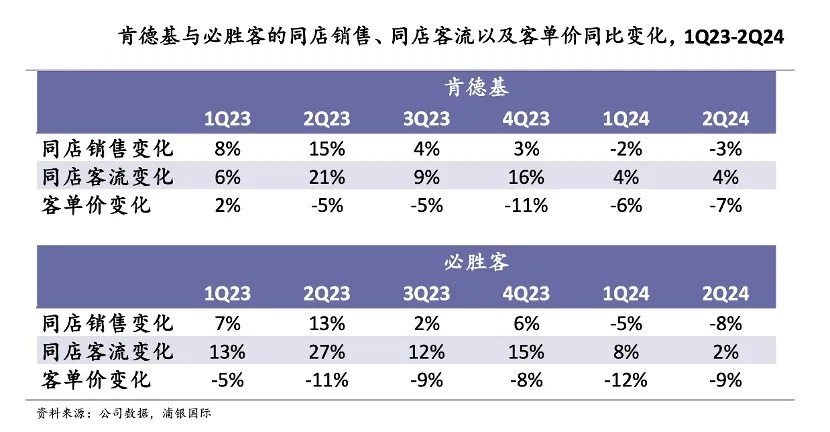
Even fast-food leaders like Pizza Hut and KFC face declining average spend and same-store sales. As wallets tighten, the industry loses pricing power, with all players dragged into price wars.
Price wars hit margins first. Boosting sales with more marketing is like "drinking poison to quench thirst," forcing restaurants to balance low margins and high sales costs.
"Pin Hao Fan" seems brutal—low prices, meager profits, and restaurants working for the platform. But it solves:
1) Trading low margins for lower sales costs. Recent quarters saw chain restaurants slash sales expenses, using standardized hits to drive traffic and offset fixed costs (rent, utilities).
2) Under the old local living model, deep-pocketed chains could outspend on marketing (e.g., influencer visits, coupons, ads) and dilute costs via supply chains and premium pricing. Small shops were disadvantaged. "Pin Hao Fan" offers them equal marketing leverage and traffic for delivery or dine-in.
Thus, views on "Pin Hao Fan" diverge. Judged solely as a product, its low margins leave little profit after rent and utilities. But as a traffic tool for dine-in or regular delivery, it’s a different story.
Hit products are old hat in e-commerce, but as competition intensifies, they’re no longer a silver bullet. Success requires not just capital but also the ability to monetize the traffic—products must deliver.
The same applies to dining. For most, "Pin Hao Fan" is a traffic tool. The real test is whether higher-margin dishes can monetize that traffic. Whether platform or semi-hosted models, local living ultimately hinges on food and differentiation—a high bar for many.
Meituan’s Recovery Hinges on Industry Revival
Now, let’s discuss Meituan’s stock.
From a P&L perspective, Meituan has defied the cycle. Amid industry slumps, product innovations (like "Pin Hao Fan") have driven extra gains, boosting platform scale and traffic.
But market reactions remain muted. Since May 2024, Meituan’s stock has been flat (underperforming the Hang Seng Index over the past year), puzzling those who see improved fundamentals.
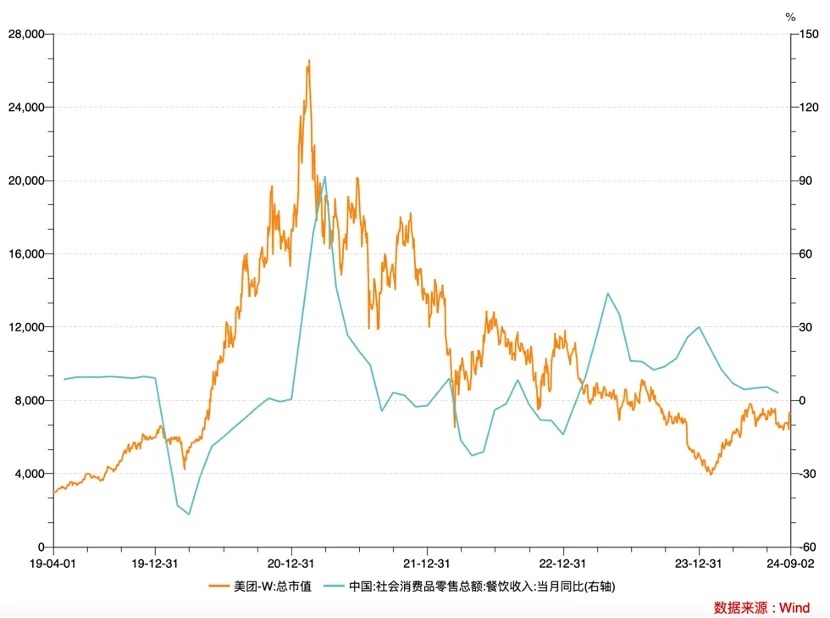
Despite innovation-driven efficiency gains, comparing Meituan’s market cap to national dining revenue shows high correlation, with Meituan leading the industry by about two months.
The market still sees Meituan’s stock as a proxy for industry sentiment. If the environment doesn’t improve, doubts will grow about the sustainability of innovations like "Pin Hao Fan." As noted, profiting in a cutthroat market is hard, and if demand stays weak, merchant confidence—and Meituan—will suffer.
This frames our outlook for Meituan:
1) A sustained external recovery is necessary for Meituan’s stock to fully rebound;
2) Innovations like "Pin Hao Fan" have raised barriers in local living (especially delivery), binding merchants to the platform via semi-hosted models. Despite complaints, merchants must participate, bolstering Meituan’s edge—though market recognition will take time.
Platforms can’t please all merchants. Some will dismiss this as "platform evil." But without mobile internet and local living services, restaurant "competition" might just mean bidding up street-corner rents.
The race never left—it just changed form.
$MEITUAN(03690.HK)
The copyright of this article belongs to the original author/organization.
The views expressed herein are solely those of the author and do not reflect the stance of the platform. The content is intended for investment reference purposes only and shall not be considered as investment advice. Please contact us if you have any questions or suggestions regarding the content services provided by the platform.
