

How do Chinese and American tech giants 'spend money'?

Major developed countries worldwide have already entered or are about to enter a rate-cutting cycle. Even so, high interest rates will persist for some time, meaning the cost of capital remains elevated.
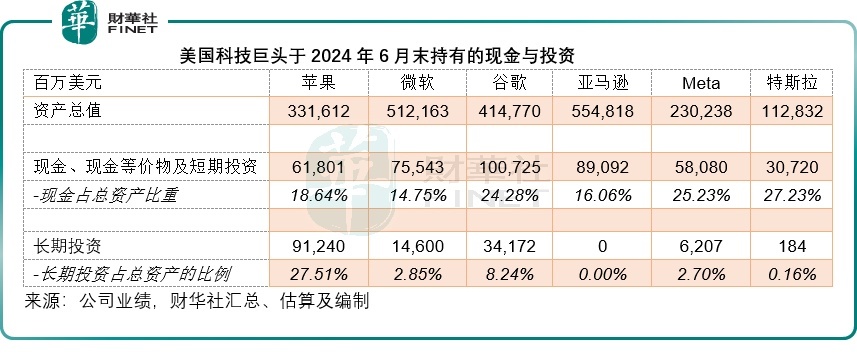
Unlike the industrial economy of the past, which relied on heavy investment and asset-intensive models, today's tech giants driving GDP growth and employment have amassed vast cash reserves through more efficient technological productivity. $Apple(AAPL.US) , $Microsoft(MSFT.US), Google (GOOG.US), Amazon (AMZN.US), Meta (META.US), and Tesla (TSLA.US) collectively held $415.961 billion in cash as of June 2024, surpassing the UK's annual GDP.
How are they deploying these funds in the current high-rate environment?
Similarly, China's tech giants $TENCENT(00700.HK), $BABA-W(09988.HK) , $PDD(PDD.US), $BIDU-SW(09888.HK) , $MEITUAN(03690.HK) held a combined RMB 1.38 trillion in cash and short-term investments. How do their cash deployment strategies differ from their US counterparts?
Dividends and Buybacks Dominate
Both Chinese and US internet companies have recently prioritized dividends and buybacks.
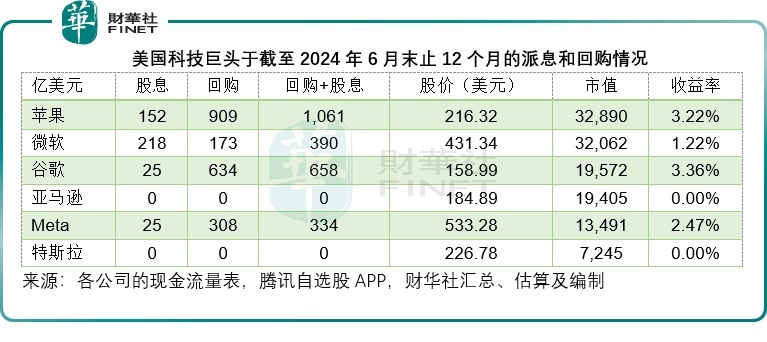
Microsoft recently declared a quarterly dividend of $0.83 per share, up 8 cents or 10% sequentially. For its fiscal year ending June 2024, it paid $21.8 billion in dividends. If subsequent quarterly dividends rise by 10%, its forward dividend yield could reach 0.75%.
Additionally, Microsoft's board approved a new $60 billion buyback program. Notably, in FY2024, it repurchased 32 million shares for $12 billion, with $10.3 billion remaining from its previous $60 billion program. Combined, this implies over $70 billion in available buyback capacity—2.19% of its $3.21 trillion market cap.
Apple, however, leads in buyback aggressiveness. Pursuing cash neutrality, it directs all post-operational free cash flow to shareholders. Per its cash flow statements, Apple spent $15.2 billion on dividends and $90.9 billion on buybacks ($106.1 billion total) in the 12 months to June 2024—3.22% of its $3.29 trillion valuation.
Google offers the highest shareholder yield: $2.5 billion in dividends plus $63.4 billion in buybacks ($65.9 billion total) equates to 3.36% of its $1.96 trillion market cap (see table).
Chinese tech giants are equally enthusiastic. Alibaba (BABA.US) stands out, repurchasing 1.1 billion shares for $10.6 billion in H1 2024—5.29% of its current $200.38 billion market cap (at $83.60/share).
As of June 30, 2024, Alibaba had $26.1 billion in remaining buyback authorization (valid through March 2027), equivalent to 13.03% of its market cap—excluding potential dividends. For FY2024, it paid $0.2075/share in total dividends ($0.125 regular + $0.0825 special), yielding 0.25% at current prices.
Tencent and Meituan also impressed, repurchasing HK$82.4 billion and HK$27.3 billion year-to-date—2.32% and 3.63% of their HK$3.55 trillion and HK$752.2 billion market caps, respectively—though still trailing Alibaba's generosity.
R&D Focus: AI Takes Center Stage
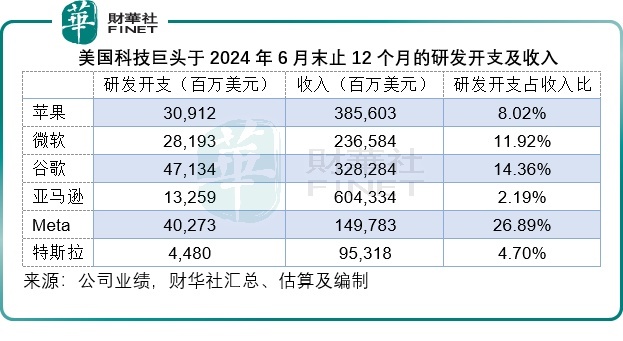
R&D remains a major expenditure for US-China tech leaders.
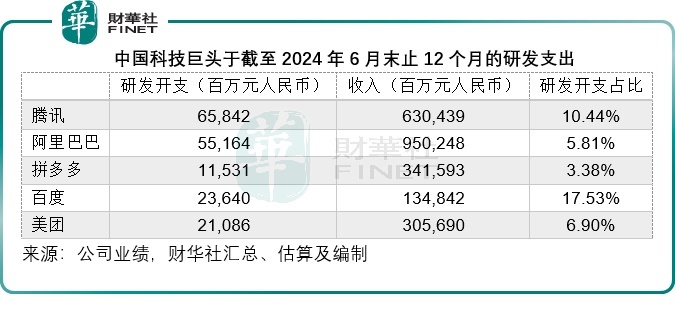
Tencent and Alibaba expensed RMB 65.84 billion and RMB 55.16 billion on R&D in the 12 months to June 2024—10.44% and 5.81% of revenue, respectively. Baidu led with 17.53% of revenue allocated to R&D, while Pinduoduo spent the least (28.64% of revenue went to marketing), suggesting it still relies on traffic 红利 for market share.
US giants are also pouring resources into AI. Google leads in R&D spending and doubled H1 2024 capex to $25.2 billion for AI infrastructure, stating underinvestment poses greater risks than overspending.
Meta allocated 26.89% of revenue to R&D and raised its 2024 capex forecast to $37-$40 billion, expecting further increases in 2025 for AI development. Wall Street's skepticism about AI ROI has triggered stock volatility among heavy investors.
US Giants Hoard Cash, Chinese Firms Prefer Investments
While both groups prioritize capex for tech competitiveness, US firms focus on in-house R&D or M&A, whereas Chinese companies emphasize financial/strategic investments.
Except for asset-light Apple, the Big Six favor cash holdings (see chart).
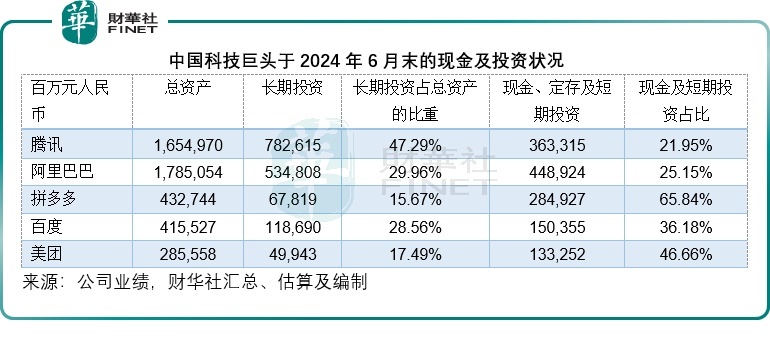
Tencent exemplifies this approach—its incubated successes like Meituan and JD.com (09618.HK) are equity-accounted rather than consolidated, allowing strategic flexibility without operational risk. Long-term investments comprise 47.29% of Tencent's assets, with cash/short-term holdings at 21.95% (69% combined). Alibaba, Baidu, and Meituan similarly allocate >50% to such assets, while Pinduoduo holds mostly liquid assets (including bonds) amid its shift from traffic- to quality-driven growth.
Conclusion
Despite divergent cash strategies, both groups heavily invest in R&D to maintain tech leadership while returning substantial cash via dividends/buybacks—sometimes exceeding capex (e.g., Google's $65.8B shareholder returns vs. $44.3B capex), signaling either undervaluation or preference over risky projects.
Initial rate cuts may have limited impact given residual high rates, but cumulative easing could boost net investment returns and trigger valuation reassessments.
Author: Mao Ting
The copyright of this article belongs to the original author/organization.
The views expressed herein are solely those of the author and do not reflect the stance of the platform. The content is intended for investment reference purposes only and shall not be considered as investment advice. Please contact us if you have any questions or suggestions regarding the content services provided by the platform.
