



Interest rate cuts are approaching! Which assets and industries are more worth looking forward to?


On September 6 (local time), a report released by the U.S. Bureau of Labor Statistics showed that the U.S. added 142,000 non-farm jobs in August, below market expectations. The unemployment rate fell from 4.3% in July to 4.2%, in line with expectations, marking the first decline since March this year.
On September 11 (local time), the U.S. Bureau of Labor Statistics disclosed data showing that the U.S. CPI rose 2.5% year-on-year in August, compared to 2.9% previously. The core CPI rose 3.2% year-on-year, in line with market expectations, and increased 0.3% month-on-month, higher than the expected 0.2%.
Overall, the August data showed weakening employment and easing inflation in the U.S. Against this backdrop, the market expects the Federal Reserve to start cutting interest rates in September.
It is worth noting that as the data indicated excessive cooling in the labor market, the market once expected an over 80% probability of a 50-basis-point rate cut by the Federal Reserve in September. However, after the CPI data was released, the CME Group's "FedWatch Tool" showed that the market now expects an 85% probability of a 25-basis-point rate cut in September, with only a 15% chance of a 50-basis-point cut.
While the extent of the rate cut remains debated, the consensus is gradually forming around the cut itself. In this context, which assets and sectors are more likely to benefit?
Under Rate Cuts, Hong Kong Stocks and Gold May Be More Favored
It is reported that Federal Reserve rate cuts can be divided into two categories: relief cuts, which are common after crises, with larger, longer-lasting, and more significant total cuts; and preventive cuts, which often occur when signs of economic slowdown appear, with smaller, shorter-lasting, and less significant total cuts.
According to research by Haitong Securities, the Federal Reserve has conducted four relief cuts and five preventive cuts since 1982. Analysis shows that Federal Reserve rate cuts significantly impact the trends of equity, fixed-income, and foreign exchange assets, but the patterns for commodity price movements are less clear.
First, equity assets have a higher win rate during preventive cuts but are more likely to decline during relief cuts. Specifically, for U.S. stocks, the Dow Jones reacts most sharply to rate cuts, followed by the S&P 500 and Nasdaq. For domestic stocks, A-shares and Hong Kong stocks generally follow similar trends as U.S. stocks during rate cuts, but A-shares show some independence. Developed markets outperform emerging markets, but emerging markets may show greater elasticity during preventive cuts.
Second, research indicates that bond yields are more likely to decline and prices to rise during both preventive and relief cuts. The probability of U.S. Treasury yields declining is high, and short-term declines in Chinese bond yields are expected, though smaller than those of U.S. Treasuries.
Additionally, the U.S. dollar is more likely to weaken during rate cuts, the Japanese yen may rise, and the renminbi and euro show independent trends.
Commodity prices have a weaker relationship with rate cuts, but gold shows relatively high certainty of rising, especially with greater elasticity after relief cuts.
Minmetals Securities recently stated in a research report that gold prices have hit new highs amid the impending Federal Reserve rate cuts. Looking ahead, in the medium to long term, the weakening of U.S. dollar credibility will be the main theme, and we remain firmly optimistic about the upward shift in gold price trends.
Researchers at Huaxi Securities believe that the September rate cut may already be priced in, and gold price performance after the cut is what deserves attention. They suggest focusing on gold price movements after one or even two rate cuts.
Which Sectors in Hong Kong and A-Shares Benefit More from Rate Cuts?
Notably, among emerging market equity assets, Hong Kong and A-shares are extremely important markets.
Recently, Xingye Fund stated: "Macro-wise, the Federal Reserve's rate-cutting cycle is gradually approaching. We analyze and judge that this will be a preventive cut. Around the start of the cut, equity markets are expected to have upward windows, likely showing a rotation pattern from U.S. stocks to other developed markets and then to emerging markets. Among them, the Hang Seng Tech Index may show significant reversal effects after the cut, gradually strengthening."
Tianfeng Securities released a research report stating that in a global market comparison, Chinese assets still offer value. As expectations gradually recover and future fundamentals improve, Hong Kong-listed Chinese stocks remain attractive in terms of valuation, with high risk-reward ratios.
From a sector perspective, Wu Lixian, an international strategy analyst at Everbright Securities, believes that Hong Kong stocks such as utilities, Chinese telecom stocks, and gold mining stocks are among the sectors that could benefit from future rate cuts. The first two, in particular, may see greater appeal in potential returns compared to U.S. Treasuries under rate cuts.
Zhang Haoen, Head of Investment for Personal and Business Banking at CMB International, believes that the focus in the Hong Kong stock market is on dividend-paying stocks, including Chinese banks, insurers, telecoms, and energy. Among tech stocks, some large-cap weighted stocks, such as mobile gaming and consumer platform stocks, though non-dividend-paying, could benefit as funds flow to Asia (e.g., Japan, Taiwan, South Korea) amid U.S. and European rate cuts. As long as funds remain in Asia, there is potential for attention and inflows into undervalued Hong Kong stocks, with large-cap weighted tech stocks likely to benefit.
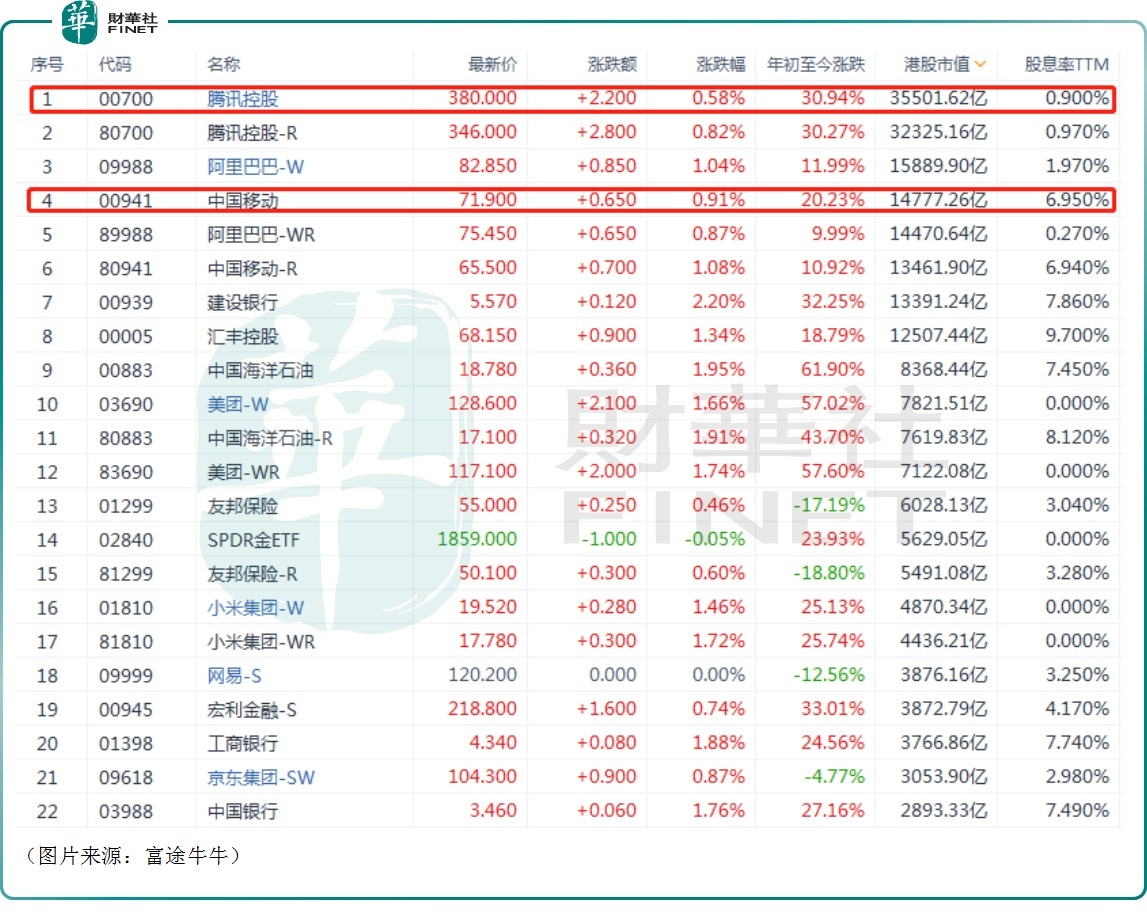
In fact, this year, the Hang Seng Index has risen slightly by 3.59%, while stocks like $TENCENT(00700.HK) and $MEITUAN(03690.HK) have far outperformed the Hang Seng Index. Additionally, high-dividend stocks like China Mobile, $CCB(00939.HK), and $CNOOC(00883.HK) have also significantly outperformed the broader market.
These sectors are also key areas to track after rate cuts.
It should be noted that in recent years, A-shares have performed weakly. Federal Reserve rate cuts could help improve market liquidity and drive a broader market recovery. However, Haitong Securities points out that during preventive cuts, A-share growth stocks outperform, while during relief cuts, A-share value stocks dominate.
Currently, based on institutional views, the likelihood of this round of Federal Reserve rate cuts being preventive is higher. Therefore, the growth direction in the A-share market deserves more attention, as lower funding costs could enhance investor willingness and preference for risk assets.
From a sector perspective, after analyzing the performance following four Federal Reserve rate cuts since 2000, Haitong Securities believes that this round of preventive cuts will likely benefit the financial sector in the short term, while consumer sectors favored by foreign capital, such as food and beverage and beauty care, may also outperform. However, from a medium-term perspective, China's advantaged manufacturing with stronger fundamentals may become the mid-term theme for A-shares, particularly focusing on mid-to-high-end manufacturing with export competitiveness and tech manufacturing driving new productive forces.
Author: Yunzhi Fengqi
The copyright of this article belongs to the original author/organization.
The views expressed herein are solely those of the author and do not reflect the stance of the platform. The content is intended for investment reference purposes only and shall not be considered as investment advice. Please contact us if you have any questions or suggestions regarding the content services provided by the platform.
