


 Posts
PostsPrediction markets are where AI+Web3 truly shines.

This year is a U.S. election year, and many eye-catching events have occurred recently. Trump is actively courting crypto voters, while the Democratic administration has shown some flexibility on key policies. All of this has provided fodder for speculation in the crypto market and made prediction markets an increasingly significant force in crypto. On August 30, financial data and news service Bloomberg began incorporating prediction market data, highlighting their growing importance in analyzing political trends and election odds. This also underscores the increasing adoption of Web3 data by traditional financial institutions. As the TVL of prediction markets hits record highs against the trend, the focus shifts to how to sustain this growth post-election and amplify its impact with AI. This brings us to PredX, a rising star in AI+Web3 prediction markets, and its underlying AI infrastructure, Aimelia Network.
Why Do We Need Prediction Markets?
According to a report by Grand View Research, the global sports betting market, including crypto gambling and prediction markets, was valued at $83.65 billion in 2022 and is expected to grow at a compound annual growth rate (CAGR) of 10.3% until 2030, reaching $182.12 billion by 2024. Prediction markets are a type of derivative market where participants can bet or speculate on the outcomes of various future events, ranging from political elections and sports events to financial market trends and even niche predictions. Essentially, prediction markets allow betting on anything, providing a convenient tool for risk management, decision-making, and gaining insights into future trends.
Since prediction markets are based on observations of the objective world, they are less prone to price manipulation like meme coin platforms such as pump.fun. Unlike futures markets, crypto prediction markets aren’t limited to guessing asset prices; they can also speculate on event outcomes. For example, a user might buy a contract that "pays $1 if a spot Ethereum ETF is approved by July" or sell a contract that "pays $1 if the ETF isn’t approved in 2024." As more people buy and sell, the contract price changes to reflect the collective belief of market participants. If a contract predicting Ethereum spot ETF approval by July trades at $0.80, it implies the market assigns an 80% probability to the event. This is the common trading model in today’s prediction markets.
Prediction markets have been developing in the crypto space for quite some time. Augur, founded by Joey Krug and Jack Peterson in 2014, was the first prediction market on Ethereum, with its native token $REP (short for "Reputation") used for staking and reporting event outcomes. Users could create and trade prediction markets on various topics. A year later, Gnosis, founded by Martin Köppelmann and Stefan George, launched another Ethereum-based prediction market platform. Unlike staking, Gnosis relied on a unique Dutch auction mechanism to determine event outcomes. In 2020, Polymarket entered the scene and gained popularity for its focus on political and current event prediction markets. Notably, users could trade using $USDC, making it more appealing to mainstream users.
On September 17 this year, prediction market Limitless Network raised $3 million in a Pre-Seed round led by 1confirmation. In May, Polymarket announced two funding rounds totaling $70 million, with investors including Founders Fund and Vitalik Buterin. Vitalik has repeatedly expressed optimism about Polymarket in public statements and articles, suggesting that prediction markets are one of the few products in crypto that have found product-market fit (PMF). Polymarket’s trading volume has exceeded $450 million this year, with over 60,000 active users. As the U.S. election reaches its climax, prediction market platforms are poised to see even higher trading volumes and user engagement. Such achievements in a niche market demonstrate the vast potential for growth in this sector.
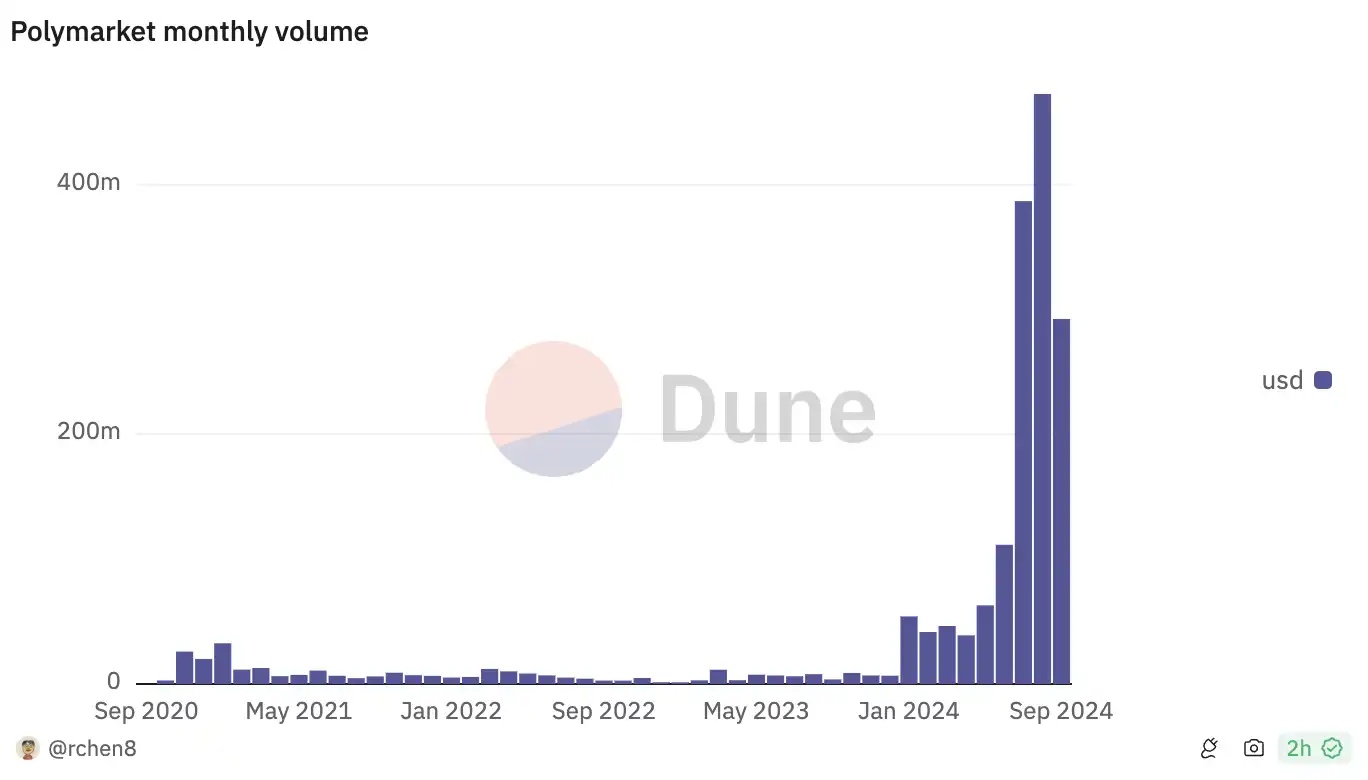
Polymarket’s monthly trading volume, potentially hitting new highs in September
With the U.S. presidential election coming to an end, prediction markets will lose a major traffic driver. Several venture capital firms have made bold predictions about the post-election era for prediction markets: Multicoin emphasized the need for sustained event themes to better consolidate user consensus, rather than short-lived event clusters. Founder Karl commented on user retention, stating that users need a series of highly repetitive events to increase repurchase rates. 1k(x) drew lessons from sports betting, analyzing how prediction markets could increase event leverage to offer richer rewards for participants. Parafi, through data, affirmed the strong growth of prediction markets in non-election events, while a partner at 1confirmation predicted a 100x growth for prediction markets, positioning them as mainstream exchanges.
The Future of Prediction Markets and AI
Prediction markets reflect the true state of the market, not individual opinions. Users back their views with capital, forming a consensus through market prices. If someone disagrees with the pricing, they can express their opinion and profit by buying or selling—this is the ultimate validation. Users can voice opinions freely, but only when they place bets do they truly prove their stance. This transparency and market-driven mechanism have set prediction markets apart in this bull run.
PredX is an AI-driven prediction market project founded by two North American AI Ph.D. holders, aiming to revolutionize finance through AI and prediction markets. At its core, PredX believes prediction markets redefine attention-centric assets and enhance the value of asset-related information, making financial data more accessible for previously unpriced asset subclasses. Prediction markets introduce additional degrees of freedom for assets and information, unlocking endless possibilities for the industry.
From a micro perspective, PredX identifies three main types of users in prediction markets: spectators, believers, and traders. Spectators seek unbiased information to better understand the world through probability shifts in prediction markets. Believers are those with strong convictions about certain events, monetizing their views through prediction markets. They often evolve from spectators, tracking events to form their own judgments and usually holding their positions until the event concludes. Traders, on the other hand, spot opportunities by tracking events and arbitrage by buying and selling event contracts. The future of prediction markets depends on how well they cater to these three user types.
Drawing from the past six months, PredX views prediction markets as intent markets. Whether spectators, believers, or traders, all need an intent to arbitrage on events. Thus, better fulfilling users’ arbitrage intent is PredX’s top priority. PredX has designed Parlay rewards for consecutive wins and a first-come, first-served policy inspired by Friend.tech, allowing users to monetize their beliefs and knowledge in familiar domains. Additionally, PredX enhances user cognition by helping them continuously gather and integrate asset-related information while assisting in comprehensive event reasoning for future judgments. Since most intents and information are expressed in natural language, leveraging large language models (LLMs) for PredX’s development is crucial.
First, AI ensures the relevance of prediction market topics by dynamically selecting and arranging events that resonate emotionally with users, offering engaging and controversial themes. Through AI-powered web scraping tools and personalized recommendation systems, the platform tailors content to individual preferences, creating a more interactive and emotionally engaging trading environment. AI also helps maintain content continuity by incentivizing event creators to provide the latest and most compelling content while filtering out topics that might trigger political or humanitarian biases. This ensures high-quality event information and a safe, enjoyable trading experience.
In terms of profitability, PredX’s AI architecture enhances the integration of user-accessible information, making the platform a rich source of event-related insights to attract high-quality subscribers. PredX collaborates with multiple data providers and projects, generating daily news to identify the most engaging themes for continuous tracking. From a trading perspective, PredX showcases AI’s reasoning process for events, reducing the time users need to place bets. Trading bots simplify the trading process, boosting trading volume. By ensuring data fairness and reliability, PredX supports a revenue-sharing model with top-tier data providers, maintaining a sustainable data ecosystem.
Meanwhile, PredX collects user feedback on AI models to evaluate and train them. AI models improve their reasoning for specific events based on user feedback, offering better auxiliary trading services. In aligning multiple intents, PredX helps synchronize the goals of data creators, spectators, believers, and traders, focusing on user intent to minimize distractions and provide a seamless event trading experience. This ensures a precise and coherent financial ecosystem.
Win-Win Collaboration: PredX’s AI Business Strategy
PredX is now live on Base, Sei, Bitlayer, ZKLink, and Ton networks, with strategic partnerships with several renowned Web3+AI projects (0G, GenLayer, Flock, 0xScope, Space & Time, Nesa, etc.). After connecting their wallets, users can access PredX’s AI services, including AI-generated event creation, news integration, personalized event recommendations, and multi-model event reasoning. PredX continuously collects user feedback on AI reasoning to refine its models. The more users engage with the platform, the better AI understands their intent and feedback, increasing their chances of winning and earning more rewards through expertise.
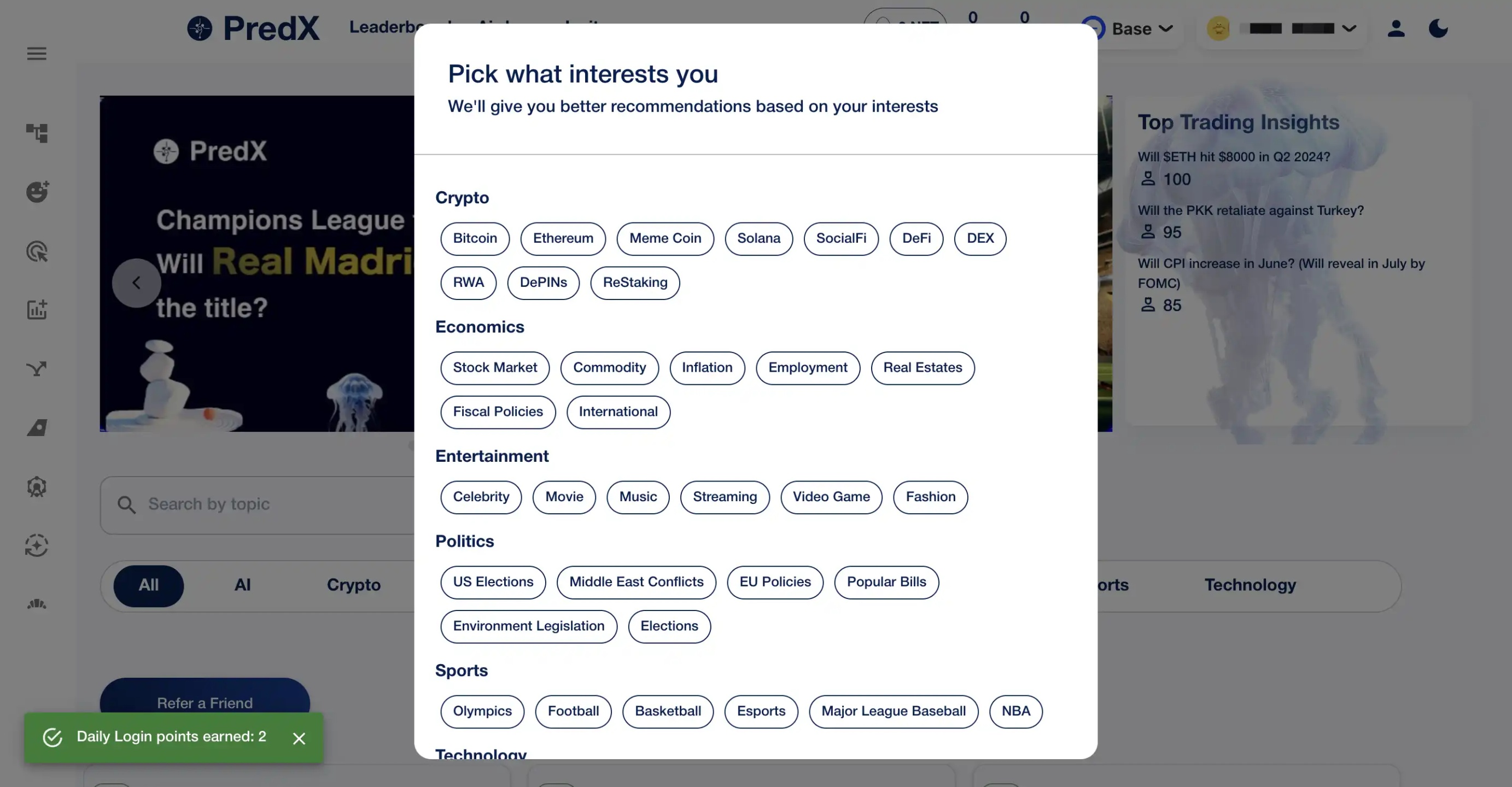
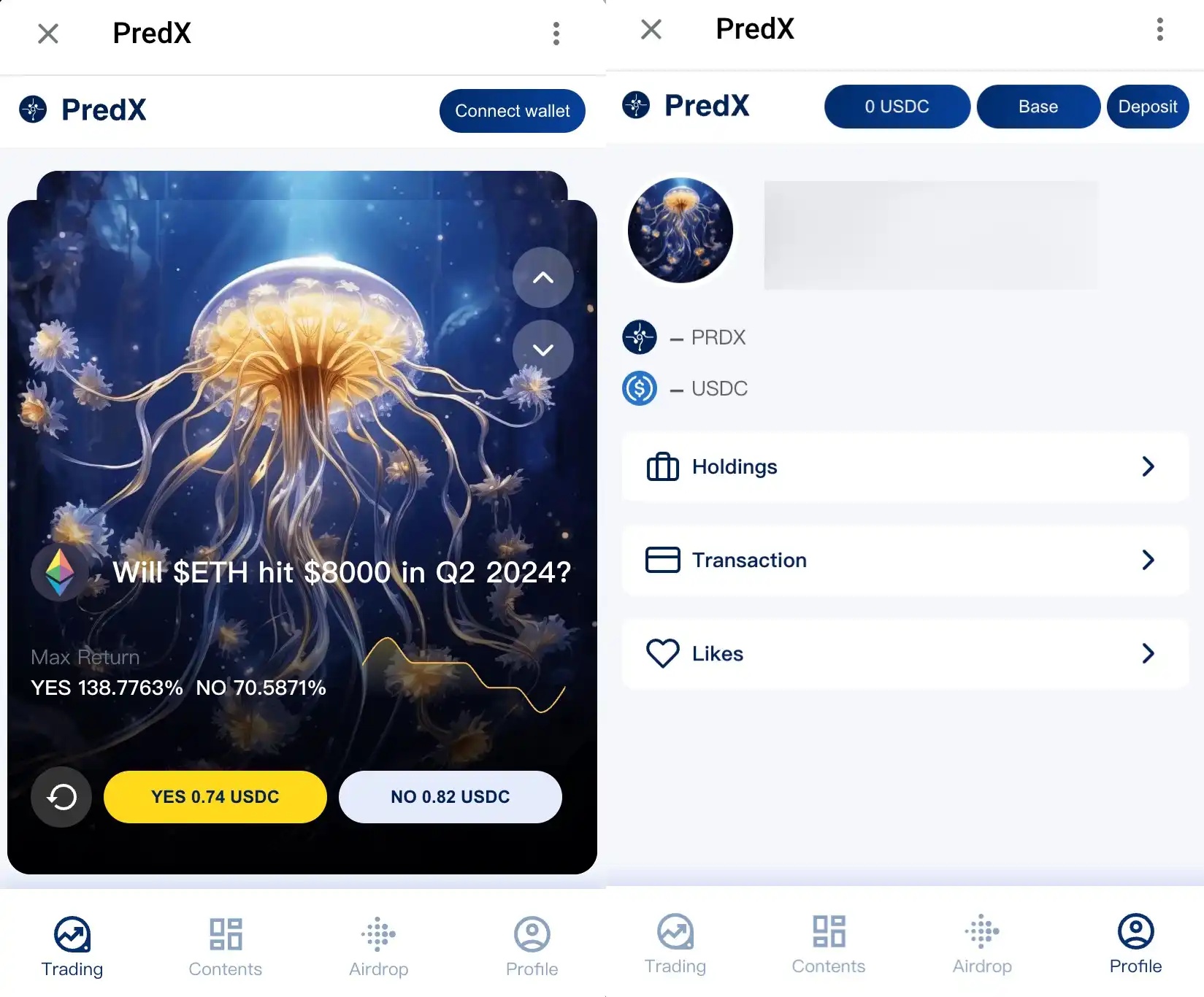
PredX has also launched two Telegram Bots for mobile users to connect TON or EVM wallets for trading or AI-generated event evaluations. The homepage displays prediction events as swipeable cards, offering a smooth, TikTok-like browsing experience for trading markets.
The PredX team won first place in the 2023 Silicon Valley AI+Web3 competition and second place in the Agent category at the 2024 BeWater AI+Crypto hackathon. Its founder, Rein Wu, a former Visa Research researcher, holds multiple AI technology patents. PredX’s extensive AI capabilities are powered by Aimelia Network, an AI infrastructure developed by Rein Wu’s team for the future of prediction markets.
Unlike Bittensor, which uses validation datasets, prediction markets allow players to trade based on their judgments of future outcomes, which aren’t determined by any black-box authority since they are events yet to happen. Many AI agents are created in closed environments with predefined answers before training begins. PredX, however, builds an open world where questions, inputs, outputs, feedback, and rewards are dynamically generated based on the latest trending events online, offering more scenarios for AI model safety evaluation and performance enhancement.
What Is Aimelia Network?
PredX’s ability to generate and recommend events tailored to user interests relies on Aimelia Network. Developed by the PredX founding team, Aimelia Network is an AI infrastructure integrating information acquisition, aggregation, and reasoning.
Most prediction markets today rely on platform-generated events rather than AI or community-generated ones. PredX leverages Aimelia Network’s technology to let community members and administrators create their own assets and list them as tradable events on the platform. This solves two major challenges for prediction markets: relevance and liquidity. In terms of relevance, most users, whether interested in political events, tech events, or crypto trading, see the same screen with the same events and news, lacking personalization. For liquidity, most markets struggle to find counterparties or face wide bid-ask spreads, leading to poor liquidity and user experience.
To address these issues, Aimelia Network improves market relevance and liquidity through an information recommendation system and a liquidity aggregation engine. The recommendation system automatically suggests the most interesting events and news based on user preferences, even providing different AI algorithms and reasoning processes for each individual. The liquidity aggregation engine pools liquidity from various prediction markets, offering a one-stop aggregation service. While many crypto AI products are criticized for merely issuing tokens to raise funds without real-world applications, Aimelia Network has found the perfect intersection of AI and Web3 in prediction markets.
Community-Centric Incentives and Tokenomics
PredX has raised $500,000 in seed funding and now boasts 200,000 active users since its mainnet launch in May. The founding team plans to airdrop 50% of governance tokens to the community, with an ongoing points system serving as a key criterion for future airdrops.
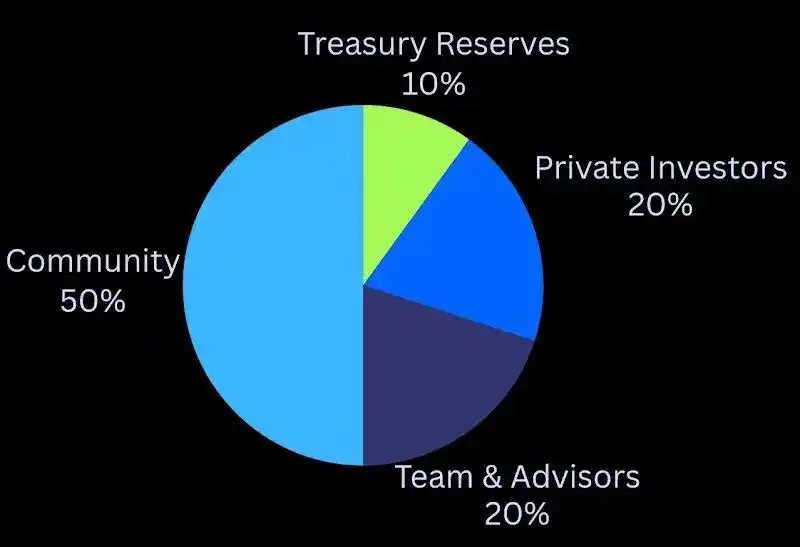
According to PredX’s official introduction, users receive 100 points upon registration, 2 points for their first login, and 50 points for their first $USDC deposit. Placing bets or creating prediction events yields even higher point rewards. Detailed point rules are available on the project’s official website. For creators, 60% of trading revenue is allocated as commissions, along with 5% of the loser’s pool, creating a sustainable incentive structure aligned with the platform’s framework.
Final Thoughts
When buying lottery tickets or betting on sports, participation is one-way—you visit a lottery shop or place a bet, with clear-cut outcomes. In decentralized markets, however, participation is two-way: users can not only trade event outcomes but also create events and provide liquidity. Web3 and AI technologies have redefined prediction markets, enabling anyone to create, understand, and trade almost any event in a transparent, open environment. This flexibility is highly appealing to younger generations. The growth of prediction markets over the past six months hints at their vast potential, and AI-powered PredX and Aimelia will bring smarter, more informative experiences to the sector, unlocking even more possibilities.
The copyright of this article belongs to the original author/organization.
The views expressed herein are solely those of the author and do not reflect the stance of the platform. The content is intended for investment reference purposes only and shall not be considered as investment advice. Please contact us if you have any questions or suggestions regarding the content services provided by the platform.
