


 Likes Received
 Posts
PostsHow do US stocks, bonds, gold, and commodities perform during a rate-cutting cycle, and which sectors outperform?

Last night, the Federal Reserve officially announced a 50 basis point interest rate cut
With this, the two-and-a-half-year-long rate hike cycle has come to an end, and the market has officially entered the rate cut cycle.
For the macroeconomy, rate cuts can reduce corporate borrowing pressure, stimulate consumption, and inject vitality into the economy.
For the corporate sector, loan interest rates for banks and other financial institutions may decline, lowering the cost of borrowing for businesses;
For households, lower borrowing costs will stimulate consumption, positively impacting economic growth.
For the financial sector, deposit rates for households may decrease, easing liability pressure on banks; interest rates for new bond issuances may drop, increasing the attractiveness of existing high-yield bonds, and hot money chasing higher returns may flow into the stock market;
As the economy is stimulated, demand for commodities may rise; economic overheating could increase inflation risks.
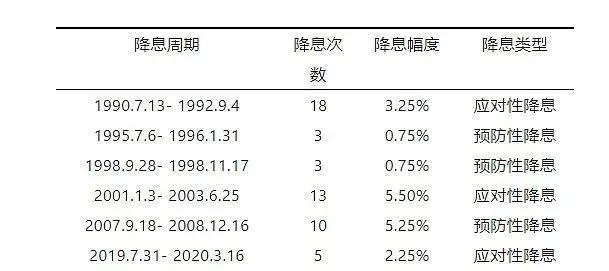
I. Performance of the USD and Bonds During Rate Cuts
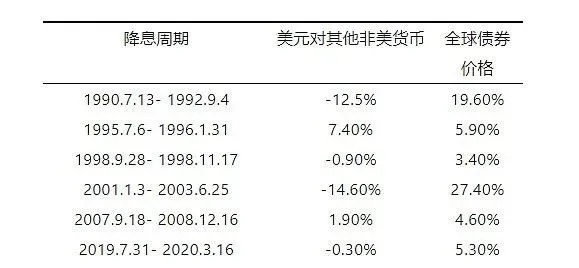
During a rate cut cycle, due to increased market liquidity and international interest rate differentials, the USD generally experiences a wave of depreciation;
Amid fears of declining yields, "high-yield" bonds become sought after, leading to a drop in bond yields.
Additionally, due to the unique "safe-haven attribute" of U.S. Treasuries, their performance is influenced by the overall U.S. economic situation.
Citigroup strategists found that the Bloomberg U.S. Treasury Index achieved a median return of 6.9% in the 12 months following the first rate cut, but only 2.3% in cases of a "soft landing."
Investors should also note that, aside from economic performance, buying U.S. Treasuries early can lock in yields.
Data from CreditSights shows that in the past 10 rate cut cycles, the 10-year U.S. Treasury yield fell by an average of 9 basis points one month after the first cut but climbed 59 basis points one year later—as investors began pricing in economic recovery.
We’ve compiled the performance of the USD and U.S. Treasuries during past Fed rate cut cycles in the chart below:
II. Performance of Gold and Commodities During Rate Cuts
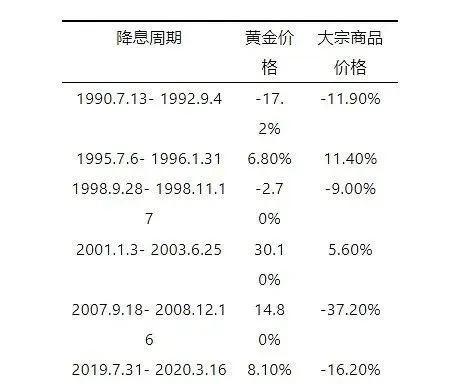
During a rate cut cycle, since gold is priced in USD, gold futures tend to rise more often than fall amid USD depreciation; meanwhile, commodity prices mostly decline during rate cut cycles.
We’ve compiled the performance of gold and commodities during past Fed rate cut cycles in the chart below$LAOPU GOLD(06181.HK)
III. Performance of the U.S. Stock Market (S&P 500) During Rate Cuts
Due to the economic stimulus from rate cuts, the S&P 500 has a high probability of rising after the first rate cut, with pessimistic performance only during the 2001 dot-com bubble and the 2007 global financial crisis; other periods saw gains.
We’ve compiled the performance of the S&P 500 over six months, one year, and two years during past Fed rate cut cycles in the chart below:
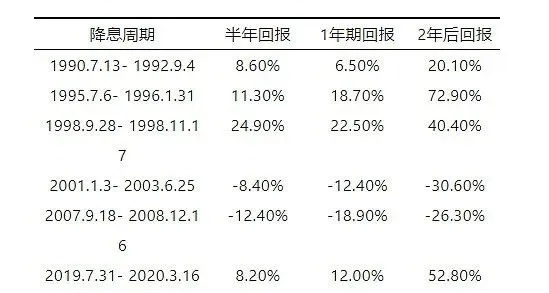
The impact of rate cuts on U.S. stocks is more complex, with both rises and declines.
Overall, Capital Economics notes that under rate cuts, economic conditions are crucial for investors assessing the long-term performance of U.S. stocks.
According to research by Ryan Detrick, Chief Market Strategist at Carson Group, one year after the first rate cut during an economic recession, the S&P 500 fell by nearly 12% on average.
In contrast, during non-recession periods where rate cuts were for "normalization" purposes, U.S. stocks rose by an average of 13% within a year.
IV. Which Sectors Benefit Most from Rate Cuts
Among specific sectors, within the S&P 500’s 11 major categories, consumer staples$Alibaba(BABA.US) and consumer discretionary performed best on average one year after rate cuts, with gains of around 14%.
These were followed by healthcare (12%) and technology$NVIDIA(NVDA.US) $Tesla(TSLA.US) (nearly 8%).
Small-cap stocks, highly sensitive to signs of economic improvement, also tend to perform well—the Russell 2000 rose by an average of 7.4% one year after the first rate cut.
The copyright of this article belongs to the original author/organization.
The views expressed herein are solely those of the author and do not reflect the stance of the platform. The content is intended for investment reference purposes only and shall not be considered as investment advice. Please contact us if you have any questions or suggestions regarding the content services provided by the platform.
