



Has the homogenization of the tea beverage industry reached a turning point? HEYTEA says 'no' to involution.

When an industry reaches maturity with high market saturation, intense competition often ensues, putting tremendous growth pressure on participants.
The freshly made tea beverage sector is a prime example. In this fiercely competitive market, price wars are escalating, with many brands slashing prices to the 10-yuan range.
Heytea, China's premium new tea beverage leader, has felt the pinch in this environment. However, Heytea is now pioneering a bold move: becoming the first to say "no" to cutthroat competition.
Rejecting Competition, Becoming the Differentiated Tea Leader
Heytea recently sent an internal letter titled "Creating Differentiated Brands and Products for Users" to its business partners.
The letter stated that limited consumer demand and homogenized strategies across the industry have led to increasingly fierce competition. This uniformity continues to erode consumer enthusiasm for tea products and brands.
Thus, Heytea believes the solution lies in delivering radically differentiated products and brand experiences. Breaking free from homogeneity requires concrete actions.
Heytea outlined four measures to resist competition:
1) Reject habitual homogenized thinking and avoid pure price wars. Focus on areas where the company excels and users need.
2) Prioritize store quality over expansion speed. Heytea will strictly control new store openings and density in the coming months.
3) Enhance brand differentiation through creativity, improving user experience. Increased investments will be made in design, packaging, marketing, and store spaces.
4) Launch more differentiated products to reignite consumer passion. New offerings will avoid replicating existing structures, exploring healthier tea options instead.
In short, Heytea is charting an unconventional path: avoiding price wars, slowing expansion, and doubling down on differentiation. The letter emphasized that differentiation is the best strategy against current and future challenges.
Why is Heytea the first to reject competition?
Two reasons stand out: First, as a premium brand with an average spend of 17 yuan per customer across its 4,334 stores, Heytea has been hit hard as consumers grow more price-sensitive and rivals cut prices.
Second, Heytea's heavy presence in Guangdong, Jiangsu, and Zhejiang—provinces with dense tea shop competition—exposes it to intense price pressures. Nearly 40% of its stores (1,646 locations) operate in these regions.
Given its higher costs for ingredients and rent, further price cuts would eliminate Heytea's premium margins, threatening profitability. Differentiation offers a way out—though developing unique products requires significant R&D investment. Whether this strategy can restore Heytea's past growth remains to be seen.
Insane Competition: 126,000 Tea Shops Closed in a Year
China's freshly made tea industry has entered a phase of 存量竞争 (stock competition). With capital backing and improved supply chains, market concentration is rising.
To grab market share, brands like Heytea have embraced franchising, accelerating chain expansion. Brands like Sweet 啦啦, Mixue Ice City, $CHABAIDAO(02555.HK), and Auntie Shanghai have grown rapidly.
As stores proliferate, overlapping coverage areas reduce foot traffic, increasing operational pressures. This has triggered a wave of closures.
Data shows China had 414,000 tea shops as of September 15. While 138,700 opened in the past year, net growth was just 12,500—meaning 126,000 shops shut down.
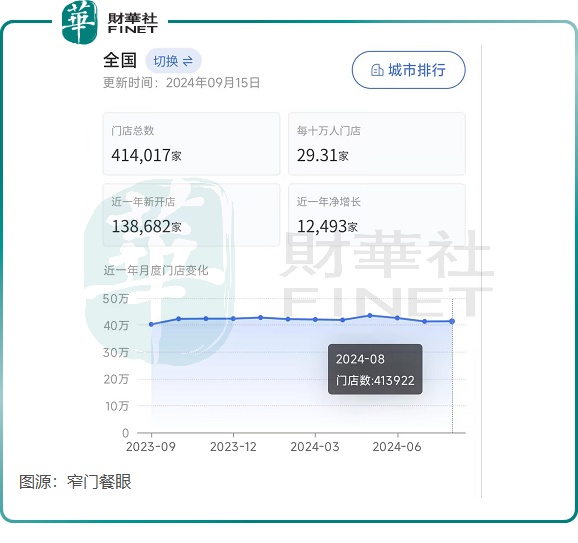
Irrational competition has hurt brands' performance.
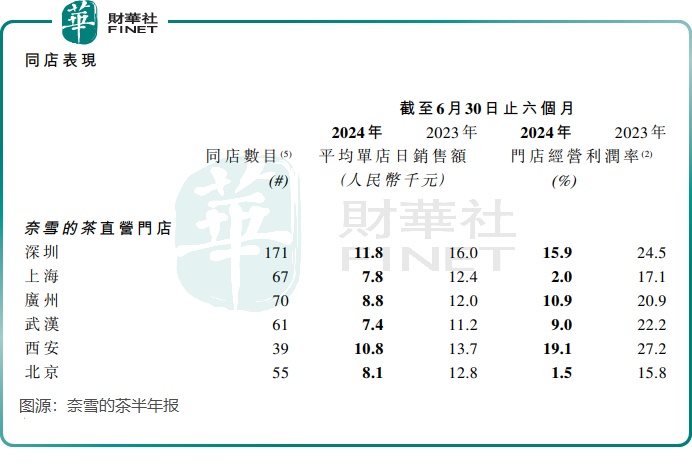
Heytea's premium rival $NAYUKI(02150.HK) saw revenue drop 1.9% to 2.544 billion yuan in H1, swinging to a 435 million yuan loss.
Same-store sales plunged in key cities like Shenzhen and Shanghai, reflecting brutal competition.
Another listed chain, CHABAIDAO, reported a 10% revenue decline to 2.396 billion yuan, with profits down 59.7% to 237 million yuan.
Poor earnings have hammered stocks. NAYUKI recently hit record lows, down over 90% from its peak.
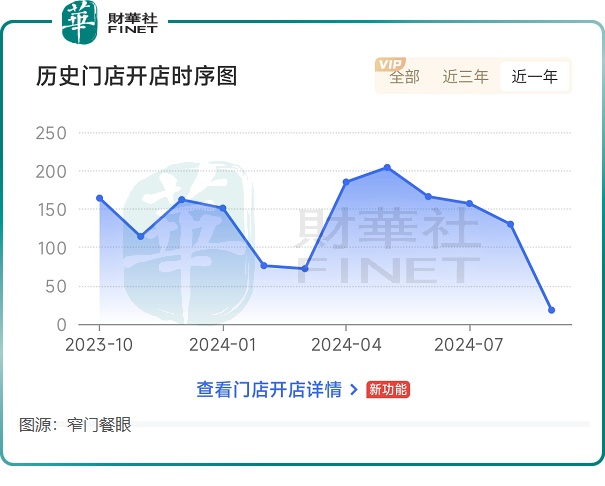
Heytea's expansion has slowed sharply since June, opening just 18 stores in September versus 200+ in May.
China's crowded tea market is accelerating consolidation as price wars trap brands in operational quagmires.
As the first to reject competition, can Heytea's differentiation strategy succeed and open new growth avenues? Only time will tell.
Author: Yuan Yao
The copyright of this article belongs to the original author/organization.
The views expressed herein are solely those of the author and do not reflect the stance of the platform. The content is intended for investment reference purposes only and shall not be considered as investment advice. Please contact us if you have any questions or suggestions regarding the content services provided by the platform.
