

The impact of the Magnificent Seven on US stocks

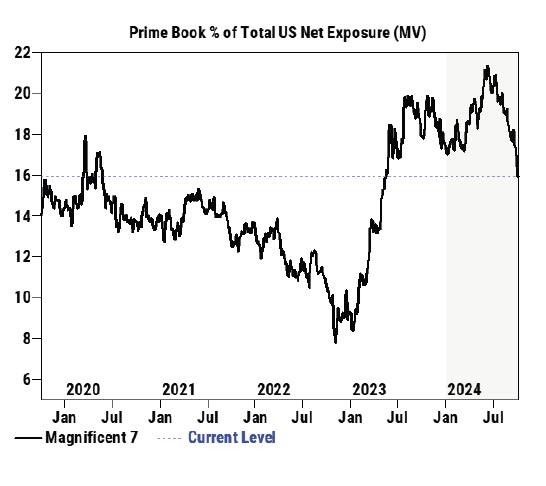
The chart shows the "Prime Book % of Total US Net Exposure (MV)" (Prime Book percentage of total US net exposure), which primarily focuses on a group of stocks known as the "Magnificent 7". The timeline spans from 2020 to mid-2024, illustrating the trend of these stocks or assets in the total US market net exposure.
1. Timeframe and Context:
◦ The "Magnificent 7" typically refers to the top-performing tech stocks or companies in the US market (e.g., Apple, Amazon, Microsoft, Google, Meta, Tesla, NVIDIA). Due to their massive market capitalization, their impact on market indices is significant.
2. "Magnificent 7" (The Big Seven):
◦ During this period, net exposure fluctuated around 14%-16%. The chart shows some ups and downs, likely reflecting market instability during the pandemic. Investors may have sought these major tech stocks as safe havens, driving their share of US net exposure higher.
3. 2020 to Mid-2021:
◦ Exposure dropped to 10%-12%, aligning with broader market adjustments at the time, possibly due to inflationary pressures and interest rate hikes. Growth stocks (especially tech stocks) typically underperform in a rising-rate environment because future earnings become less attractive.
4. 2022:
◦ A significant rise occurred in 2023, indicating renewed investor interest in these tech stocks. This may reflect restored confidence in their long-term prospects despite ongoing economic uncertainty. Rapid advancements in AI and tech innovation (e.g., NVIDIA's push in AI) likely drove this surge.
5. 2023:
◦ After peaking above 20% in early 2024, exposure gradually declined to around 16%-17%. This drop may signal profit-taking after strong gains or concerns about valuations or potential corrections in these tech stocks.
6. 2024:
Potential Drivers:
– 2020-2021: During the pandemic, tech stocks gained favor due to their resilience in remote work and e-commerce booms. Fluctuations may reflect market reactions to reopening and vaccine rollouts.
– 2022 Decline: Fed rate hikes to combat inflation made tech stocks less appealing, as they are sensitive to higher rates. This explains the drop in exposure as funds shifted to stable sectors like energy or utilities.
– 2023 Rise: The rebound likely stemmed from optimism about tech's future, especially in AI, 5G, and cloud computing. As leaders in these fields, the "Magnificent 7" naturally attracted heavy investment.
– 2024 Drop: The pullback may indicate cooling AI hype, macroeconomic worries (e.g., inflation or rising rates), or signs of diversification away from these high-weight stocks.
Conclusion:
The chart shows the weight of the "Magnificent 7" stocks in total US market net exposure $Meta Platforms(META.US). Peaks and troughs reflect market cycles influenced by macroeconomic factors and tech industry dynamics. Despite the decline from 2024 highs, exposure remains historically elevated, underscoring these stocks' key role in overall market sentiment.$Tesla(TSLA.US) $NVIDIA(NVDA.US) $Amazon(AMZN.US) $Meta Platforms(META.US) $Alphabet(GOOGL.US) $Apple(AAPL.US) $Tesla(TSLA.US)
The copyright of this article belongs to the original author/organization.
The views expressed herein are solely those of the author and do not reflect the stance of the platform. The content is intended for investment reference purposes only and shall not be considered as investment advice. Please contact us if you have any questions or suggestions regarding the content services provided by the platform.
