


 Likes Received
 Posts
PostsTencent's stock price has been continuously declining. Buying at the current price, what would the annualized return be? Would it be a good opportunity?

Tencent Holdings $TENCENT(00700.HK) reached its annual peak at HKD 482.4 on October 7th and has since dropped 12% from that high.
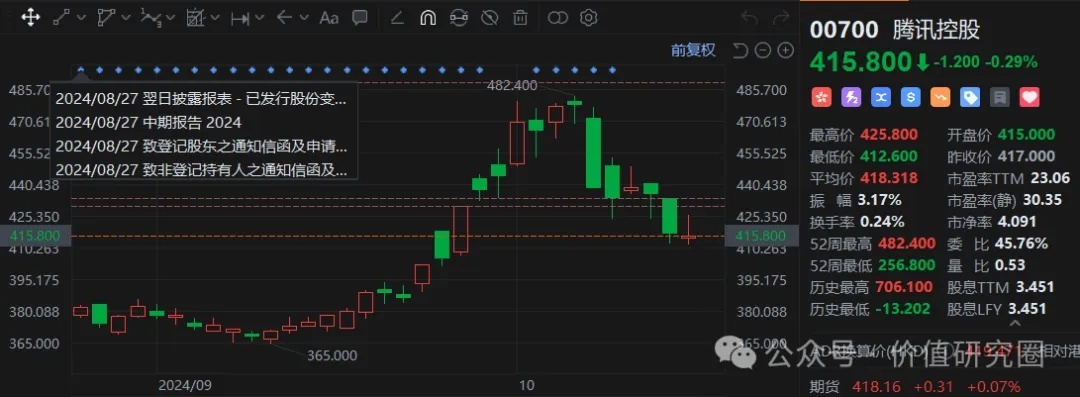
After browsing through other posts, it's clear that many regret not selling at HKD 480.
On January 12th this year, the stock hit its lowest point at HKD 260.2. From the lowest price, the maximum annual gain was 85%.
This is the volatility of the stock market—such dramatic swings in just over nine months. Imagine if you were lucky enough to buy at HKD 260.2—would you have held on until HKD 482.4?
My answer: No.
This involves two issues:
1. Stock prices are unpredictable.
You can't be sure if HKD 482 is the peak, but if your stock hits HKD 480, you'll likely become more optimistic and raise your profit-taking target, hoping to earn more.
For trend speculators, even if they bought at the bottom of HKD 260, they'd probably sell by HKD 300, unable to hold until HKD 482.
Trend speculators don't care about a stock's intrinsic value—they focus solely on price and whether someone will pay more.
2. Focus on intrinsic value.
If you look at Tencent's financial reports, you'll see that despite a 60% stock rise this year, its valuation isn't overstretched.
In 2024, Tencent's net profit is expected to reach RMB 200 billion, with a current P/E of around 18x—a reasonable, undervalued level.
For value investors focused on business performance, they'll likely ride the elevator longer.
No wonder Buffett often says that to achieve good returns in the stock market, you only need two things:
First, psychological resilience.
For example, Tencent's stock surged 85% this year, and even wilder swings may come—you must seize opportunities and not get shaken out.
Second, the ability to assess a company's value.
This lets you estimate intrinsic value and stay calm during volatility.
Both are essential. Otherwise, even if you know a stock is undervalued, fear may force you to sell. Conversely, you might hold when prices far exceed intrinsic value.
The stock market defies human nature—many aspects test you. Stay disciplined.
........
As for valuation, Tencent's declining stock price worries many. I used a calculator to project its market cap over the next three years.
Tencent's current price is HKD 416. With a 2024 net profit of RMB 200 billion, excluding its external investment assets, this serves as a margin of safety.
Assuming a conservative 10% annual net profit growth, three years later, net profit would be RMB 200B * 1.1^3 = RMB 266.2B—a highly achievable target, barring black swan events or regulatory shocks beyond prediction.
In three years:
Pessimistically, if the P/E drops to 15x, the market cap would be RMB 3,993B, with a 3-year CAGR of 3.51%.
Neutrally, at an 18x P/E, the cap would be RMB 4,791.6B, matching the 10% net profit growth rate.
Optimistically, at a 25x P/E (aligned with risk-free rates), the cap would hit RMB 6,655B, delivering a 22.73% CAGR—nearly doubling.
Super-optimistically, with 15% annual profit growth and a 25x P/E, the cap would reach RMB 7,604.4B, yielding a 28% CAGR—crushing Buffett's returns.
Three years is distant, but not insignificant. Whether a 25x P/E and 15% growth materialize depends on individual judgment.
An investing adage: "Be roughly right rather than precisely wrong."
Crunching numbers alone to value a company and invest accordingly is a recipe for losses.
Calculations are just tools—what matters more is understanding the company's business model, competitive edge, and sustainable profitability.
Only then can you estimate intrinsic value and compare it to the market.
When market value far exceeds intrinsic value, sell for gains and patiently await the next opportunity.
That's investing!
$Sunac China(01918.HK) $BABA-W(09988.HK)
The copyright of this article belongs to the original author/organization.
The views expressed herein are solely those of the author and do not reflect the stance of the platform. The content is intended for investment reference purposes only and shall not be considered as investment advice. Please contact us if you have any questions or suggestions regarding the content services provided by the platform.
