


Meituan raided JD.com's home turf.

JD.com is fighting on the front lines against Tmall and Pinduoduo, while also guarding against Douyin and Xiaohongshu on the flanks. When they look back, they find Meituan's troops already at the gates.
$JD.com(JD.US) $MEITUAN(03690.HK)
This story begins with Meituan's forward warehouses.
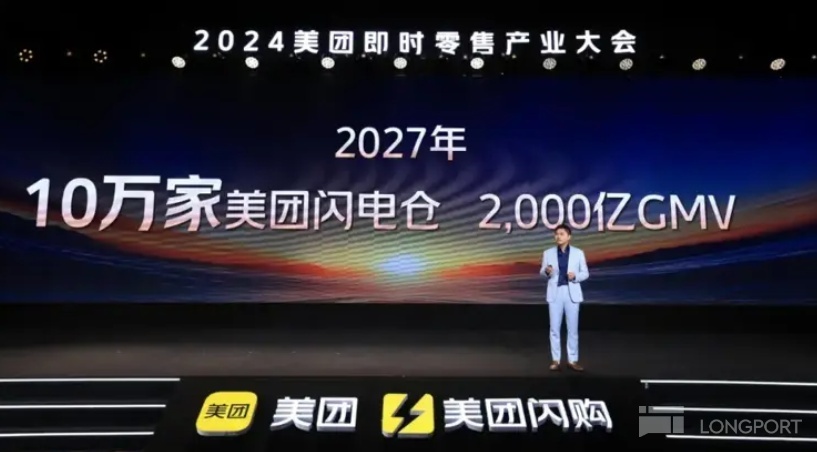
On October 15, Meituan held the "2024 Meituan Instant Retail Industry Conference," its most significant project this year. During the event, CEO Wang Puzhong shared several key data points:
1. The market continues to expand. In 2023, the instant retail industry grew by over 50%, and it is projected to exceed 1 trillion yuan by 2026 and 2 trillion yuan by 2030.
2. The variety of consumer goods is diversifying. From daily necessities like snacks, beverages, fresh produce, and groceries, the range is rapidly expanding to include electronics, cosmetics, apparel, healthcare, and pet supplies.
3. The customer base is growing significantly. Instant retail's primary audience is expanding from first- and second-tier cities into lower-tier markets. Meituan's flash delivery service has seen a 20%-34% year-on-year increase in active users.
4. The forward warehouse model is developing rapidly. Meituan currently operates 30,000 lightning warehouses, with plans to reach 100,000 by 2027.
However, industry insiders are even more optimistic about Meituan, predicting that the 100,000 lightning warehouses could be completed as early as 2025-2026, meaning over 70 new warehouses would be added daily.
Why is Meituan investing so heavily in forward warehouses, and what is their potential?
Once a nationwide network of forward warehouses is established, Meituan can sell anything—not just groceries and supermarket items as it does now. This is an ambitious long-term strategy.
China has many high-quality products, but competition is fierce, and distribution remains a challenge due to the fragmented retail landscape. Why have China's tea and milk coffee markets evolved so quickly? Brands like Luckin Coffee have led the way in flavor and innovation by building their own distribution channels, whether through direct operations or franchising.
When a brand wants to test a new product, our 100,000 lightning warehouses can reach 100,000 terminals in just two weeks, allowing standout products to emerge quickly. Unlike the current model, where brands spend heavily on advertising and intermediaries without seeing profits, and consumers miss out on the best and newest products. This is what Meituan fundamentally aims to achieve—it's our mission.
Meituan has branded its services in various ways: food delivery, flash delivery, instant retail, same-city retail... These may seem different from traditional e-commerce, leading many to believe Meituan isn't directly competing with e-commerce companies. But if we categorize all these as "online retail," the picture becomes clear: they all sell goods online, differing only in fulfillment methods. Can we really say there's no competition?
However, Meituan's forward warehouses don't impact all e-commerce platforms equally. It depends on the user base. Meituan's target customers prioritize convenience, are willing to pay extra for fast delivery, and exhibit some premium consumption traits. These are not Pinduoduo's users, who haggle over small savings. Building a 3 km delivery network in lower-tier markets isn't feasible either. The most directly affected is JD.com.
Meituan started with food delivery, then expanded to emergency products like adult items, fruits, and drinks, and naturally transitioned to daily necessities like fresh food, alcohol, phones, and clothing. When new iPhones launch, some consumers now order from Meituan instead of JD.com. Consumers have grown accustomed to Meituan's doorstep delivery, which the company calls:
A highly predictable lifestyle.
The most interesting aspect is delivery times.
From 9 PM to 6 AM—when traditional stores are closed—we handle a quarter of our business. This is pure incremental demand; previously, consumers had nowhere to buy during these hours. Traditional offline retail couldn't meet this need.
Years ago, JD.com touted its e-commerce slogan: "Wide selection, fast delivery, high quality, and low prices." But "wide selection" went to Taobao, "low prices" to Pinduoduo, and now "fast delivery" is being taken by Meituan: Can JD.com's logistics ever match Meituan's riders? Without Meituan's proximity advantage, JD.com's fastest delivery is same-day in top-tier cities—still taking hours. Meituan's riders deliver in under 30 minutes, nationwide, even at midnight. How can JD.com compete?
If we rank consumer priorities for these four attributes, it's: low price > speed > quality > selection. The same order applies to competitive barriers. Pinduoduo dominates "low price" with its ultra-cheap supply chain, unmatched by others. Meituan owns "speed" with its 8 million riders, maintaining razor-thin profits per order. Competitors like Ele.me lose money even with 30% market share—no one can challenge Meituan here. JD.com once had "quality" and "speed," but Meituan has taken "speed," and "quality" isn't a strong enough barrier since consumers ultimately trust brands. Pinduoduo's subsidized iPhones are just as appealing. Finally, "selection" matters less in an oversupplied market where 99% of products are available everywhere. Having more niche items isn't necessarily an advantage, making Taobao's barrier the weakest.
When Pinduoduo focused on low prices, everyone dismissed it. By the time Taobao reacted, it was too late. Meituan is now doing the same—building its foundation step by step in plain sight. If JD.com doesn't act fast, its stronghold will be breached.
Meituan's accelerated moves coincided with Liu Qiangdong stepping back from JD.com between 2020 and 2022. Liu must have watched anxiously. After resolving his U.S. legal issues, he returned to JD.com in late 2022, immediately convening an all-hands meeting to criticize executives for focusing on flashy presentations and buzzwords instead of core strategy.
No matter what, I won't give up, and I hope my team won't either.
What can JD.com do? Fight back.
So JD.com poached executives from Meituan, launched instant delivery, built its own forward warehouses (Qixian), and started offering free coffee to counter Meituan's siege.
Long-term, we boldly predict this battle's outcome will mirror Taobao's struggle against Pinduoduo. Like Pinduoduo with "low price," Meituan has perfected "speed," leaving JD.com unable to respond effectively. JD.com can only slow its decline.
Short-term, JD.com must accelerate its instant delivery network to narrow the gap with Meituan. Initiatives like instant delivery, forward warehouses, and delivery subsidies are essential.
Meituan's ultimate move is complete—the endless war won't stop. Now that it's breached JD.com's stronghold, JD.com has no choice but to fight. The business world is never easy.
The copyright of this article belongs to the original author/organization.
The views expressed herein are solely those of the author and do not reflect the stance of the platform. The content is intended for investment reference purposes only and shall not be considered as investment advice. Please contact us if you have any questions or suggestions regarding the content services provided by the platform.
