


 Buffett Apprentice
Nvidia news update and evaluation

Recently, despite ASML's earnings bomb, NVIDIA and TSMC performed very well, both hitting record highs in trading on October 17.
Currently, the market's main focus on NVIDIA is still on the delivery expectations of the new Blackwell product and the growth of the AI industry chain in the near future. This article compiles some market rumors and news.
- Recently, Jensen Huang frequently emphasized strong demand for Blackwell at exchange meetings; sovereign AI revenue is expected to reach low double-digit (LDD) billions of dollars by January 2025; NVIDIA's growth after 2025 may be driven by frontier models + reinforcement learning (updated the logic of inference-side scaling into the PPT).
- At the October 8 Hon Hai Techday, it was mentioned that Blackwell demand is better than expected, with 24Q4B cards expected to reach 250,000-300,000 units, generating $5-10 billion in revenue. 25Q1B card revenue may exceed H cards, with shipments of 750,000-800,000 units, nearly 3x that of 24Q4. Hon Hai plans to achieve a GB200NVL72 rack capacity of 20,000 by 2025 and establish the world's largest NVIDIA B200 assembly plant in Mexico.
- NVIDIA has delivered one of the first engineering versions of the DGXB200 to OpenAI's office.
- CoWoS outlook continues to be revised upward. TSMC plans to significantly increase capacity in the coming years, with monthly capacity expected to reach 35,000 wafers by the end of 2024, 65,000 wafers by the end of 2025, and 75,000 wafers by mid-2026 (from Jefferies Semi CoWoS meeting).
- Minor changes to the NVRoadmap: B200AUltra/B200Ultra/GB200Ultra may be renamed B300A/B300/GB300, with mass production planned for mid-2025. The originally planned B200A shipment in 25Q1 may be canceled.
- AMD MI325X will enter mass production in 24Q4, equipped with HBM3e, and is 30% faster than NVIDIA's H200. Future roadmap: MI350 in 2025, competing with Blackwell; MI400 in 2026.
2025 NVIDIA shipment expectations: Total GPUs around 8 million units, including 60,000 GB200 racks (4 million units), 700,000-800,000 B300 8-card servers, over 2 million H100/H200 units, and the rest being B200A.
New product timeline: B300 products are still being aligned with customers, with updates expected by the end of November. Prototypes will be delivered to customers in June or July next year. The 2025 GTC conference is expected to showcase Rubin prototypes, and Computex may feature NVIDIA's self-developed CPU paired with Rubin products.
Product pricing and ODM profit margins: GB200 priced at $3-3.3 million, non-GPU value around $800,000, gross profit approximately $64,000, net profit close to $50,000. There will be room for price cuts in the future, with NVIDIA adjusting based on market competition. Price pressure will be passed on to ODMs, who will adjust component suppliers accordingly.
NVIDIA's product strategy: Aim to capture as much customer demand as possible, with GB200 and Rubin racks as high-end products, and B300, B200A, and H200 as high-to-low-end single-node products to cover all customers. Simultaneously, NVIDIA is pushing CPU products to compete with rivals.
Copper cables, optical modules, and PCB status: GB200 switch tray connection solutions are still under validation. PCBs may face heat dissipation issues and account for a smaller share, while copper cables will have a higher share. In the long term, high-density rack solutions are more likely to use optical solutions due to transmission distance, signal attenuation, and connection complexity limitations of copper cables.
[Evaluation]
First, the market's earlier focus on Blackwell, despite some twists and turns, has now solidified with strong certainty for mass production and delivery within the year. As NVIDIA's new killer product, Blackwell's emergence may reshape the entire AI industry chain.
A more powerful computing foundation will enable superior AI models. This is undoubtedly good news for companies that have already built and accumulated AI models. Whether it's OpenAI, Google, Microsoft, or Meta's models, they will gain a significant boost from this new infrastructure.
At the same time, for upstream core suppliers like TSMC, NVIDIA's new products will drive demand for advanced process chips and advanced packaging. TSMC's capacity commitments for Alibaba over the next two to three years are also highly certain, which is positive news for upstream manufacturers.
Further upstream, LAM, AMAT, TEL, and KLA will all benefit from this semiconductor industry boom. These high-tech companies have gross margins of at least 40-50% and are clear beneficiaries in the market.
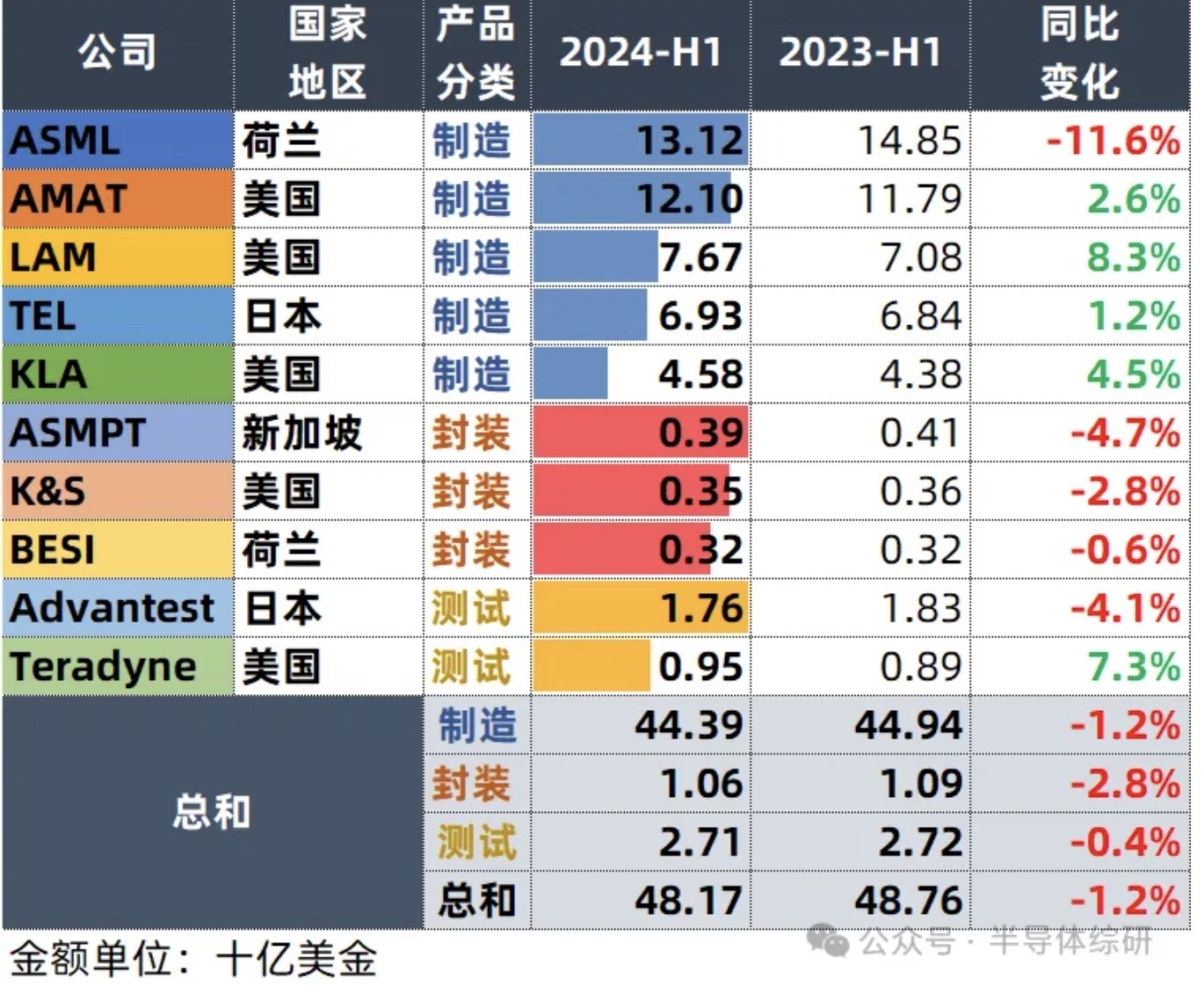
Additionally, advanced packaging company BESI has grown rapidly in recent years, with gross margins exceeding 60%. Over the next two to three years, advanced packaging equipment will continue to benefit.
From this material, the PCB industry may gradually fade, while more efficient copper cables and optical modules will benefit in the new generation of products. Many domestic manufacturers could be excellent beneficiaries.
Overall, this new technological revolution driven by NVIDIA and TSMC is fueling an unprecedented boom in the semiconductor industry. $NVIDIA(NVDA.US)
The copyright of this article belongs to the original author/organization.
The views expressed herein are solely those of the author and do not reflect the stance of the platform. The content is intended for investment reference purposes only and shall not be considered as investment advice. Please contact us if you have any questions or suggestions regarding the content services provided by the platform.
