


 Commemorative
 Posts
Posts[Investment Encyclopedia] A comprehensive guide to American Depositary Receipts (ADR)

Depositary Receipt (DR) is a negotiable certificate representing the securities of a foreign company circulating in the securities market of a country. Depending on the location of issuance or trading, it is given different names. As the name suggests, the American Depositary Receipt (ADR) is issued by U.S. financial institutions and serves as a certificate for investors to trade non-U.S. company stocks (such as Hong Kong-listed or mainland China-listed companies) on U.S. stock exchanges. It allows investors who cannot or find it inconvenient to trade non-U.S. company stocks to gain exposure to non-U.S. equities through this investment instrument.
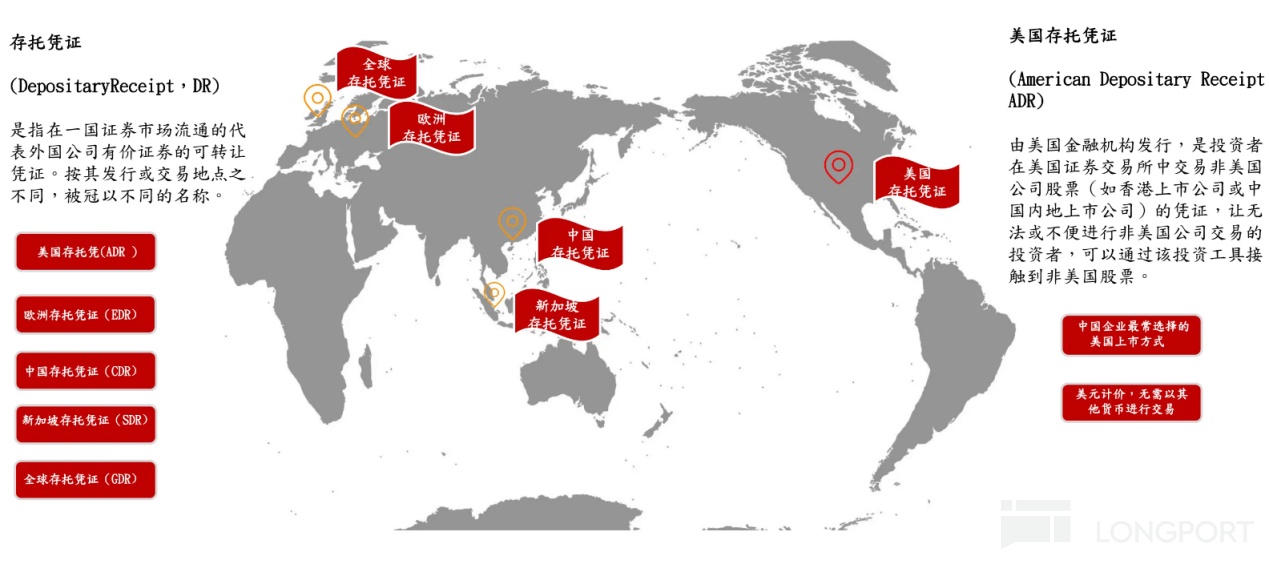
Based on their relationship with the underlying stocks, ADRs can be classified into different types, mainly the following:
Level I ADR: Traded in the over-the-counter (OTC) market. Since it does not involve fundraising in the U.S., companies are not required to fully comply with the SEC's disclosure regulations.
Level II ADR: Can be listed on major U.S. stock exchanges (such as the New York Stock Exchange) and must comply with SEC reporting requirements, offering higher liquidity.
Level III ADR: Raises capital through public offerings and is listed on exchanges, subject to the strictest regulatory oversight.
The issuance and trading of ADRs involve collaboration among multiple parties. Typically, a foreign company deposits a certain number of shares with a depositary bank, which then issues a corresponding number of ADRs. These ADRs can be traded on U.S. exchanges or the OTC market, allowing investors to indirectly hold the company's shares by purchasing these certificates. The depositary bank handles cross-border settlement and dividend conversion on behalf of investors.
3 Easy Steps to ADR Trading
Investors can purchase ADRs through any U.S. securities dealer, similar to buying stocks. The specific steps include:
(1) Select the Right ADR: Search for ADR codes or company names already trading in the U.S. market via financial platforms.
(2) Open an Investment Account: Open an account with a broker qualified for ADR trading and ensure sufficient funds are available.
(3) Place a Trade Order: Just like buying local stocks, investors only need to place an order to purchase the selected ADR on the platform.
Invest in ADRs for Global Asset Allocation
Investors who choose to trade ADRs typically enjoy several benefits:
First, it simplifies international investing. ADRs are listed and traded on major U.S. exchanges, with trading times and processes identical to those of ordinary stocks. Investors can buy and sell them as conveniently as U.S. domestic products, avoiding the hassle of opening accounts directly on foreign exchanges and enabling U.S. investors to easily invest in overseas companies.
Second, ADRs use USD for all transactions and dividend settlements, reducing the currency risk associated with investing in foreign stocks. Investors need not worry about exchange rate fluctuations. Additionally, ADRs offer simplified tax handling, as foreign dividends are already processed for certain tax matters when converted to USD.
Finally, for investors, ADRs offer strong liquidity, and the issuing companies are often industry leaders in their respective fields. By investing in ADRs, both investors and companies benefit from the globalized market. For U.S. investors seeking portfolio diversification, ADRs provide a convenient gateway to international investments. Understanding the mechanics and opportunities of ADRs will help investors better allocate their global assets.
ADRs Bridge Global Investments
Issuing ADRs provides foreign companies with access to the U.S. capital market, expanding their investor base and enhancing international visibility. It is one of the strategic moves for foreign companies to enter the U.S. securities market and attract global capital. Many foreign companies have successfully entered the U.S. capital market by issuing ADRs, boosting their visibility and liquidity. For example, CK Infrastructure Holdings (CKISY.US), Tencent Holdings ADR (TCEHY.US), Alibaba (BABA.US), and Meituan ADR (MPNGY.US) have attracted numerous U.S. investors through ADR issuance. These companies often gain more funding post-ADR issuance, improving stock liquidity and valuations.
$DOWWAY(08403.HK) $Tencent(TCEHY.US) $Alibaba(BABA.US)
The copyright of this article belongs to the original author/organization.
The views expressed herein are solely those of the author and do not reflect the stance of the platform. The content is intended for investment reference purposes only and shall not be considered as investment advice. Please contact us if you have any questions or suggestions regarding the content services provided by the platform.
