



Where is the divergence between TSMC and ASML?

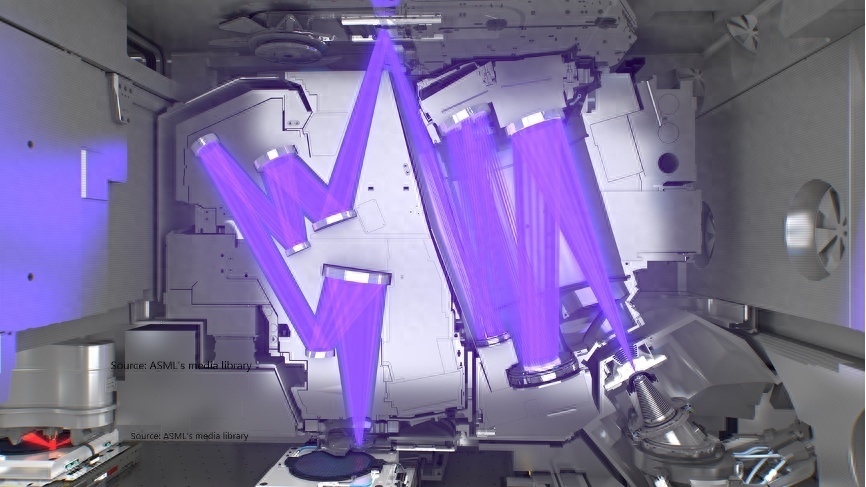
Lithography giant $ASML(ASML.US) saw its stock price plummet after announcing its Q3 2024 earnings, while the world's top foundry $Taiwan Semiconductor(TSM.US) surged to a new all-time high, with its market cap surpassing $1 trillion. Why the divergence?
TSMC and ASML's positions in the supply chain
The AI investment boom has fueled rapid growth in the AI chip industry. Both TSMC and ASML are undisputed leaders in their respective fields, making them prime beneficiaries of AI's rise.
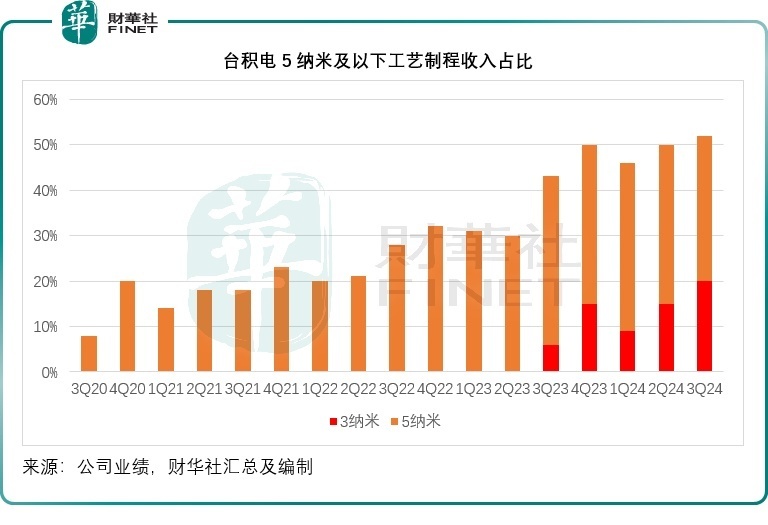
Producing cutting-edge AI chips requires 5nm process technology. TSMC, which commands at least 60% of the logic chip market, can manufacture the most advanced AI chips and has achieved mass production of sub-5nm processes. As shown below, TSMC has even mass-produced 3nm chips, with sub-5nm processes now accounting for over 52% of its revenue in Q3 2024—leading the industry.
To produce these advanced wafers, TSMC relies on lithography machines. The widely used ArFi (immersion lithography) systems theoretically support 7nm processes, but sub-7nm production costs rise sharply. Extreme ultraviolet (EUV) lithography significantly reduces 5nm costs and enables 3nm/2nm chip production—with ASML as the dominant EUV supplier.
In other words, ASML and TSMC operate in an upstream-downstream relationship. Strong AI chip demand first reaches TSMC, then flows to ASML through TSMC's lithography orders.
Why is memory chip demand declining?
However, note that while TSMC dominates logic chips, AI also requires memory chips—mainly supplied by Samsung and other Korean firms.
HKBT estimates ASML's Q3 logic segment revenue grew 48% QoQ to €3.793B (64% of total, up from 54%), while memory revenue fell 3% to €2.133B (36% of total, down from 46%).
At its earnings call, ASML stressed AI's momentum remains strong with further upside, but recovery in other segments will take longer—extending into 2025—causing some clients to stay cautious.
This gradual recovery affects logic chips, compounded by foundry competition delaying some clients' node transitions. Memory clients are even more restrained in capacity expansion—though ASML sees strong demand for HBM and DDR5-related tech transitions.
Notably, $Intel(INTC.US)'s foundry push continues to lose money with little progress. Since Intel still relies on TSMC for AI chips, this may dent its ASML orders.
Meanwhile, Samsung—whose management recently issued an apology—also struggles. Despite targeting 3-5x HBM sales growth in H2, Korean reports say it's stuck validating 12-Hi HBM3e for $NVIDIA(NVDA.US), with issues in 1a DRAM adoption.
Samsung planned 1a DRAM mass production in late 2021 using 5 EUV layers (vs. SK Hynix's 1), but EUV's technical challenges hurt yields and cost targets. Reports suggest redesigns could delay volume production to Q2 2025—impacting ASML demand.
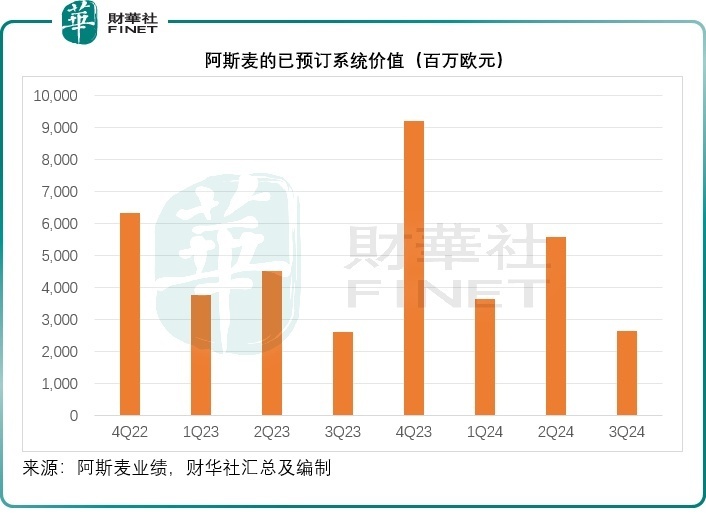
ASML's Q3 system bookings fell 52.7% QoQ to €2.633B (see below).
Is AI still promising?
When asked if AI is a bubble, TSMC CEO C.C. Wei declared: "The demand is real!" He noted all major AI innovators work with TSMC, giving unrivaled industry insight. TSMC uses AI internally to boost yields, efficiency, and quality—with each 1% productivity gain worth ~NT$1B in revenue.
ASML also emphasized AI's long-term strength. HKBT estimates its U.S. revenue surged to ~€1.244B in Q3 (vs. €265M YoY), likely reflecting America's chip supply chain buildup.
Wei confirmed TSMC's Arizona Fab 1 will start production in early 2025, with Fabs 2/3 using more advanced tech (2028/2030 targets). Its Japan fab began output this quarter, while Germany's Dresden fab (focused on auto/industrial 12-28nm chips) aims for 2027 production.
TSMC's expansion plans signal sustained demand for ASML. At its call, ASML reiterated long-term drivers: AI's rise, growing client share, and energy/electrification trends boosting both advanced and mature nodes. Despite delays, global fab projects will drive future orders.
Conclusion
Both TSMC and ASML affirm robust AI demand and future growth—though timing differences explain their post-earnings stock reactions. After TSMC's bullish outlook, markets pivoted back to AI optimism: ASML rose 2.5% post-TSMC and remains up pre-market.
Mao Ting
The copyright of this article belongs to the original author/organization.
The views expressed herein are solely those of the author and do not reflect the stance of the platform. The content is intended for investment reference purposes only and shall not be considered as investment advice. Please contact us if you have any questions or suggestions regarding the content services provided by the platform.
