


[True Insight Hong Kong Stocks Expert] Entering the earnings redemption period, Zai Lab may achieve overall profitability by the end of 2025.

Last week, the Hang Seng Index (HSI) target of 20,000-21,000 points mentioned by the author was reached. The 20,255 point level represents 50% of the entire upward trend and is normally unbreakable. Fortunately, on Friday, the Chinese government introduced new policies and directives: "Advancing Chinese-style modernization, with technology taking the lead." At the same time, the People's Bank of China (PBOC) officially launched the Securities, Funds, and Insurance Companies Swap Facility (SFISF): 20 securities and fund companies have been approved, with the first batch of applications exceeding 200 billion yuan. The PBOC also officially introduced stock repurchase and increase loans, with an initial quota of 300 billion yuan. The State Council also proposed combining the advancement of a unified national market with the implementation of a basket of incremental policies. The index rose nearly 700 points in a single day, and the 20,255 point level was held again. After the introduction of these policies, the market surged further. From a medium-term perspective, the index is expected to move within the range of 20,000-21,800 points, and it is recommended to buy on dips.
During this correction period, some stocks did not fall as deeply as the broader market and rebounded earlier, surpassing previous highs. These stocks performed exceptionally well on the charts, possibly because their earlier gains were not as exaggerated as other stocks in the market. However, they showed strong momentum and more stable trends, making it technically easier to control risks.
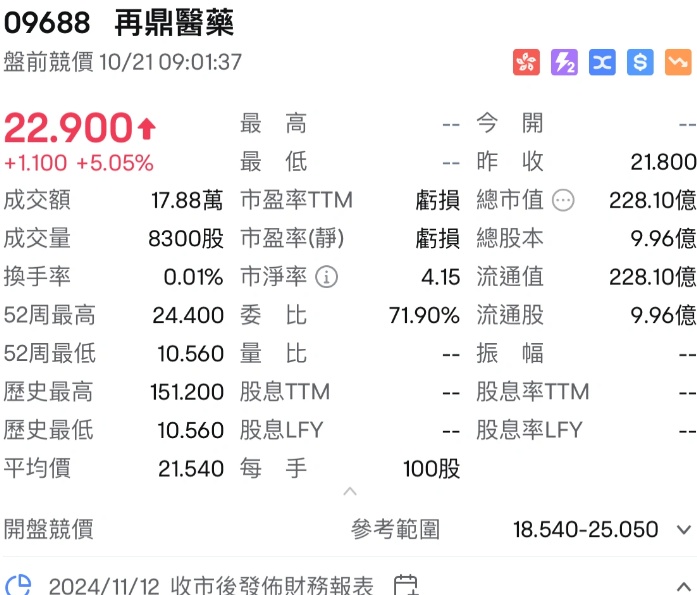
$ZAI LAB(09688.HK) Zai Lab (09688.HK) is one such stock. On the day the market fell (October 8), it dropped nearly 10%, but in the following days, it only consolidated sideways. Starting Wednesday of this week, it rose for three consecutive days, with a nearly 9% increase on Friday, breaking through previous highs.
Zai Lab is a patient-centric, commercial-stage innovative global biopharmaceutical company with significant operations in Greater China and the United States. It is committed to addressing unmet medical needs in oncology, autoimmune diseases, central nervous system disorders, and infectious diseases through product discovery, development, and commercialization. Currently, it has five commercialized products (Zeija®, OPTUNE, Qinlock®, Nuzyra®, and Vyvgart®) approved for marketing in at least one region of Greater China. OPTUNE refers to tumor-treating field devices sold under various brand names, including Optune® for the treatment of GBM. The company also has multiple late-stage product development projects and several key clinical studies underway.
All five currently marketed products have generated sales revenue, with the core product Vyvgart® (for the treatment of myasthenia gravis) showing strong growth momentum. Since entering the national medical insurance in 2024, it has rapidly expanded, contributing $36.4 million in revenue in Q1 2024. The company expects its annual sales to reach $80 million. Another new drug application (NDA) for Vyvgart® for chronic inflammatory demyelinating polyneuropathy was accepted by the CDE in May 2024. Vyvgart® has the potential for "same drug, different diseases" applications and a rich pipeline of potential indications, making it a promising blockbuster in autoimmune diseases.
Another potential blockbuster product is KarXT for the treatment of schizophrenia. On September 27, 2024, the company's partner Bristol-Myers Squibb (BMY.US) announced that the FDA had officially approved Cobenfy (KarXT) for the oral treatment of adult schizophrenia on September 26. This news makes KarXT the first new-mechanism drug approved by the FDA for schizophrenia in decades, without the common side effects of other antipsychotic drugs. In other words, most existing schizophrenia treatments are old drugs approved last century, and KarXT represents the most promising breakthrough in schizophrenia treatment. Market estimates suggest Cobenfy could achieve $2.8 billion in sales by 2028, with peak sales reaching approximately $6 billion.
According to WHO statistics, there are about 24 million schizophrenia patients worldwide, with over 8 million in China. Expert Market Research estimates that the global schizophrenia treatment market will grow from $8.18 billion in 2023 to $12.97 billion in 2032, with a compound annual growth rate of 5.26%. KarXT is expected to open domestic and international markets with its advantages in efficacy and safety.
Zai Lab holds the development, production, and commercialization rights for KarXT in Greater China. In August 2024, the company completed patient enrollment for the Phase III bridging clinical trial for schizophrenia in China. It expects to obtain key study data and submit a Chinese NDA between Q2 2024 and Q1 2025, with a lead time of at least two years over competitors. Considering this, Zai Lab is already in a strong position in the schizophrenia field.
In addition to Vyvgart® and KarXT, Zai Lab's partner Novocure (NVCR) recently announced that the FDA has approved the tumor-treating fields (TTFields) therapy Optune Lua for use in combination with PD-1/PD-L1 inhibitors or docetaxel for the treatment of adult patients with metastatic non-small cell lung cancer (mNSCLC) who have experienced disease progression during or after platinum-based therapy.
This marks another breakthrough for a blockbuster product. Previously, Zai Lab's Optune Lua (Optune®) performed below expectations after its domestic launch in May 2020, with sales stagnating at around $47 million in 2022-2023 due to the small market for its indications. However, this news signifies the arrival of a new major indication. It is estimated that about 30,000 stage 4 NSCLC patients in the U.S. experience disease progression during or after platinum-based therapy each year and actively seek treatment. Additionally, TTFields have further differentiated market potential in indications such as NSCLC brain metastases, lung cancer, pancreatic cancer, and gastric cancer. If these indications are successfully realized, the growth potential is vast.
From the news about these blockbuster products, Zai Lab seems to be on a positive trajectory. The company has achieved consecutive years of revenue growth and reduced losses for two consecutive years. It boldly forecasts a compound annual growth rate of about 50% for revenue from 2023 to 2028, achieving overall profitability by the end of 2025 and entering positive profitability in 2026.
According to Guosheng Securities' DCF valuation model, the company's reasonable market value in 2024 is estimated at approximately HKD 36.572 billion, while Zai Lab's current market value is only HKD 21.7 billion, indicating a certain discount. It's no surprise that major shareholders, including Wellington Management and Capital Group, have recently increased their holdings in Zai Lab's H-shares.
Unlike many biotech companies previously introduced by the author, Zai Lab primarily follows a License-in model rather than License-out. The License-in model involves acquiring future sales rights for IP products through upfront and milestone payments, essentially importing products from external sources.
Although License-out models have been highly praised in recent years, this does not mean the License-in model lacks value. The License-in model emphasizes the company's vision and sales capabilities.
Judging by Zai Lab's rich pipeline, the products it has introduced are mostly first-in-class and include major indications. The blockbuster products also demonstrate the company's unique vision, though it will take time to verify profitability. The company's sales capabilities are also noteworthy, such as the leading sales of niraparib in the Chinese market. However, Zai Lab has also transitioned to a dual-track development model of "external introduction + independent R&D" in recent years. It currently has self-developed innovative molecules such as IL-17 Humabody, DLL3 ADC, and CCR8 monoclonal antibody in clinical research stages, which may become new growth points.
In summary, Zai Lab, as a License-in biotech company, has its unique strengths. Its product pipeline is rich, commercialization capabilities are strong, and it has entered a period of performance realization. Coupled with the international potential of its self-developed products, Zai Lab's prospects are very optimistic. For those interested in investing in the biotech sector, Zai Lab is a good choice.
Other biotech stocks previously mentioned, such as Akeso Biopharma (09926.HK), InnoCare Pharma (09969.HK), and WuXi Biologics (02269.HK), did not fall much even during the market correction.
Disclaimer
The above is purely personal research sharing and does not represent the stance of any third-party institution. This commentary should not be construed as an offer, solicitation, invitation, or recommendation to buy or sell any investment product or make any investment decision, nor should it be interpreted as professional advice. Readers should fully understand the risks and related legal, tax, and accounting implications before making any investment decisions and determine whether the investment suits their financial situation and objectives based on their personal circumstances. Seek appropriate professional advice if necessary. The author or related parties do not hold any financial interests in the listed companies discussed in this commentary.
Written by: Li Jiacong
The copyright of this article belongs to the original author/organization.
The views expressed herein are solely those of the author and do not reflect the stance of the platform. The content is intended for investment reference purposes only and shall not be considered as investment advice. Please contact us if you have any questions or suggestions regarding the content services provided by the platform.
