


 Likes Received
 Posts
PostsWinona "submits the paper", down 28%! The "beauty-loving" business is not easy anymore.

The business of "pursuing beauty" is indeed becoming more challenging.
The once high-growth medical aesthetics sector is now parting ways with high valuations. With the absence of high-growth expectations, the market is repricing these companies.
Against this backdrop, the bubble in this industry is bursting, and the "Three Musketeers of Medical Aesthetics" are bearing the brunt, with their market capitalizations experiencing significant declines.
From their peaks, "the Moutai for women" Imeik Technology has dropped by over 60%, Bloomage Biotech has fallen by more than 75%, and Betaine$BTN(300957.SZ) has plummeted by over 80%.
Of course, with the recent overall market recovery, the stock prices of the "Three Musketeers of Medical Aesthetics" have stabilized somewhat. However, the real test for them has just begun.
On October 24, Betaine released its Q3 2024 financial report, showing that the company achieved revenue of 4.018 billion yuan in the first three quarters, a year-on-year increase of 17.09%, while net profit attributable to shareholders was 415 million yuan, a year-on-year decline of 28.39%.
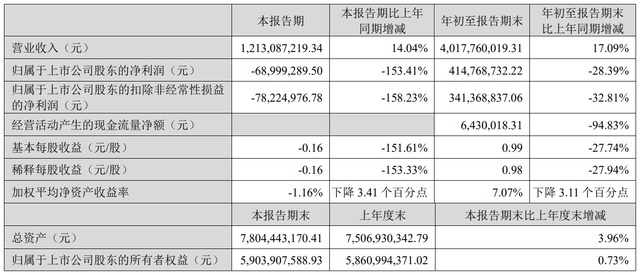
Regarding the decline in net profit, Betaine stated that the decrease was mainly due to the continuous growth in revenue, a slight drop in gross profit margin due to changes in product sales structure, and a rise in various operating expenses.
Notably, among the "Three Musketeers of Medical Aesthetics," Imeik Technology performed the best, with revenue of 2.376 billion yuan in the first three quarters, up 9.46% year-on-year, and net profit of 1.586 billion yuan, up 11.79% year-on-year. As a result, Imeik's stock price decline was the smallest among the three.
The downturns for Betaine and Bloomage Biotech actually began in 2023.
According to financial reports, after Betaine's net profit peaked in 2022, it began to decline significantly, with a drop of over 28% in 2023 and a non-GAAP net profit decline of over 32%.
Additionally, despite the decline in net profit, revenue continued to grow slowly. Betaine attributed the revenue growth in its Q3 report to the consolidation of Yuejiang Investment's financial statements.
However, the market was not convinced by Betaine's revenue growth without profit growth. Consequently, Betaine's stock price has been on a downward trend since mid-2022.
Fortunately, with the market recovery, Betaine's stock price has begun to rebound. Statistics show that since the end of September, Betaine's stock has risen by over 30%. However, the stabilization of its stock price does not mean the company is out of the woods.
According to its Q3 report, Betaine's revenue for the third quarter was 1.213 billion yuan, up 14.04% year-on-year, but it reported a net loss of 68.9993 million yuan, down 153.41% year-on-year, and a non-GAAP net loss of 78.22 million yuan, down 158.23% year-on-year. The shift from profit to loss in Q3 is a concerning signal.
Alongside the decline in performance, shareholder 减持 is another issue troubling Betaine.
On October 14, Betaine announced that Sequoia Capital, a shareholder holding over 5% of the company, planned to 减持 up to 12.6388 million shares, or 3% of the total shares, within three months after 15 trading days from the announcement date. Notably, this is not the first time Sequoia has 减持 Betaine.
Data shows that before Betaine's IPO, Sequoia held 25.39% of the shares, making it the second-largest shareholder and the largest external institutional shareholder.
After Betaine went public and the lock-up period ended, Sequoia quickly began 减持. In April 2022, Sequoia disclosed plans to 减持 4% of the total shares, cashing out approximately 139 million yuan, reducing its stake to 17.58%. In August of the same year, Sequoia announced another 减持 plan, cashing out 1.826 billion yuan and reducing its stake to 14.58%.
In January and April 2023, Sequoia proposed further 减持 plans, though these were not ultimately executed. Betaine stated that Sequoia's 减持 does not directly impact the company's operations or marketing.
Kan Jian Finance believes that the combination of declining performance and major shareholder 减持 will undoubtedly pressure the stock price. However, compared to shareholder 减持, the decline in performance is the more critical issue. Therefore, Betaine needs to adjust its strategy, reduce reliance on certain channels, and find new growth drivers to return to a growth trajectory.
The copyright of this article belongs to the original author/organization.
The views expressed herein are solely those of the author and do not reflect the stance of the platform. The content is intended for investment reference purposes only and shall not be considered as investment advice. Please contact us if you have any questions or suggestions regarding the content services provided by the platform.
