



The stark contrast between Google and AMD

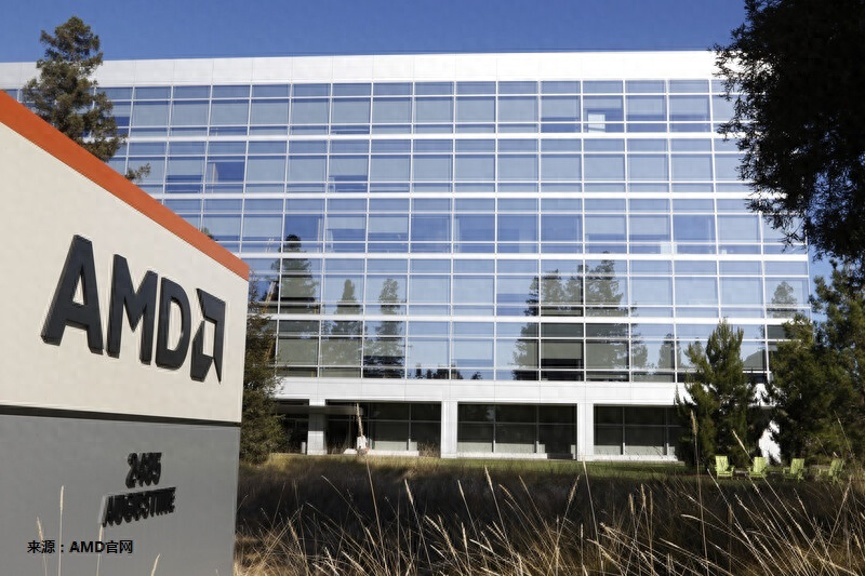
Search engine service provider $Alphabet - C(GOOG.US), and AI chip stock $AMD(AMD.US), both announced their Q3 2024 earnings on the same day. However, despite both being AI concept stocks, their post-earnings stock performances diverged significantly. Alphabet-A surged 5.79% in after-hours trading, while Alphabet-C jumped 5.89%. In contrast, AMD dropped 7.63% in after-hours trading.
Why such a big difference?
Alphabet Cloud Shines Bright
In Q3 2024, Alphabet's revenue grew 15.09% year-over-year to $88.268 billion, surpassing market expectations of $86.3 billion. Diluted earnings per share rose to $2.12, beating the expected $1.85. Operating margin expanded from 27.83% to 32.31% year-over-year.
Alphabet's search and other businesses maintained double-digit growth in Q3, rising 12.17% year-over-year to $49.385 billion. YouTube ad revenue also grew 12.19% to $8.921 billion. Overall, Alphabet's traditional services revenue increased 12.54% to $76.51 billion, while segment operating profit surged 28.91% to $30.856 billion. Operating margin rose from 35.21% to 40.33% year-over-year.
Notably, bolstered by AI, Alphabet Cloud delivered outstanding performance. Q3 revenue grew 34.98% year-over-year to $11.353 billion, with segment operating profit skyrocketing 631.95% to $1.947 billion. Operating margin surged nearly 14 percentage points from 3.16% to 17.15%.
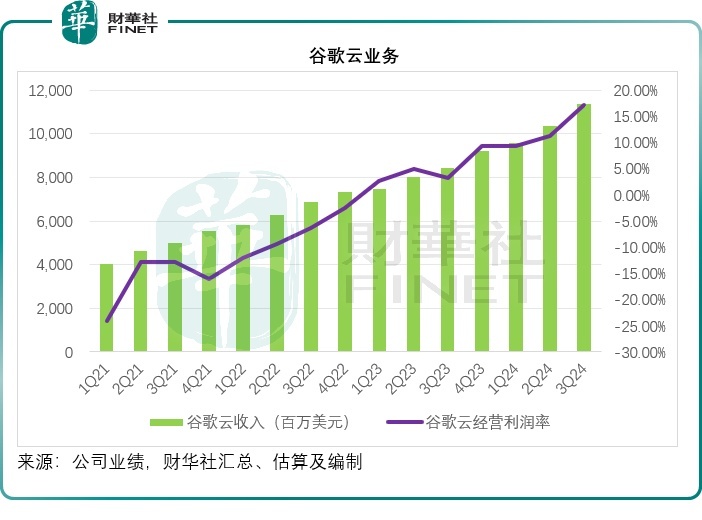
Alphabet attributed the strong growth in cloud business to AI opportunities, as this revenue includes bookings from enterprise clients. Management noted that its full-stack AI products are fully operational, forming a "virtuous cycle," suggesting Alphabet Cloud still has significant room for revenue and profit expansion.
No Surprises from AMD?
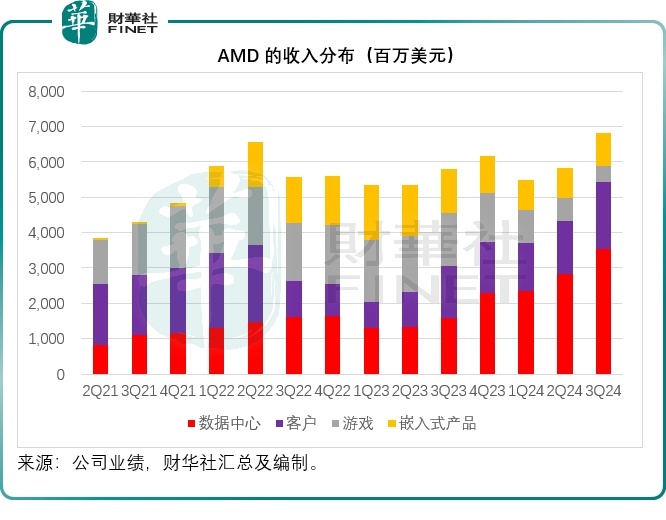
AMD's Q3 performance was also impressive, driven by AI. Quarterly revenue grew 17.57% year-over-year to $6.819 billion. Adjusted gross margin improved 2.54 percentage points to 53.63%, while adjusted EBITDA margin rose 2.86 percentage points to 27.67%. Adjusted net profit increased 32.51% to $1.504 billion.
The data center segment, including AI business, contributed $3.549 billion in revenue, up 122.09% year-over-year. The client segment also saw a 29.46% revenue increase to $1.881 billion, offsetting declines in gaming and embedded products, which fell 69.32% and 25.42%, respectively. As shown below, data center and client segments saw significant contributions.
Additionally, operating profits for data center and client segments grew substantially, rising 240.20% and 97.14% year-over-year to $1.041 billion and $276 million, respectively. Data center operating margin expanded over 10 percentage points from 19.15% to 29.33%, while client segment operating margin rose over 5 percentage points from 9.64% to 14.67%. As shown below, data center and client segments saw sharp profit increases, while embedded and gaming profits contracted.
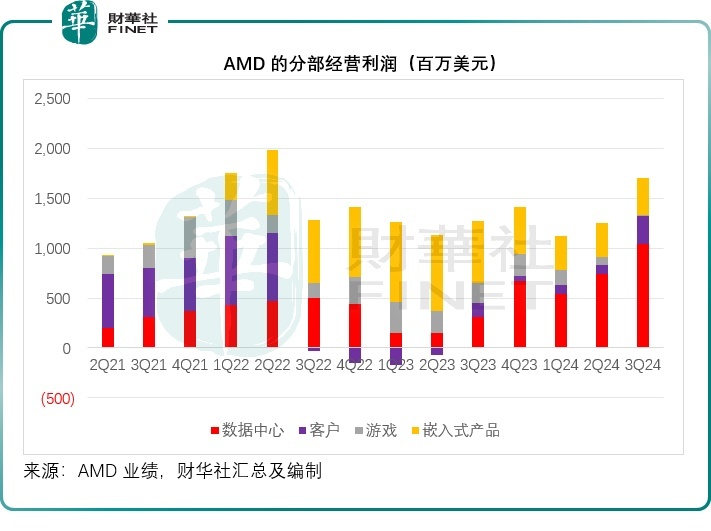
AMD stated that Q3 data center performance set records, driven by strong deliveries of AMD Instinct GPUs and growth in AMD EPYC CPU sales. The client segment's robust growth was fueled by strong demand for AMD's x86 microprocessors, particularly the Zen 5 Ryzen processors.
AMD completed its acquisition of Silo AI to accelerate AI model development and deployment on AMD hardware. Additionally, AMD and Intel (INTC.US) announced the formation of an x86 ecosystem advisory group with Broadcom (AVGO.US), Dell (DELL.US), Alphabet, Hewlett Packard Enterprise (HPE.US), HP (HPQ.US), Lenovo, Meta (META.US), Microsoft (MSFT.US), Oracle (ORCL.US), Red Hat (RHT.US), and industry leaders to collaborate on architectural interoperability and simplified software development to counter ARM (ARM.US).
In October, AMD launched the new AI chip MI325X, a competitor to $NVIDIA(NVDA.US)'s H200, expanding memory capacity and bandwidth advantages. Compared to the H200, the MI325X offers 20% better inference performance and superior training capabilities. CEO Lisa Su noted strong interest from clients and partners, with mass production and deliveries starting in Q4. The chip is expected to be available in systems from Dell, HP, Lenovo, Super Micro Computer (SMCI.US), and others by Q1 2025. Longer-term, AMD has accelerated product development, with the next-gen MI350 series slated for H2 2025 and the MI400 series based on CDNA Next architecture expected in 2026.
During the earnings call, Lisa Su highlighted robust demand for data center AI, raising the full-year sales forecast from $4.5 billion to over $5 billion—up from an initial $2 billion estimate at the start of the year. She also noted strong performance in data center and client segments, with future growth expected from Zen 5 and AIPC launches, while gaming and embedded products will see slower growth.
However, despite Lisa Su's optimism about AMD's AI prospects, the guidance provided lacked major surprises.
AMD expects Q4 revenue of around $7.5 billion (±$300 million), implying 22% year-over-year growth and ~10% sequential growth. Non-GAAP gross margin is projected at 54%. This guidance aligns with market expectations of $7.54 billion in revenue and adjusted EPS of $1.16, which may have disappointed investors.
Conclusion
Both Alphabet and AMD benefit from the AI wave, with AMD positioned upstream as a supplier to Alphabet. However, despite strong AI chip demand, NVIDIA remains dominant, and cost considerations weigh on investor sentiment. If AI ROI falls short of expectations, valuations may adjust. While AMD has seized AI opportunities, its growth trajectory appears less impressive than hoped, deterring some investors.
Alphabet's traditional search business faces fierce competition from peers like Meta, Amazon (AMZN.US), and Microsoft, yet it maintains double-digit growth and improving profitability, underscoring its industry leadership. Alphabet Cloud's unexpected surge and margin expansion, coupled with AI adoption, position Alphabet to further dominate the AI application market, earning it bullish sentiment.
Mao Ting
The copyright of this article belongs to the original author/organization.
The views expressed herein are solely those of the author and do not reflect the stance of the platform. The content is intended for investment reference purposes only and shall not be considered as investment advice. Please contact us if you have any questions or suggestions regarding the content services provided by the platform.
