


 Posts
PostsIs Upbit failing? Why is the premium effect of Korean listings gradually disappearing?

Original Title: Korean Meme Mania
Original Author: MORBID-19
Compiled by: Deep Tide TechFlow
I hope everyone can make life-changing money on-chain. No luck? Maybe you got dumped by the Korean market. I've seen dozens of P&L screenshots with profits ranging from hundreds of thousands to millions of dollars. Even in real life, I've heard of people I know—not too distant acquaintances—who made a killing. Yeah, if you're not trading meme coins, you're not making money.
Until now, the public perception was that Koreans only trade on centralized exchanges, mainly Upbit. That's only partly true. What's the point of centralized exchanges when there are 1000x opportunities on-chain?
But when you look at $DOGE and $SHIB, Upbit is still the second-largest spot market.
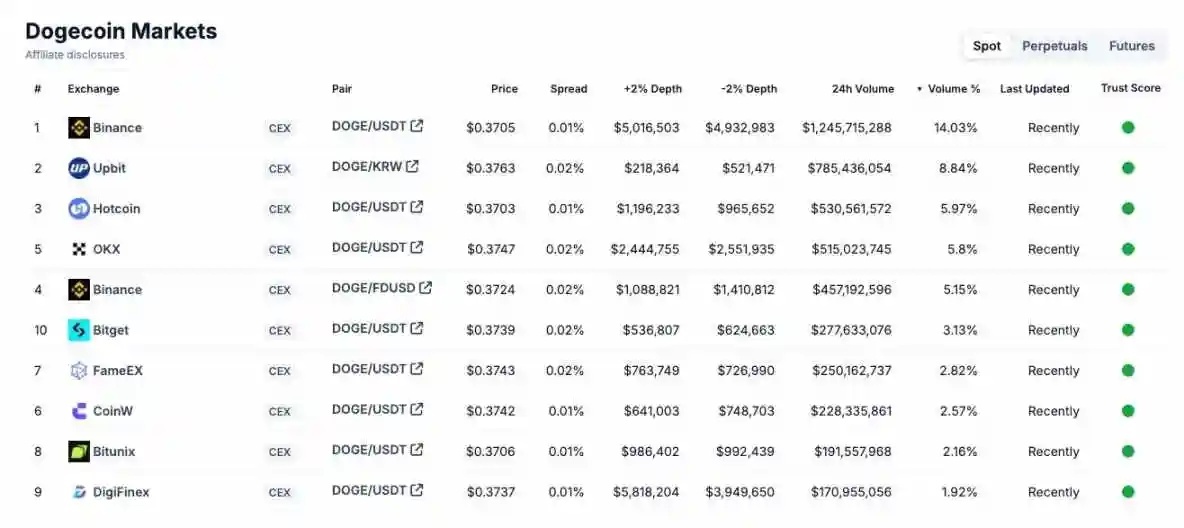
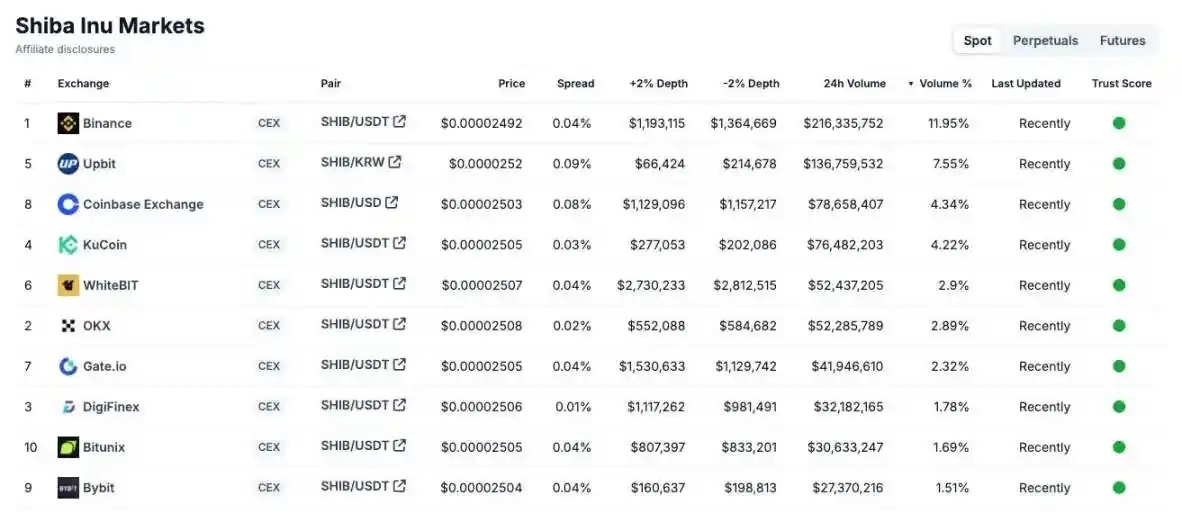
"Don't ignore the crazy Korean buying power" is an old saying.
This Time, the Korean Market Feels Different
But where's the premium? For the past few weeks, I've been talking about the Korean market premium as a sentiment indicator. If the premium hits +10%, it's time to cool down. But this time feels different. I've seen people checking their Binance portfolios on the subway, friends asking about DOGE.
So why isn't there a 10% Korean market premium?
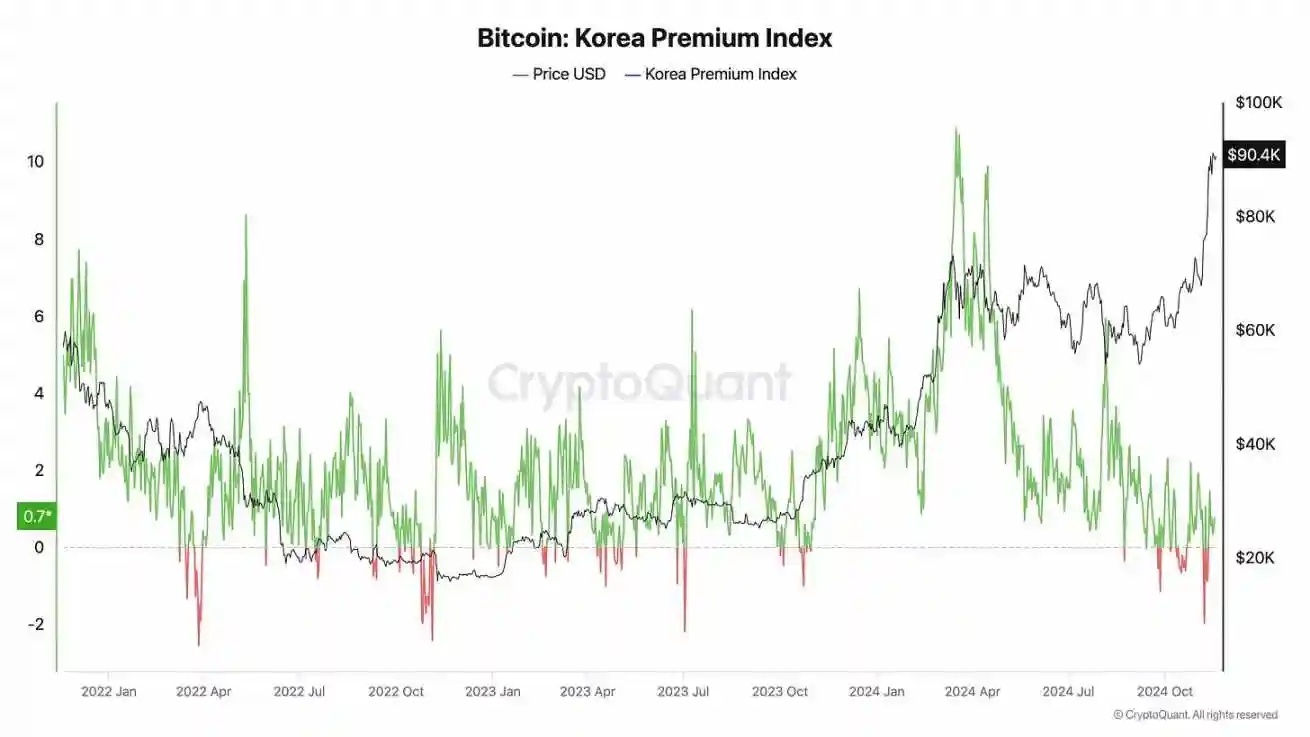
Bitcoin hit $90K, which is insane. But this chart makes no sense. What's going on?
Are Koreans not buying? Not really. Recent listings on Upbit have seen massive pumps.
No new users? Wrong again. Korean crypto apps are topping the charts in app stores.
Are we better at arbitrage? Nope.
If so, why didn't we perform better earlier this year?
Actually, we did find better ways to arbitrage the Korean premium. The team at Presto Research nailed it: Maybe it's just "we're still early," but Upbit's recent trading volume surpassed $18B, way higher than the $14B in March 2024 when the Korean premium hit 10% and stayed at 5%. So why no premium now?
What changed from March 2024 to now? I think the main reasons are:
1) USDT listings
2) Macro conditions
3) The "Virtual Asset User Protection Act"
While Bithumb listed $USDT in December 2023, Upbit was late to the party, only adding it in June 2024. Before that, most Korean investors used $TRX Gold(TRX.US) or $Bitwise XRP ETF(XRP.US) to move crypto from Korean exchanges to global platforms like Binance, Bybit, and OKX. With USDT listed, it's now easier to arbitrage the premium and invest directly in USD.
Especially with the weak KRW and Korean stocks underperforming crypto and U.S. markets, interest in USD investments has surged. This boosted USDT trading volume, now at ~9% market share vs. just 2.6% in December. Note: Most trading pairs on Korean exchanges are KRW-based (e.g., BTC/KRW, ETH/KRW), not stablecoins. So most USDT volume comes from USDT/KRW pairs.
Historically, one of the easiest ways for Koreans to make money was trading the Korean premium. This meant buying USDT, sending it to offshore exchanges, profiting, and returning when the premium appeared (post-law, also earning KRW + Bithumb's zero-fee promo)—or simply buying USDT when the premium was low and selling high. This activity has intensified, which I think is suppressing the premium.
—Min Jung (Read the full thread here)
Wow, I never thought of this. My earlier assumption that the Korean premium would fade as institutional accounts opened now seems outdated. The Korean premium might be meaningless now!
But Is This Good or Bad?
I'm not sure. For Koreans, a lower premium means fairer prices. For the broader market, they lose a peak indicator.
Still, Koreans are losing something too. Just today, Korea's Financial Supervisory Service (FSS) proposed letting exchanges freeze crypto accounts without notice.
Under the "Virtual Asset User Protection Act," exchanges must disclose reasons before freezing accounts. But the FSS wants exceptions for "special cases" like hacks, fraud, or money laundering attempts.
In principle, notice is required, but they stress that predictability and intent should be considered.
The same applies if tax or investigative agencies request freezes and delayed notice for investigations.
The FSS emphasizes that notice must be given unless unavoidable.
Wait, what? They’re allowing preemptive freezes to protect consumers and national interests? Who knew? Another reason not to keep funds on Korean exchanges. Imagine 5x’ing a shitcoin on Upbit only to have your funds frozen by the tax office.
No need to elaborate:
· Paju City in Gyeonggi-do plans to be Korea’s first local government to directly sell seized virtual assets from tax delinquents.
· On the 13th, Paju notified 17 individuals owing 124M KRW in back taxes, warning of imminent asset seizure and sale.
· The city has already confiscated their crypto via exchanges. If unpaid by month-end, ~50M KRW in crypto will be transferred to city accounts as tax payment.
· A city official explained: "This sends a clear message—delinquents can’t hide assets. We’ll chase their property until taxes are paid."—KBS News
Why would Koreans keep funds on exchanges? Why convert crypto to KRW? As the market grows, this becomes glaring. If crypto can be seized so easily, who’d want it on Korean exchanges?
If crypto is a trillion-dollar opportunity and governments support it, capital must flow freely. People prefer USD over CNY for a reason—the latter can be confiscated.
This fear of confiscation is why crypto was born. It’s absurd for an accepted industry to revert to old thinking.
Protectionist, high-control measures will only drive capital out, especially for high-risk on-chain activity. Assets will stay on-chain, and what they aim to protect will be destroyed by fear of loss.
The copyright of this article belongs to the original author/organization.
The views expressed herein are solely those of the author and do not reflect the stance of the platform. The content is intended for investment reference purposes only and shall not be considered as investment advice. Please contact us if you have any questions or suggestions regarding the content services provided by the platform.
