

 Total Assets
 Rate Of Return
Pony.ai (PONY): What is mentioned directly and not directly in the prospectus

$Pony AI(PONY.US) $WeRide(WRD.US) $HORIZONROBOT-W(09660.HK)
This article is only a record of personal thoughts and research. All data comes from public information and does not constitute any investment advice.
Written in a hurry, please point out any shortcomings, and the author will make quick corrections. Thank you!
1. Mentioned revenue structure, but not the gross margin breakdown
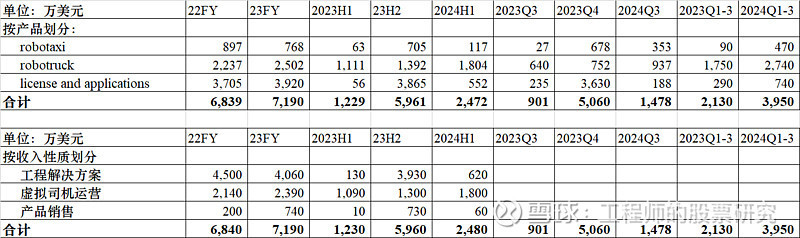
(1) According to product division, in 24H1 revenue, about 73% came from robotruck, about 22% from license and applications, and only about 5% from robotaxi, which is quite different from the previous impression that PONY's main business was robotaxi.
In 24Q1-3, Pony's robotaxi product revenue was $4.7 million, a significant increase from $0.9 million in the same period of 23, but mainly from technical service fees of a project in South Korea, not from robotaxi operating income. Robotaxi is still in the early stage of commercialization.
In 24Q1-3, Pony's robotruck business revenue was $27.4 million, up +57% from $17.5 million in the same period of 23, mainly due to the addition of 45 trucks (total 190) compared to the same period in 23. Operating mileage increased from 12 million kilometers in 23Q1-3 to 17 million kilometers in 24Q1-3, a +42% growth.
In 24Q1-3, Pony's license and applications business revenue was $7.4 million, a significant increase from $2.9 million in the same period of 23, mainly because only 1 customer signed a contract in 23, while 7 customers signed contracts in 24, indicating a clear decline in average contract price.
(2) According to revenue nature, in 24H1 revenue, about $18 million came from virtual driver operations (mostly from robotruck business), about $6.2 million from engineering solutions (corresponding to license and applications), and about $0.6 million from product sales.
(3) Gross margin breakdown not mentioned
The prospectus does not clearly provide the gross margin of each business, but it gives the cost structure (as shown below). The author attempts to calculate based on the cost structure in the prospectus.
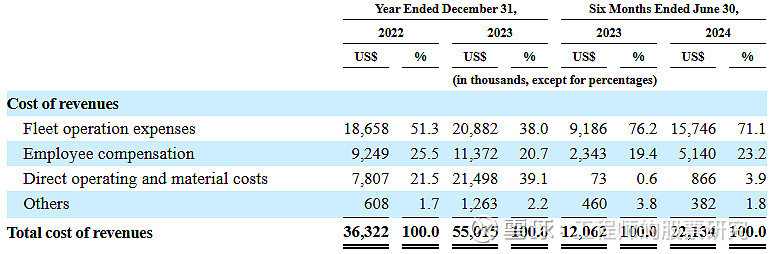
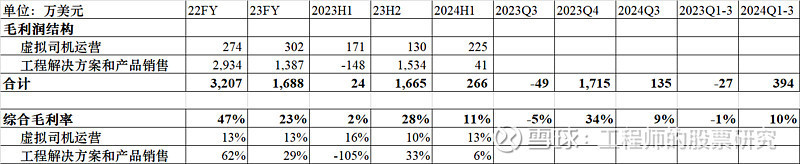
Assuming Fleet operation expenses fully correspond to the "virtual driver operations" revenue nature, and assuming employee salaries, direct operating and material costs, and other costs fully correspond to the "engineering solutions" and "product sales" revenue nature, the following can be calculated:
1) In 22FY, 23FY, and 24H1, the gross margin of virtual driver operations business was basically stable at 13%.
2) In 22FY, 23FY, and 24H1, the gross margin of engineering solutions and product sales was 62%, 29%, and 6%, respectively, showing a continuous decline.
This can also explain why Pony's overall gross margin has been declining:
1) The revenue structure in 23FY was basically the same as in 22FY, but the gross margin of engineering solutions revenue, which accounted for 56%, was halved, leading to the overall gross margin dropping from 47% in 22 to 23% in 23, also halved.
2) In the 24H1 revenue structure, the proportion of engineering solutions was only about 25% (vs. 56% in 23), and the gross margin of engineering solutions revenue further declined sharply, causing the overall gross margin to drop from 23% in 23 to 11% in 24H1.
Engineering solutions are project-based revenue, with poor continuity, and the gross margin has been declining in recent years. Relying solely on engineering solutions cannot support the company's long-term healthy development.
The market's expectations for Pony mainly lie in the robotaxi/robotruck business, but the current scale of robotaxi business is only about $1~2 million (excluding technology development revenue), which is still extremely low. Robotruck business, due to its determined routes and relatively high proportion of closed scenarios, is easier to implement but cannot achieve continuous technological progress (analogous to always practicing middle school exam questions being of little help for college entrance exams). It may also face intense competition, which will be expanded in point 4.
2. Mentioned existing vehicle numbers, but not the continuous decline in vehicle purchase investment over the past 3 years (slowing R&D & test vehicle deployment)
(1) Mentioned existing vehicle numbers
According to the prospectus, Pony operates a fleet of 250 robotaxis, with cumulative autonomous driving mileage of 33.5 million kilometers and unmanned driving mileage exceeding 3.9 million kilometers. It also operates a fleet of 190 robotrucks (45 added in 24H1), with cumulative freight ton-kilometers exceeding 767 million.
(2) Not mentioned: continuous decline in vehicle purchase investment over the past 3 years (slowing R&D & test vehicle deployment)
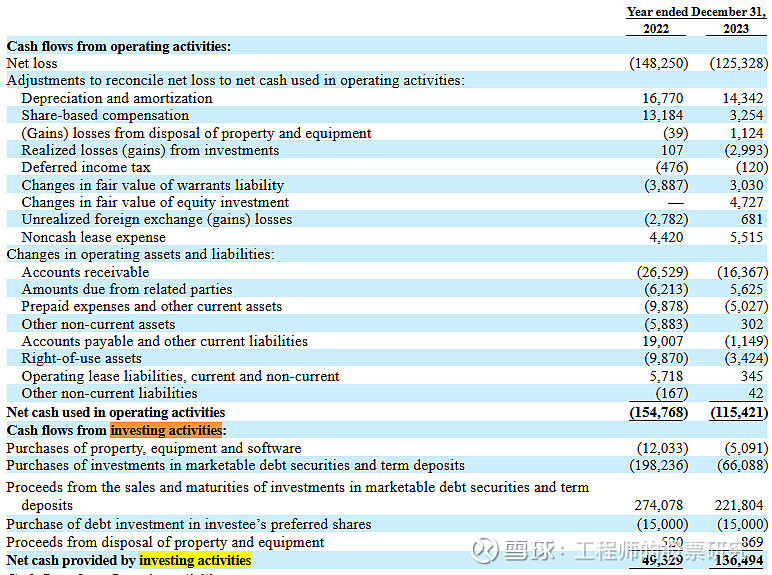
According to the prospectus, Pony's expenditures on property, equipment, and software purchases in 21-23 and 24H1 were approximately $25 million, $12 million, $5 million, and $2 million, respectively, showing a significant decline over the past 3 years. This indicates a sharp slowdown in the deployment of R&D & test vehicles. Another evidence is that in 24H1, only 45 new robotrucks were mentioned, with no mention of an increase in robotaxis.
Generally speaking, the development of autonomous driving algorithms requires a large amount of actual road test data (although simulation data can partially compensate for actual road test data, it cannot fully replace it). Although Pony has a certain first-mover advantage, in the increasingly fierce competition in autonomous driving, from R&D to implementation, the significant slowdown in the deployment speed of R&D & test vehicles raises questions about the rationale behind this decision.
For OEMs with annual shipments of hundreds of thousands of vehicles, every sensor-equipped vehicle is a potential data collection point for autonomous driving. For example, TESLA has a shadow mode to iterate autonomous driving functions through mass-produced vehicles. Under such circumstances, can a candidate who only practices middle school exam questions compete with those who regularly practice college entrance exam questions?
3. Mentioned expected market size, but not revenue expectations and breakeven time
(1) Company's mentioned expected market size
According to the prospectus, Frost&Sullivan estimates that China's Robotaxi market size will be about $200 million in 25 and about $39 billion in 2030. China's robotruck market size will be about $90 million in 25 and about $12.3 billion in 2030.
(2) Not mentioned: revenue expectations and breakeven time
2030 is too far away. Let's look at next year first. The combined market size of robotaxi and robotruck is about $290 million. Optimistically assuming no discount on the market size and Pony's market share at 25%, the optimistic virtual driver operations revenue is about $72.5 million, a +80% growth compared to the expected $40 million in 24 (vs. expected +65% growth in 24).
Optimistically assuming the gross margin of virtual driver operations doubles from 13% to 25% in 25, the virtual driver operations business will contribute about $18 million in gross profit in 25. Compared to the ~$160 million in R&D, sales, and administrative expenses in 23, the gap is still large.
Assuming the long-term gross margin remains at 25% (vs. Uber's 33% and Didi's 18%, and considering potential price wars), and assuming the company's various expense items remain at $160 million as in 23, robotaxi + robotruck revenue needs to reach $640 million to achieve breakeven in operating profit. If expense items increase, the required revenue scale will be even larger.
The roughly calculated $640 million is about 8.8x the expected virtual driver operations revenue in 25. That is, under the assumption of doubling revenue growth annually from 26 to 28, breakeven in operating profit can be basically achieved by 28. If R&D, sales, and administrative expenses further increase, the time to achieve breakeven will be longer or require higher revenue growth.
4. Mentioned issuance valuation, but not the implied PS multiple
On the first day after listing, the closing market cap was $4.2 billion, corresponding to a PS-Forward of about 58x based on the expected virtual driver operations revenue of $72.5 million in 24 (other business revenue is less meaningful, and gross margin is continuously declining). The PS-28E is about 6.6x based on the expected virtual driver operations revenue of $640 million in 28. The valuation level will be judged by the market.
5. Mentionedtechnical leadership, but not the specific market competition situation
(1) Mentionedtechnical leadership
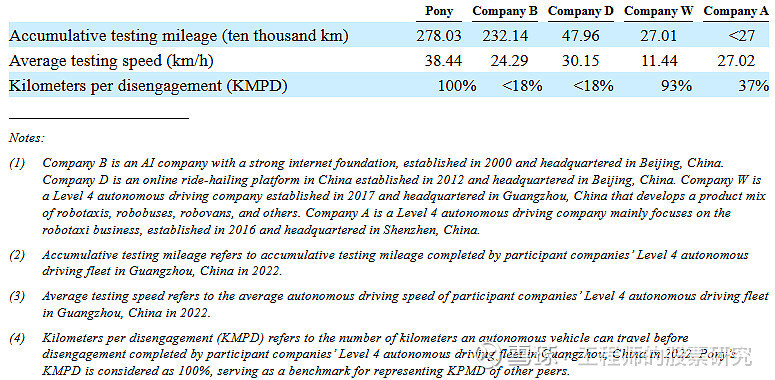
(2) Not specifically expanded: market competition situation
1) OEMs have the advantage of vehicles and data, along with strong R&D awareness, leading to rapid improvements in autonomous driving capabilities (e.g., TESLA, XPeng, Li Auto, Xiaomi). Among traditional OEMs, strong players like BYD are also developing autonomous driving in-house. OEMs with slower progress can collaborate with Huawei and Horizon ecosystems to directly obtain first-class, implementable autonomous driving capabilities (Huawei has committed to not manufacturing vehicles and only being a supplier). Will pure software algorithm developers for autonomous driving still have commercial space to acquire OEM customers in the future? Or how much commercial space can they compete for from traditional OEMs that do not develop autonomous driving in-house or have slower progress, compared to Huawei and Horizon ecosystems?
2) If the future vision is not to sell algorithms to OEMs but to operate robotaxi fleets themselves, it should be noted that new OEMs have already made many breakthroughs and implementations in urban NOA. If urban NOA becomes fully mature in the next 2-3 years, will new OEMs consider operating robotaxi fleets themselves for data collection? After all, producing more vehicles can dilute unit costs, and the collected data can improve autonomous driving capabilities. Robotaxi fleets are also a natural form of brand promotion and consumer outreach, killing multiple birds with one stone. Pure software algorithm developers for autonomous driving cannot manufacture vehicles themselves, resulting in higher vehicle procurement costs, less historical data, and no experience in heavy-asset, heavy-operation businesses. How will they compete with robotaxi fleets backed by OEMs? (Note: How Uber, Didi, and other internet ride-hailing platforms will be affected by robotaxi is also a topic worth discussing.)
3) If robotaxi wants to achieve large-scale commercial implementation, there will likely be national/industry access standards. Without standards, large-scale implementation is unlikely to be allowed. Logically, only after standards are established can manufacturers that meet the standards operate robotaxi businesses. One of the major reasons for the difficulty in autonomous driving implementation is the unclear boundaries. Once an accident occurs, it is unclear who is responsible. If relevant national/industry standards are established, they will help clarify the boundaries. For accidents within the boundaries, the algorithm provider is responsible; for accidents outside the boundaries, the algorithm provider is not responsible. Further reasoning, the clarification of access standards and boundaries will significantly lower the threshold for autonomous driving manufacturers to enter the robotaxi market. Everyone will develop according to the standards, and currently, there are no fewer than 5~10 manufacturers capable of competing. By then, technological differences will quickly level out (as long as the standards are met), and robotaxi will become an industry heavy on government relations, assets, and operations. Everyone will invest capex in vehicles and operations teams. With little difference in algorithms, price wars may quickly erupt. That is, without significant differences in initial investments, if Manufacturer A prices with an expected annual return of 8%, Manufacturer B may lower it to 5% to seize the market, as long as it is higher than interest rates, quickly driving returns to a level that sustains survival but does not generate excess profits.
4) Following the above, if robotaxi cannot achieve large-scale commercial implementation, autonomous driving algorithm manufacturers have no commercial space. If robotaxi can achieve large-scale commercial implementation, autonomous driving algorithm manufacturers will have to compete with more experienced competitors in an industry heavy on government relations, assets, and operations. For high-tech, R&D-heavy autonomous driving algorithm manufacturers, the challenges are indeed significant.
The copyright of this article belongs to the original author/organization.
The views expressed herein are solely those of the author and do not reflect the stance of the platform. The content is intended for investment reference purposes only and shall not be considered as investment advice. Please contact us if you have any questions or suggestions regarding the content services provided by the platform.
