


 Likes Received
 Posts
PostsBaidu Group's market value has evaporated 445 billion! Below book value.

Baidu's $Baidu(BIDU.US) core segment—advertising business—has raised concerns.
According to the latest financial report, Baidu's online advertising revenue in the third quarter of this year fell by 4% year-on-year. This marks the third consecutive quarter of declining growth in Baidu's advertising business and the second consecutive quarter of negative growth.
In terms of profits, Baidu's operating profit in the third quarter was 5.9 billion yuan, down 19% year-on-year. In response, the market "voted with its feet." On the day the financial report was released, Baidu's U.S. stock price plummeted, with an intraday drop of over 7%.

If calculated based on Baidu Group's IPO price of 252 Hong Kong dollars, Baidu's Hong Kong stock has fallen by more than 65% over the past three years, with its market value evaporating by over 478.5 billion Hong Kong dollars (approximately 445.3 billion yuan). As of the latest closing, Baidu's Hong Kong market value was only 228.06 billion Hong Kong dollars.
Faced with these concerns, foreign giants have issued warnings and downgraded Baidu's performance outlook and target prices. Among them, Citigroup predicts that Baidu's core advertising revenue in the fourth quarter of 2024 will decline by 7% year-on-year, with a deeper quarterly drop. JPMorgan also expects Baidu's adjusted earnings per share in 2025 to drop sharply by 21%, downgrading its rating from "overweight" to "neutral" and slashing its target price by 32% from $125 to $85.
Dangerous "Signals"
Recently, Baidu released its third-quarter 2024 financial report, which showed that its revenue during the period was 33.557 billion yuan, down 3% year-on-year.
First, let's look at Baidu's core business—advertising. The report shows that in the third quarter of this year, Baidu's online advertising revenue was 18.8 billion yuan, down 4% year-on-year. This marks the third consecutive quarter of declining growth in Baidu's advertising business and the second consecutive quarter of negative growth.
Next is Baidu's AI business. The report shows that the daily calls to the ERNIE model reached 1.5 billion, a 30-fold increase from 50 million in the fourth quarter of last year and a 150% increase from 600 million in August this year. The intelligent cloud business contributed 7.7 billion yuan in revenue, up 12% year-on-year, though slightly down from 14% in the previous quarter.
Additionally, the much-anticipated autonomous driving business—Apollo Go—showed a significant slowdown in growth. The report shows that in the third quarter, Apollo Go provided 9.88 million autonomous driving orders, with only a 20% year-on-year increase.
It's worth noting that iQiyi's performance in the third quarter was "terrible," with revenue contribution of 7.2 billion yuan, down 10% year-on-year, dragging down Baidu's overall revenue.
In terms of profits, Baidu's operating profit in the third quarter was 5.9 billion yuan, down 19% year-on-year.
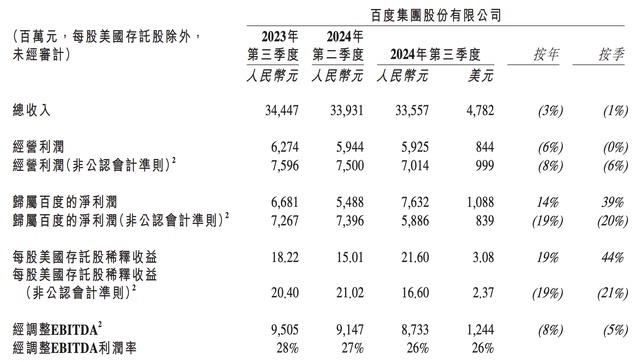
The main drag on net profit came from iQiyi. iQiyi's financial report shows that its third-quarter operating profit fell by 68% to 240 million yuan.
However, due to increases in fair value and asset disposals, Baidu's net profit in the third quarter rose 14% year-on-year to 7.6 billion yuan, hitting a three-year high.
From Baidu's financial report, apart from its AI business, other business modules were lackluster, which could be described as a "bomb."
More notably, the report shows that in the third quarter, Baidu's core free cash flow was only 2.4 billion yuan, down 59% year-on-year, a level only higher than in the first quarter of 2022. The main reason was the decline in operating cash flow, not capital expenditures, which actually contracted against the trend.
In response, Baidu's founder, chairman, and CEO Robin Li said, "Baidu's core revenue performance in the third quarter was flat, reflecting the continued weakness in our online marketing business, but this was offset by the growth in the AI cloud business. The increasing call volume of the ERNIE model proves that our strong AI capabilities are gaining broader market recognition."
In response, the market "voted with its feet." On the day the financial report was released, Baidu's U.S. stock price plummeted, with an intraday drop of over 7%. By the close, the decline was still 5.9%, wiping out $1.797 billion (approximately 13 billion yuan) in market value in a single day. The next day, Baidu's stock price fell again, hitting a low of $78.95 intraday, a nearly two-year low. As of the latest closing, Baidu's U.S. market value was $29.823 billion (approximately 216 billion yuan).
Over a longer period, Baidu's U.S. stock price has fallen by more than 28% since the beginning of 2024. According to Wind data, Baidu Group's price-to-book ratio is only 0.79 times, meaning Baidu has become a "net asset value stock"—the only Chinese internet giant to do so.
Foreign Giants Downgrade One After Another
While operating performance growth slowed, Baidu's third-quarter buyback scale also declined, with only $160 million repurchased. Management explained this as a reduction due to the rebound in market value during the quarter.
It's worth noting that Baidu is not short of cash. As of the end of the third quarter, Baidu's core cash and short-term investments totaled 200 billion yuan, and after deducting long- and short-term debt, net cash was $18.4 billion.
During the earnings call, management said that buyback pace would recover in the fourth quarter as market value declined but did not provide a quantitative commitment.
Shareholder returns are a core concern for foreign investors, and this is one reason for the sell-off in Baidu's U.S. stock.
Faced with these concerns, foreign giants have issued warnings and downgraded Baidu's performance outlook and target prices.
Among them, Citigroup predicts that Baidu's core advertising revenue in the fourth quarter of 2024 will decline by 7% year-on-year, with a deeper quarterly drop. It also lowered its forecast for core advertising revenue in the first quarter of next year by 3.1%, adjusting from a year-on-year decline of 3% to 6%, and revised its spending forecast, considering the larger decline in higher-margin advertising revenue and increased operating and sales expenses related to its AI transformation plan.
Citigroup lowered Baidu's U.S. stock target price from $142 to $141 but maintained a "buy" rating due to low valuation. New catalysts could come from potential increases in shareholder return policies and the impact of the search engine transformation bottoming out in the first quarter of next year.
Meanwhile, JPMorgan also expects Baidu's adjusted earnings per share in 2025 to drop sharply by 21%, 17% lower than Bloomberg's consensus estimate, downgrading its rating from "overweight" to "neutral" and slashing its target price by 32% from $125 to $85.
JPMorgan believes that while Baidu's core advertising revenue growth is expected to bottom out in the first quarter of next year and then accelerate quarter by quarter, the current recovery pace is difficult to estimate, and downside risks are hard to dissipate. On the other hand, considering commercial bank deposits and financial products issued by commercial banks and other financial institutions with maturities exceeding one year, Baidu's net cash is 84% of its market value, meaning the price-to-earnings ratio excluding cash for 2025 is only two times.
JPMorgan said that given the company's historical practice of providing $1 billion in capital returns to shareholders annually, the downside risk to the current stock price is limited.
The copyright of this article belongs to the original author/organization.
The views expressed herein are solely those of the author and do not reflect the stance of the platform. The content is intended for investment reference purposes only and shall not be considered as investment advice. Please contact us if you have any questions or suggestions regarding the content services provided by the platform.
