


Has the Hong Kong IPO market rebounded in Q4?

As the end of 2024 approaches, the IPO market seems to be experiencing a long-awaited spring. After the logistics giant $SF HOLDING(06936.HK) successfully listed on the Hong Kong Stock Exchange in November, several well-known companies have followed suit, and the active performance of Chinese concept stocks in the U.S. market indicates a gradual recovery in Hong Kong's IPO market and international capital markets.
On December 2, the highly anticipated "first domestic cosmetics stock in Hong Kong," $MAO GEPING(01318.HK) , began its IPO on the $HKEX(00388.HK) , offering 70.588 million shares, with 10% allocated to Hong Kong investors. The offering price ranges from HKD 26.30 to HKD 29.80, with a minimum investment of approximately HKD 3,010.05 per lot, and a total fundraising target of up to HKD 2.104 billion.
In addition to MGP, other companies set to list in early December include digital solutions provider $DMALL(02586.HK) and energy storage solutions provider $REFIRE(02570.HK). Rumors suggest that the global asset management giant GLP, specializing in supply chain, big data, and new energy infrastructure, may also list on the Hong Kong stock market next year.
The long-dormant Hong Kong IPO market appears to be reviving, especially since the fourth quarter of this year.
Wind data shows that in October and November, there were 8 and 7 IPOs on the Hong Kong main board, raising HKD 14.464 billion and HKD 9.026 billion, respectively—a significant improvement over previous months, second only to September, when the year's largest IPO, $MIDEA GROUP(00300.HK), raised HKD 35.7 billion.
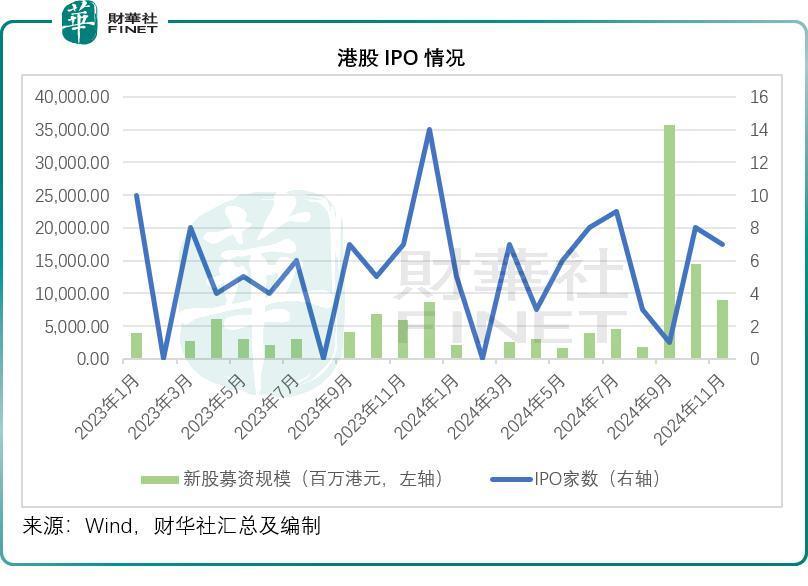
Apart from the fundraising giant Midea Group, the fourth quarter also saw several large IPOs raising billions, including $CR BEVERAGE(02460.HK) (HKD 4.903 billion), $HORIZONROBOT-W(09660.HK) (HKD 5.142 billion), and $SF HOLDING(06936.HK) (HKD 5.661 billion).
Despite their large fundraising scales, these three IPOs also saw high subscription multiples. Wind data shows that SF Holdings, Horizon Robotics, and China Resources Beverage had subscription multiples of 40.61x, 22.55x, and 64.49x, respectively, locking up significant capital during the subscription period, suggesting substantial idle capital in the Hong Kong market seeking investment opportunities and indicating potential upside for Hong Kong stocks.
Meanwhile, Chinese concept stocks also became more active in the fourth quarter of 2024. Wind data shows that there were 9 Chinese concept stock IPOs in October and November combined, compared to just 8 in the entire third quarter. However, some Chinese concept stock IPOs performed poorly, such as FlashEx (FLX.US), which debuted at $16.50 but has since plummeted to $6.75.
However, certain themes, such as smart driving, have gained investor support.
Since its listing, Horizon Robotics-W has risen over 6%, with a current market capitalization of approximately HKD 55.969 billion.
The U.S. market also seems optimistic about China's smart driving concept stocks. Since October, autonomous driving technology solution providers $WeRide(WRD.US) and RoboTaxi $Pony AI(PONY.US) have listed in the U.S., with post-listing gains of 12.06% and 0.15%, respectively, and market capitalizations of $4.768 billion and $4.543 billion (approximately HKD 37.1 billion and HKD 35.4 billion).
Currently, the performance of Chinese concept stocks largely mirrors that of Chinese stocks in Hong Kong. Both reached a peak in late September before undergoing a sustained correction. Since October, the Nasdaq Golden Dragon China Index has fallen 7.85% to 6,697.7 points, while the Hang Seng Index has declined 7.49% to 19,550.29 points.
Chinese concept stocks have not benefited from the U.S. market rally, with the Dow Jones Industrial Average (DJI.US) and Nasdaq Composite (IXIC.US) rising 6.10% and 5.66%, respectively, over the same period.
On the other hand, the Hong Kong Exchanges and Clearing continues to expand its business, such as opening an office in Riyadh to strengthen its presence in the Middle East, expanding the Stock Connect program, and launching more ETFs to increase the visibility of listed companies and attract diverse capital. These efforts should encourage more Chinese companies to list in Hong Kong, benefiting the exchange.
However, improving the performance of Chinese stocks and Chinese concept stocks requires addressing fundamentals—boosting investor confidence in these companies' prospects and fostering optimism about macroeconomic and policy conditions—to resolve their undervaluation.
Author: Mao Ting
The copyright of this article belongs to the original author/organization.
The views expressed herein are solely those of the author and do not reflect the stance of the platform. The content is intended for investment reference purposes only and shall not be considered as investment advice. Please contact us if you have any questions or suggestions regarding the content services provided by the platform.
