



Another liquor company enters the sauce-flavored liquor market! What is Dynasty Wine aiming for?

As is well known, the liquor industry experienced a "sauce-flavored liquor boom" in recent years. Riding this trend, $Shede Spirits(600702.SH) , $CHINA RES BEER(00291.HK) , Quanjude, and Qiaqia, among others, ventured into the sauce-flavored liquor market.
Recently, Hong Kong-listed company $DYNASTY WINES(00828.HK) announced its foray into sauce-flavored liquor and yellow wine. Is its future outlook promising?
Dynasty Fine Wines Expands into Baijiu and Yellow Wine
Dynasty Fine Wines primarily engages in the production and sales of wine, operating through three segments. The red wine segment produces and sells red wines, including Dynasty Merlot Dry Red Wine and Dynasty Dry Red Wine. The white wine segment produces and sells white wines, such as Dynasty Semi-Dry White Wine and Dynasty Chardonnay Dry White Wine. The other products segment includes sparkling wine, brandy, and ice wine.
It’s clear that while Dynasty Fine Wines is a liquor company, its main business is wine. At its peak, Dynasty Fine Wines was once known as one of the "Three Giants of Domestic Wine," alongside Great Wall and Changyu.
On the evening of December 20, Dynasty Fine Wines announced that its wholly-owned subsidiary, Dynasty Winery, signed a joint venture agreement with Guowei Company to establish a joint venture in Renhuai City, Guizhou Province, China. According to the agreement, Dynasty Winery and its subsidiaries (including the joint venture) will purchase sauce-flavored baijiu products from Guowei Company and its subsidiaries for three years.
Guowei Company owns a large base in Renhuai, producing over 8,000 tons of high-quality Daqu sauce-flavored baijiu annually.
Overall, Dynasty Fine Wines is only purchasing sauce-flavored baijiu products from Guowei Company for resale and is not involved in production.
Notably, on December 18, Dynasty Fine Wines also announced plans to establish a joint venture with Jiangsu Jiuzhongxian Liquor in Dongtai, Jiangsu, focusing on the production and sales of yellow wine and tangerine peel wine.
Jiuzhongxian will be responsible for the construction of factories and offices, while Dynasty will handle the procurement of production systems and equipment.
Additionally, Dynasty Fine Wines stated that the primary sales regions for its existing wine products overlap significantly with those for yellow wine and tangerine peel wine, covering Jiangsu, Zhejiang, Shanghai, Fujian, and Guangdong. The joint venture’s sales channels will leverage Dynasty’s existing network for rapid distribution.
Regarding these cross-border ventures, Dynasty Fine Wines noted in its announcement that the joint ventures will combine the expertise of Guowei Company and Jiuzhongxian Liquor to develop new alcoholic beverages, diversifying revenue streams and enhancing the scale and brand influence of Dynasty.
From the market’s reaction, Dynasty Fine Wines’ stock price surged over 16% on December 19 but fell more than 2% on December 23.
Cross-Border Move Likely Due to Challenges in Wine Sector
It’s worth noting that Dynasty Fine Wines’ expansion into baijiu, yellow wine, and tangerine peel wine may be driven by difficulties in the wine sector.
Changyu A (000869.SZ), a leading domestic wine producer, stated in its 2024 interim report that while the wine industry is still growing, intense competition and pressure from other liquor categories have led to declining consumption and widespread losses among wine companies, with no clear signs of a rebound.
Data from the National Bureau of Statistics also shows that wine production from January to September this year totaled approximately 85,000 kiloliters, down 8.6% year-on-year.
In terms of performance, Changyu A’s revenue in the first three quarters of 2024 fell 21.56% year-on-year to RMB 2.197 billion, with net profit attributable to shareholders dropping 47.25% to RMB 224 million. ST Tongpu reported a net loss of RMB 31.6108 million, while CITIC Niya’s net profit plunged 94.69%. Mogao’s losses also widened.
Dynasty Fine Wines’ performance has also been lackluster in recent years. After turning a profit in 2020, it saw declines again. Although 2023 showed growth, its net profit in the first half of 2024 rose 72.80% year-on-year to HKD 18.54 million.
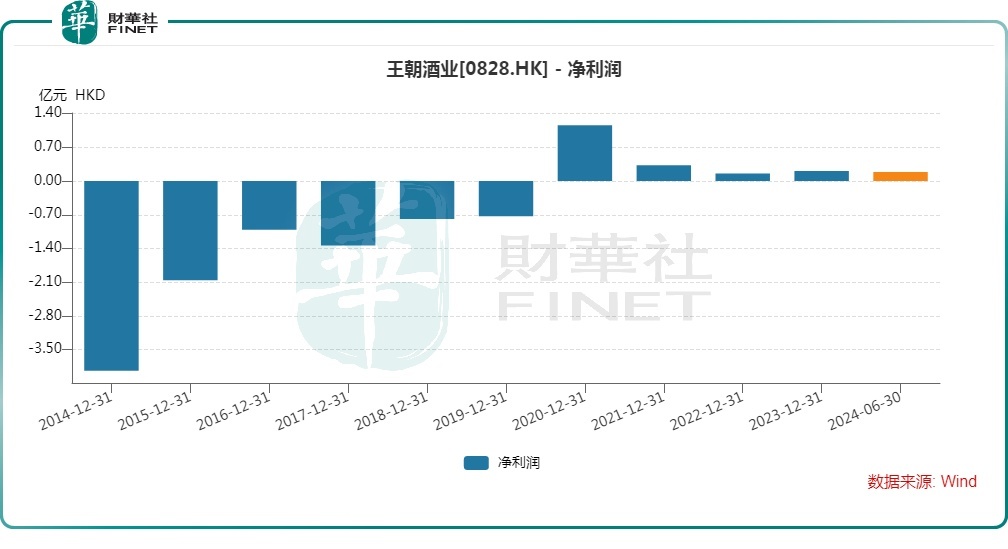
Clearly, with sluggish wine consumption and market challenges, many wine companies have seen declining performance. Although Dynasty Fine Wines achieved profit growth in the first half of this year, its scale remains small, and its overall performance is mediocre. Expanding into new businesses is a logical move.
Baijiu Market Faces Deep Chill
Yellow wine and tangerine peel wine are niche segments, but the more notable move is the venture into sauce-flavored baijiu.
Dynasty Fine Wines stated that entering the sauce-flavored baijiu market is an attempt to innovate in liquor categories. The growing market and rising customer base could drive rapid sales growth and enhance the company’s influence and brand recognition.
However, baijiu companies have also faced challenges in recent years, with 2024 being particularly tough. Unusual off-seasons, price cuts, and high inventory have become common, and even leading companies are showing signs of fatigue.
In the first three quarters of 2024, most baijiu companies remained profitable. However, notable players like Yanghe Brewery (002304.SZ), Shede Spirits, Kouzi Liquor, and Jiuguijiu saw net profits decline.
Hong Kong-listed Zhenjiu LiDu (06979.HK) also reported a 52.57% year-on-year drop in net profit to RMB 752 million in the first half of the year.
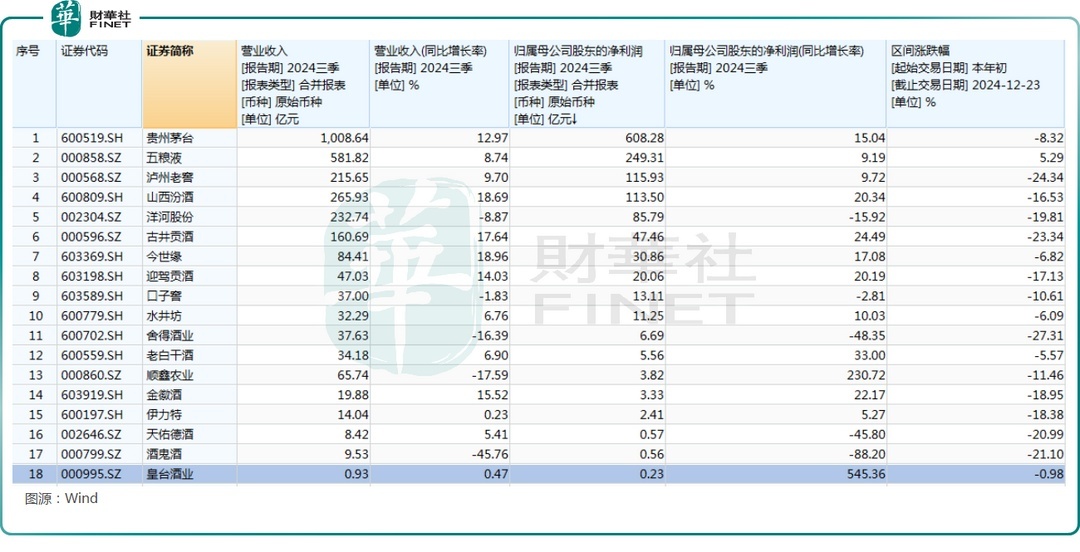
While Kweichow Moutai (600519.SH) and Wuliangye (000858.SZ) posted year-on-year profit growth, there are signs of slowing momentum.
For example, Wuliangye’s net profit growth rate fell from 42.58% in 2017 to 13.19% in 2023, and in the first three quarters of 2024, it dropped below 10% to 9.19%.
In Q3, Wuliangye’s net profit growth was just 1.34% year-on-year.
Among leading baijiu companies, Kweichow Moutai and Shanxi Xinghuacun Fenjiu performed relatively better, but they also showed signs of slowing growth in 2024, while Yanghe Brewery’s net profit declined.
Yanghe Brewery noted in its interim report that the baijiu industry is facing intensified competition, with high concentration and strong differentiation, further squeezing margins and demanding higher operational capabilities.
Amid the industry downturn and weak performance, baijiu stocks have underperformed this year. As of December 23, only Wuliangye saw a slight gain among A-listed baijiu stocks, while Luzhou Laojiao, Shede Spirits, and Jiuguijiu fell over 20%, reflecting market sentiment.
Conclusion
Overall, Dynasty Fine Wines’ entry into the sauce-flavored baijiu market may not be well-timed. With the "sauce-flavored liquor boom" cooling in recent years, the impact on its performance remains to be seen.
Author: Yan Shisi
The copyright of this article belongs to the original author/organization.
The views expressed herein are solely those of the author and do not reflect the stance of the platform. The content is intended for investment reference purposes only and shall not be considered as investment advice. Please contact us if you have any questions or suggestions regarding the content services provided by the platform.
